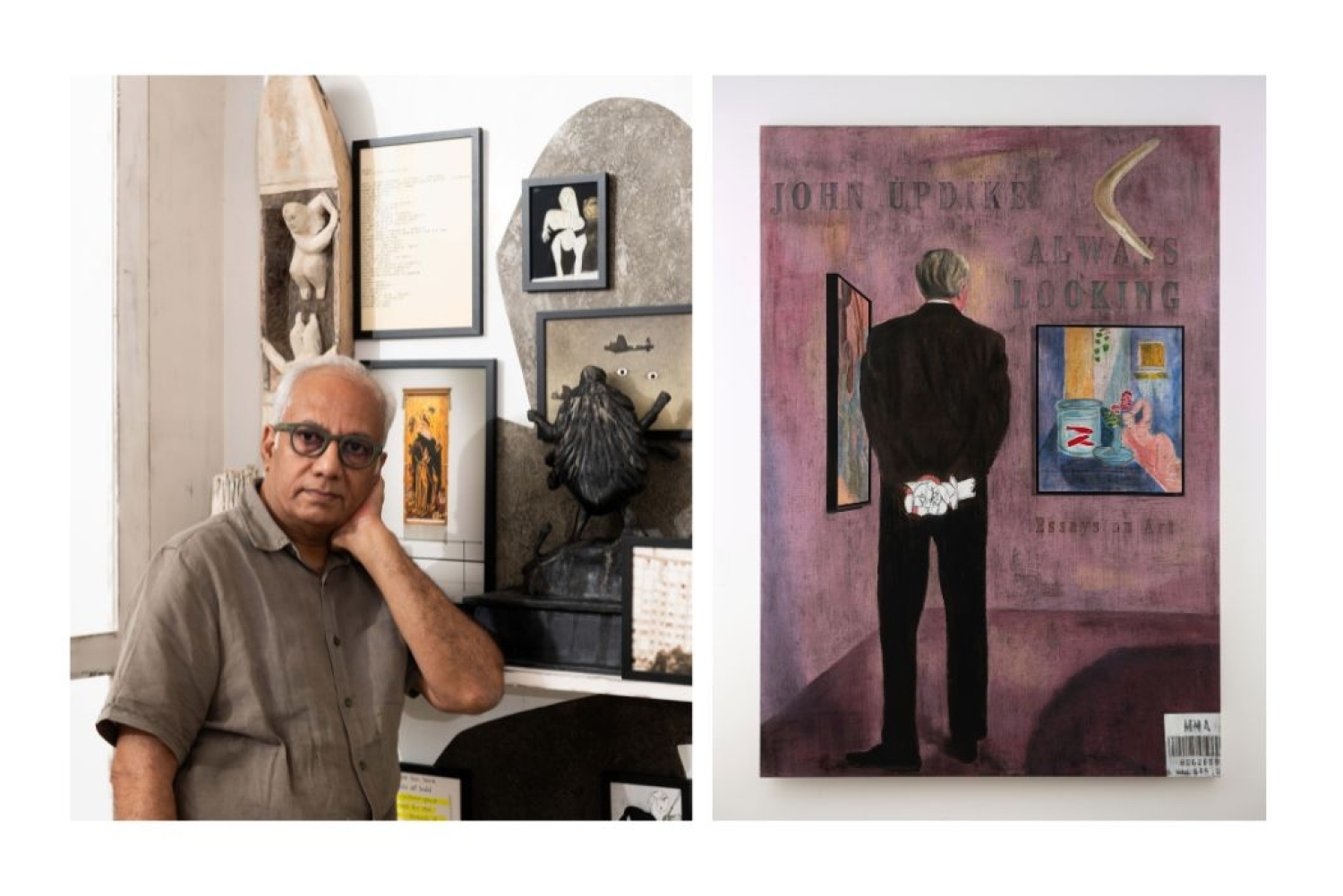
L: Atul Dodiya R: Always Looking Oil on canvas 84 x 60 in 2025
L: Atul Dodiya R: Always Looking Oil on canvas 84 x 60 in 2025
On a late February Saturday morning, I made my way to Vadehra Art Gallery in Defence Colony, excited to begin my weekend thinking, writing, and listening to Atul Dodiya walk us through his series of twelve large-scale oil paintings titled The Gatecrasher. As an ode to the theme of the exhibition itself, which revolves around the varied and evocative ways in which we engage with art, he offered his perspectives on the role of the ‘viewer’. We moved from painting to painting as he shared anecdotes and nuances behind each creative choice, while also giving us a glimpse into the artist’s life, one spent constantly observing, capturing, and making meaning from everything around him.
Memory plays a crucial role in this series. The paintings carry elements from his own life, and associations formed in his mind that have found their way onto the canvas. He even jokes that his friends and family anticipate finding themselves in a painting whenever he takes a photograph of them. ‘Every time I see something, I grab it and make it mine,’ he says, inviting viewers to do the same and create meanings independent of the artist’s intent. He shares more on his ethos, process, and understanding of art.
Looking, Remembering, Beginning
In cinema, there is this basic thing called a synopsis, the storyline in a brief dimension. I could easily tell you the story behind each of these paintings, but I also wonder about that because I love telling stories, yet that is an area which is peripheral. Knowing what is going on, who is who, what occasions are there, is not everything. When we see anything, we are reminded of so many other things. You see something, and memory immediately arrives. What does one do with memory? How does something come to your mind? That is where the work begins.
Very early, at the age of ten, I was clear that I wanted to be a painter and nothing else. Since then, there has been a huge craving in me to see and observe art. As a student in India, we learned oil painting through European and American masters, but we did not always have the opportunity to see those paintings directly. A student in Paris or London can walk into a museum anytime. Here, one had to remember paintings through books. That desire to see stayed with me. One might say, ‘come on, tell us about this painting, not about the rest of the world’, but nothing is that simple and nothing is that easy. You see something, you are reminded of something else, and that is how a painting evolves.
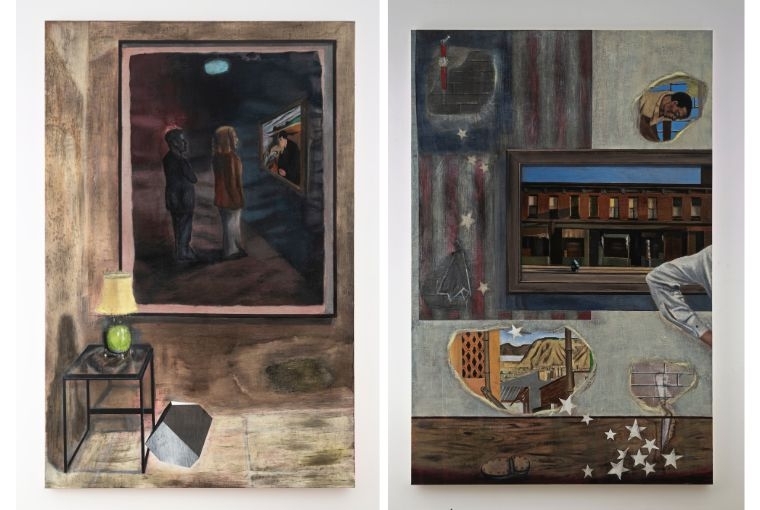
L: Melancholy Oil on canvas 72 x 48 in 2025 R: The Sparrow in Manhattan Oil on canvas 72 x 48 in 2025
The Evolution of a Painting
A painting can start from something very ordinary. A friend invited me home and there was a painting there by Sudhir Patwardhan. It showed a strange couple looking at a painting by Edvard Munch. I took a picture on my mobile phone. Later, looking at the image again and again, I thought to myself, what if I paint two people looking at a painting by Munch.
Then, memory intervened. Seeing Munch took me back to Norway in 2003, during my first exhibition there. I saw snow for the first time in my life. During that visit I received a phone call telling me my father had passed away. I was shattered and had to rush back home, but there was no immediate flight. I travelled through London and spent long hours waiting at the airport.
I was spending time in the airport when I saw a British Museum bookshop. There, I found a print by Albrecht Dürer, and it was very strange. My father had died because of an enlargement of the spleen, and in one of Dürer’s etchings, he had painted himself gesturing as if he died of the enlargement of the spleen. I saw this while travelling on the flight, and I still cannot understand the whole thing.
These coincidences happen, strange coincidences. But when something like this occurs, I take it in. I do not allow it to vanish. Elements of a painting enter slowly. A geometric block in the painting came from an etching remembered later. The stool and lamp came from the photograph I had taken. Many things happen by chance. If you ask what would have happened otherwise, I do not know.
Enjoyment and Understanding
The German philosopher Theodor Adorno said that to understand a work of art, means you enjoy it less. I understand that thought, but I want viewers to enjoy the work. Whether abstract or figurative does not matter. The feeling that comes to you while looking is important. There may be meaning behind a work, but I do not think viewers must know what the artist intended. You read and create your own story. I would be happy if there were fifty different stories about a painting which have nothing to do with mine.
The viewer should see the way they want to see. Painting is sharing. We exhibit, people come, there is buying and selling, but essentially we are sharing. When I was a student, I used to sit in galleries watching visitors all day, observing how they looked, what they noticed, what they ignored. All kinds of people came, and that experience stayed with me.
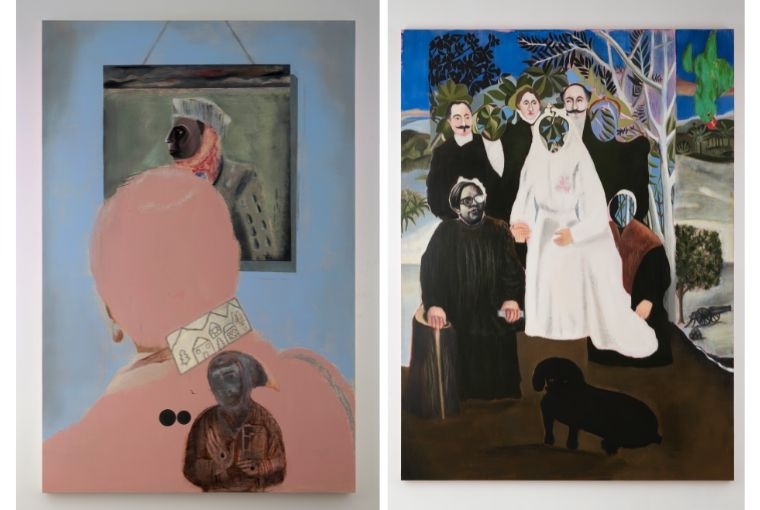
L: Stigmata Oil on canvas 72 x 48 in 2025 R: The Gatecrasher Oil on canvas 96 x 72 in 2025
Playfullness in the Studio
One thing I must say is that throughout the process of painting I have to remain playful. I should be laughing. If I become too serious, I consider that a very bad thing. When I would return home from the studio, my mother would look at my face and immediately know if I’ve had a good day, referencing that something has worked that particular day, and it seems like a painting has gone well or I have discovered something. She could notice it instantly. So, I feel that while painting I must be happy, and I should remain in that state.
Recognition and the Familiar
There is a different kind of engagement, a different kind of joy you get by observing or understanding a work, perhaps. One of the roles of an artist is to enter what is unknown, what is not familiar, and try to understand it, to make it familiar for yourself and for others as well. That should happen. It should not remain distant.
In the process, when you are working with so many references, with well known artists and their images, the question becomes how to create something of your own out of a ready made, existing image, whether it is a David Hockney painting or Edvard Munch or Sudhir Patwardhan. How do I make it mine when it already carries an established meaning in art?
Again it brings me back to how memory works in strange ways. I may see a stranger walking, and his profile might remind me of a friend. That friend reminds me of an uncle. The uncle reminds me of another artist. In a fraction of a second, so many associations happen. I like to think of it like this: nothing and nobody is an outsider. Everything belongs to me, and I belong to everything.
Every time I see something, I grab it and make it mine. The viewer also comes, they see, but at the same time they bring their own ideas, concepts, and thoughts, which they sometimes impose. We go with a very humble attitude in front of a work of art, but gradually, if you notice, we begin arguing within ourselves. And I feel that if my work creates that kind of conflict, then it is fantastic. When the viewer leaves the gallery or the museum and the work still remains with them, when they are slightly bothered by it, then I feel the work stays longer with them, and that is important.
Words Neeraja Srinivasan
Date 6.3.2026
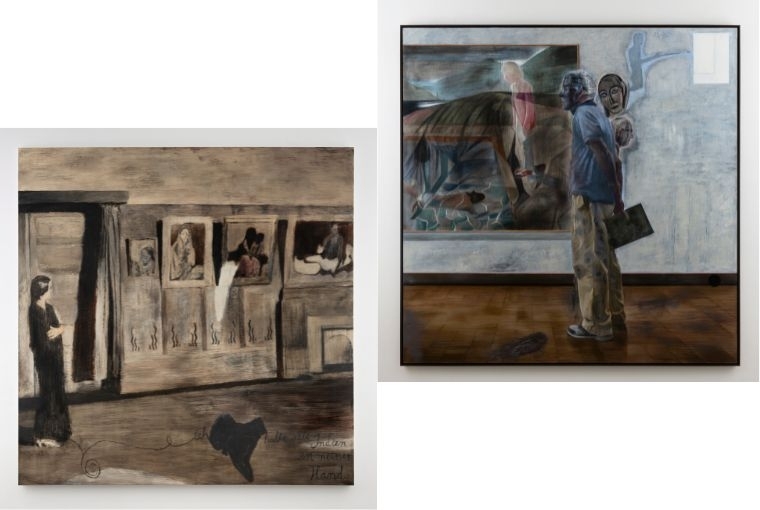
L: Faletti’s Hotel, Lahore (Amrita 1937)’ Oil on canvas 78 x 78 in 2025 R: Portrait of an Artist Oil on canvas 78 x 78 in 2025