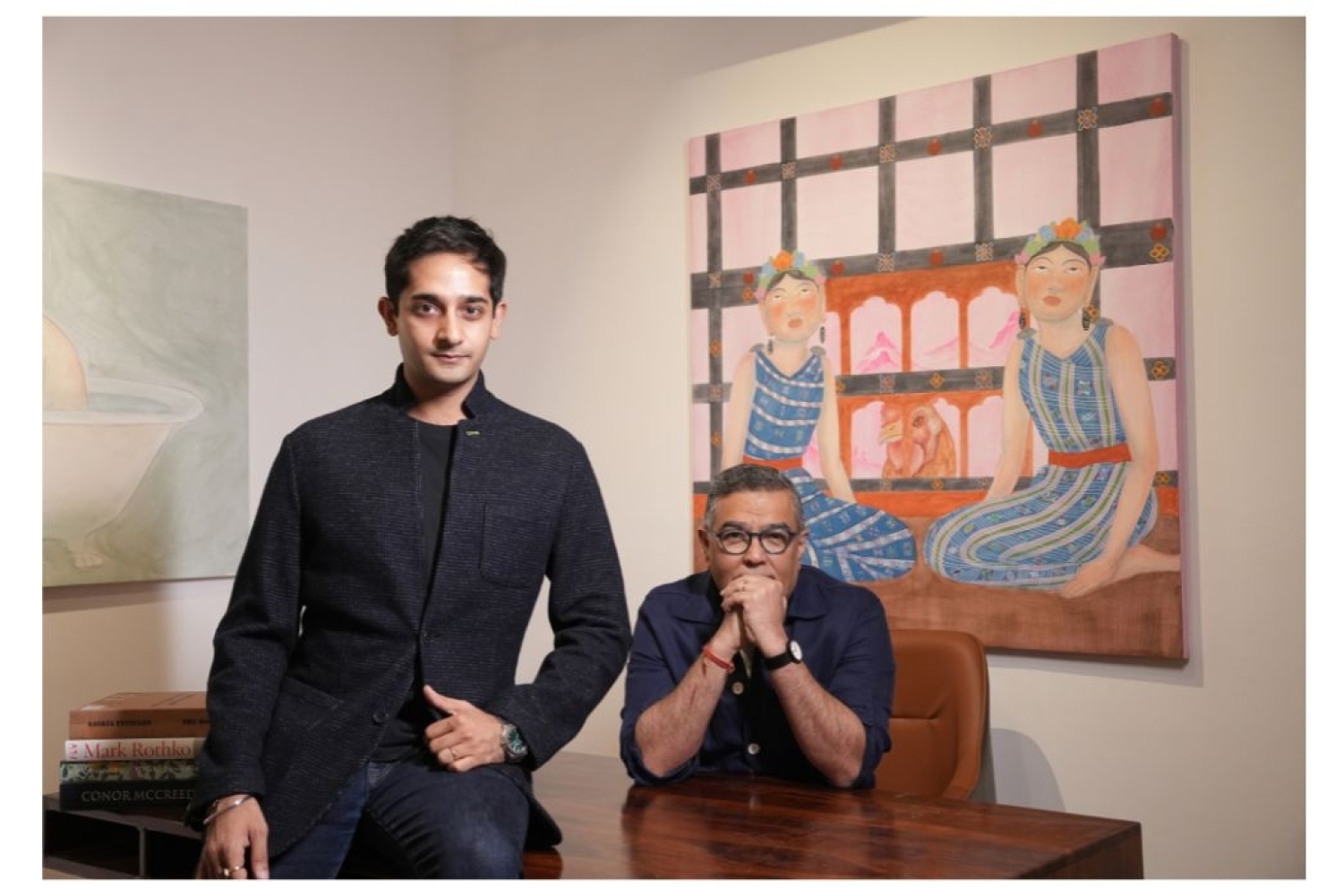
When Arjun Sawhney and Arjun Butani started Pristine Contemporary Gallery in Delhi two years ago, they began with a solo show by Saskia Pintelon, an 83-year-old Sri Lanka-based Belgian artist whose work moves across canvas, fabric, and collage to engage with climate change, gender politics, and the rise of the right. It was an instructive first move: international, rigorous, and entirely indifferent to the noise of the market.
Two years on, the gallery’s mandate has only grown more ambitious. Their latest show, She, brings together seven women artists from across South Asia, with works arriving from studios in Bhutan, Kerala, Rajasthan, Gujarat, England, and Oman, at a moment when women across the subcontinent are increasingly refusing to exist in the shadows or beneath the umbrella of any man. Meanwhile, the Indian art market itself is transforming: younger collectors are entering in greater numbers, and the questions around AI, speculation, and institutional gatekeeping are growing louder.
Against this backdrop, we sat down with both directors to talk about two years of Pristine, what it means to champion emerging artists, and the evolving conversation around art today.
Pristine is now two years old. How have you both managed to hold the line on the ethos you started with?
Even before establishing Pristine, both of us, in our respective journeys as collectors, have always led with faith. Faith in an artist’s practice, and faith in the galleries that choose to nurture and stand by them. That philosophy naturally became the foundation of Pristine. At Pristine, we exhibit artists we genuinely believe in. We work closely alongside them to help shape meaningful and promising careers, and every practice we show is one we feel deeply connected to aesthetically and intellectually. As Directors, we are far less influenced by institutions, awards, or existing collections than we are by an artist’s fine skill, conviction, and desire to create. It is through that shared belief that we continue to champion the artists we work with; helping their practices find their way into museums, institutions, and private collections, while ensuring that the voice they carry and the stance they stand for are heard with clarity and integrity.
Your new show She brings together seven women artists from South Asia, each with a distinct and powerful voice. What was the thinking behind this particular gathering of artists at this particular moment?
Women across South Asia are going through a profound transition, but this is a transition rooted in strength, visibility, and self-possession. More and more, women are refusing to remain in the shadows or exist beneath the umbrella of any man, and that spirit naturally became the starting point for this exhibition.
The show brings together seven women artists from across the subcontinent, each with a distinctly individual voice and visual language, yet all connected by a shared sense of courage and presence. There is bold colour throughout the exhibition, a celebration of skin and femininity, openly expressed emotion, and above all, a powerful sense of belonging within society rather than existing at its margins.
As an emerging artists’ show, it was also important for us to create something that a younger audience could deeply resonate with. We want younger collectors and art enthusiasts to feel welcomed into the space, to see reflections of contemporary identity and emotion within the works. Running through the summer, the exhibition allows ample time for audiences to return, engage, and immerse themselves in these practices at their own pace.
“At Pristine, we exhibit artists we genuinely believe in. We work closely alongside them to help shape meaningful and promising careers, and every practice we show is one we feel deeply connected to aesthetically and intellectually.”
Walk us through the curatorial process for She. How did you arrive at it, and how did you think about the dialogue between the works?
Once every year, both of us take on the rather mammoth task of self-curating a group exhibition that brings together a wide range of artistic voices. This edition of She was particularly exciting because the works were arriving from studios scattered across Bhutan, Kerala, Rajasthan, Gujarat, England, and Oman, each carrying its own cultural rhythm, sensibility, and lived experience.
The decision to bring together these seven women artists came quite organically. They were all artists whose practices we had been closely following in the year leading up to the exhibition, artists whose works stayed with us long after viewing them, and whose voices felt urgent, honest, and deeply relevant to the present moment. Interestingly, the dialogue between the works emerged very naturally. Despite their differing geographies and visual languages, there was a shared undercurrent running through the exhibition: each artist, in her own way, is striving for visibility and viability within her distinct society. They are cementing spaces for themselves, asserting presence, and navigating identity with both vulnerability and strength. That shared pursuit became the thread that tied the exhibition together.
You have both been working in the arts and cultural space for a long time. How do you think the landscape has shifted in recent years, and what do those changes mean for a space like Pristine?
Both of us have witnessed the arts landscape evolve quite dramatically, albeit from slightly different vantage points. For Arjun Sawhney, the world of art has undergone what feels like a complete 360-degree shift. He was present during the earlier years of contemporary art in India, when the ecosystem felt gentler and far more straightforward, whether in terms of artist publicity, acquisitions, relationships between galleries and collectors, or even pricing structures. Today, India is a far wealthier and more culturally engaged economy, and with that has come a surge of young and first-time collectors entering the market. It is undoubtedly a stronger and more active market, which is incredibly positive for a space like Pristine. Of course, growth also brings its perils; speculation, speed, and noise, but we do not believe those challenges outweigh the positives.
For Arjun Butani, the most striking transformation over the last decade has been the increasing intersection between art and technology. Works are often sold before they are even seen physically, and PR and marketing now play a major role in shaping visibility and relevance. Publications such as AD and Art India Mag have, in many ways, become the equivalent of fashion magazines in the 1990s, spaces that can define who is perceived to be ‘in’ and who remains outside the conversation. At the same time, there is a growing number of institutions in development, alongside an ever-expanding ecosystem of fairs, fairs, and more fairs, all of which can be deeply beneficial for galleries like Pristine when approached thoughtfully. And of course, today everyone is asking the same question: will AI impact the art market? The answer, like most things in art, is nuanced. It depends entirely on how it is embraced, resisted, or integrated into the larger cultural conversation.
“As Directors, we are far less influenced by institutions, awards, or existing collections than we are by an artist’s fine skill, conviction, and desire to create.”
There is a generational shift happening in who collects art, who writes about it, and who gets to define its value. Where do you see the Indian collector and the Indian audience in that conversation right now?
Amidst all the jargon, rapid market movement, and constant noise, the average Indian collector today is often left feeling lost and confused. This is precisely where the role of the gallery becomes important. Galleries can either guide collectors with integrity, clarity, and genuine engagement, or consumers of art can very easily be taken for a spin. With so much information, marketing, and speculation circulating the art world today, it becomes essential to create spaces where collectors feel informed rather than intimidated.
At the same time, the Indian audience is becoming increasingly curious, visually aware, and willing to engage with contemporary culture in new ways. There is immense potential in this moment, but it requires honesty, education, and trust-building from the institutions and galleries shaping the conversation.
What is the one artist, movement, or idea that you think the art world is consistently underestimating, and why?
One movement we believe the art world is consistently underestimating is the rise of OTT, bling-driven, hyper-figurative art. Perhaps many of the senior players within the art ecosystem still perceive it as ‘unserious’, work that exists more for spectacle than for intellectual or ideological depth.
But we think that assumption is precisely why it is being overlooked. This generation of artists understands visual culture, digital consumption, fashion, celebrity, and attention in a way previous generations did not have to. Their works are unapologetically bold, emotionally immediate, and highly accessible to newer audiences entering the art world today. In many ways, they reflect the visual language of the contemporary moment far more accurately than quieter or more traditional practices. Whether one agrees with it or not, this movement has enormous cultural pull, and we genuinely believe it could one day consume a very large part of the art world conversation.
This is an article from the June EZ. For more such stories, read the EZ here.
Words Hansika Lohani
Date 15.6.2026