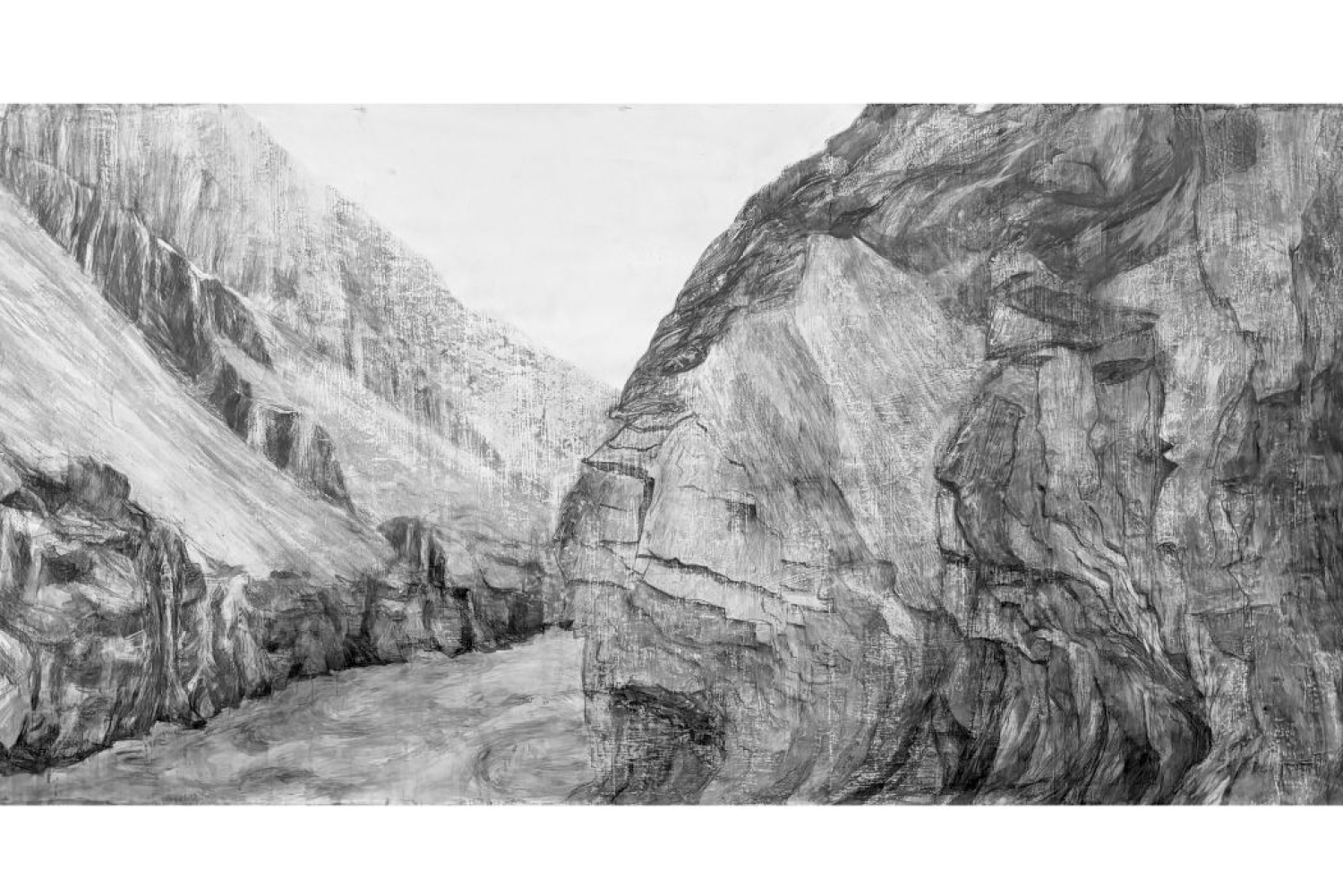
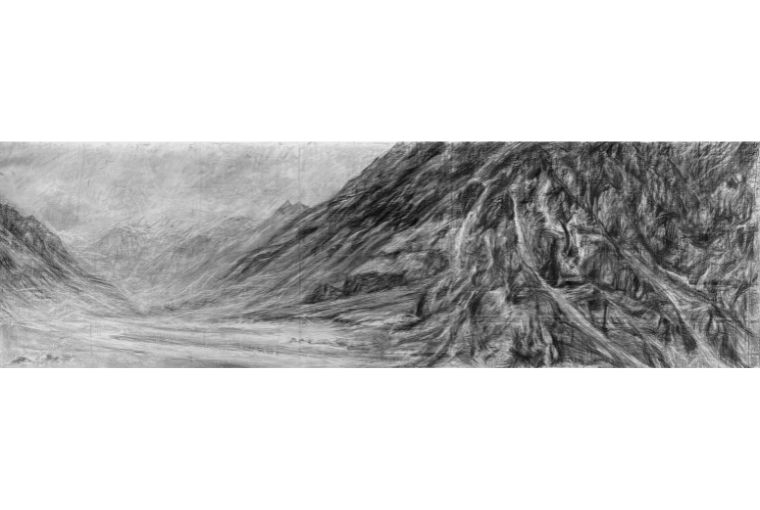
‘Rock Face’, Graphite and emulsion paint on paper, 2024
‘Rock Face’, Graphite and emulsion paint on paper, 2024
‘I still have pictures of three or four-year-old me and my masterful wall scribbles reaching as high as my little arms could reach.’ Multidisciplinary visual artist Saara Nahar knew she wanted to be an artist for as long as she could remember. Growing up with a professionally creative family and on the campus of a design institute, she was surrounded by student projects and sketches, stirred to turn imagination into the tangible. The walls of her home became her first canvas, afternoons disappeared into designing worlds with friends and by high school, fan art and portraits got her an audience online. ‘I knew I wanted to work with my hands as I’ve always loved … (to) be more autonomous and self-introspective than a typical designer.’ Today, through graphite, paper and experimental materials, she has built a practice in Fine Arts where her images and words constantly inform one another.
Currently at an art residency in Japan overlooking Lake Harunako, Saara has been hiking through trails, foraging, boating and spending time with the landscape around her, as art continues to be her immediate mode of thinking about the world. In my conversation with her, she delves into the heart of her art and the questions that shape it.
What kinds of ideas, questions, or experiences tend to show up in your work?
I am constantly looking at the way people engage with the world. I look at their encounters with nature and the way their existence is shaped by it. I observe a potted plant, a rectangle-coiffed tree, or a plastic deer in a park, all of which seem to be in appreciation of nature, but in fact make me realise how we create these grave and absurd abstractions of nature by believing that we are exceptional and can shape nature according to our liking and convenience.
As mediation by technology and social media distances us more than ever from our ‘human nature’, I try to go back to spending time observing, collecting, making and reflecting. I draw from my own experiences in nature and within landscapes; hence my presence and my gestures become very important. The surface of the work becomes a landscape and drawing becomes a re-articulation of the experience/image that I draw from, as well as a new way to occupy it. For example, I sometimes sit on top of my work in order to access its full length and it is a perspective very immersive and close to the drawing. I believe in the Buddhist philosophy of interdependence, impermanence and dependent origination of all things and it reflects in my working process and my method of installing my drawings. My work is shaped, quite literally, by my surroundings in the way that it incorporates the impression of the surface it was drawn on via graphite rubbing. Recently, I’ve also tried to place my work in space along with the surrounding architecture of the display space, questioning the effectiveness of the default painting-on-a-wall.
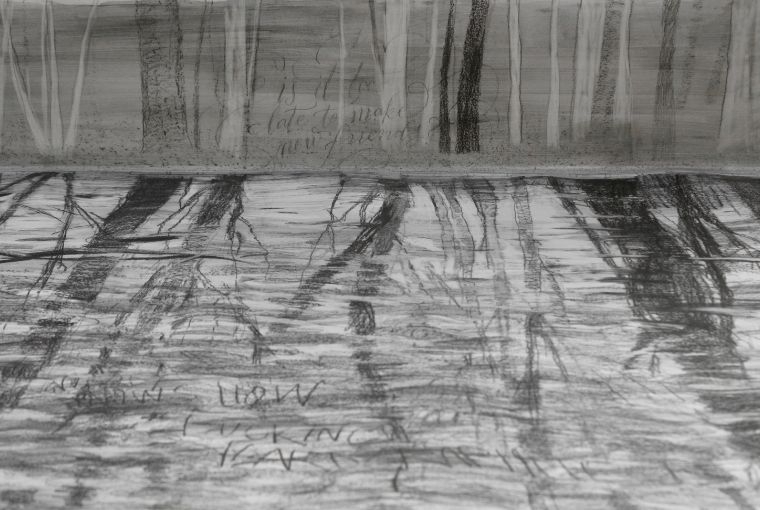
‘Frozen Lake’, Graphite and tapestry on paper, Detail, Master’s Jury at E?cole Nationale Supe?rieure d’Art, Bourges, France, 2026.
You work a lot in black and white now. What prompted this shift?
My drawings in black and white came about as I was looking for a way to paint the vast, rocky, trans-Himalayan landscape of Ladakh- a place that possessed a very different life praxis for me, a city-dweller. Society there worked at a very human pace and though it takes extreme patience to survive the terrain and harsh winter, the Ladakhis were very welcoming and empathetic. ‘This is reflected in the fact that Ladakhis measure land according to how long it takes to plough it. The size of a plot is described as ‘one day,’ ‘two days,' and so on’, writes Helena Norberg-Hodge, observing Ladakh in the 1980s.
I wished to live deep amid nature and this prompted me to make large paintings of mountains, in colour, as a means to further physically internalise the experience of the place. I shifted to drawing with graphite when we were assigned by our professor to translate in drawing the same thing that we were painting. The use of graphite and monochrome clicked immediately for me because it had a hardness -when used on a sheet of paper pinned to the wall- that mirrored that of the mountains. This same quality also demanded a different kind of physical effort, which I enjoyed. The absence of multicolour also allowed me to sharpen my focus on tone, texture, and composition. I enjoy the simplicity and truthfulness of graphite marks and how powerful it can become; and love to find out how far I can take my work with this one constant variable.
Tell me about your creative process. Do you have a studio routine or way of working when you’re developing a new piece?
There is no one way my work comes about. The starting of a new piece is often sparked by the certain quality in a picture that implores me to draw, as I mentioned earlier. I often cut a piece from a large roll of paper and coat it in thick, textured white paint. As I draw, the marks make an impression of the support and the paint underneath. My process is highly revisional, I may ‘complete’ an image but then coat it with white paint partially, sand it, erase it or wash it off and re-draw and layer it, adding depth. The selection of an image and then drawing it is the easy part though. The framework of meaning and intention that the image sits within is an ever-changing, unfixed process. It involves travelling, observing, journaling, discussions, note-taking and referring back to older such records. I often go with my intuition to take me to the right place at the right time; be energetic to go out and explore places when I can, and also give myself the time and space to digest and mull over things. Interacting with places and beings often sparks an idea, but I need to trace it back to why it came to me, and where I actually place myself with regards to it. I also like to create knowing the place of the installation, if possible. This clarity is often required for me to have the surety to start a project or have an idea of how I’ll present it. Since I am still in art school, my schedule and studio space timings aren’t entirely in my control: routines are shaped by events, trips and deadlines. Hence, there is often a period of ‘collection’, and a period of ‘release’ where I produce most and in a concentrated manner, and then present it.
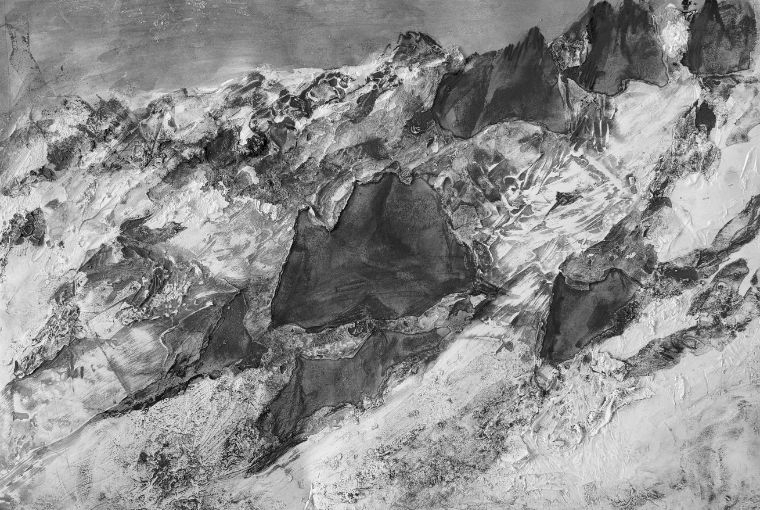
‘Dirty Snow’, Graphite and emulsion paint on paper, 2024.
Which artists, writers, or thinkers have most shaped the way you think about drawing and material?
As I started to draw landscapes, the traditional Chinese and Japanese landscape paintings in ink have often come to mind. Their masterful strokes, tones, panoramic continuation, and haziness and the presence of mist really inspired me. The minimalism of a few calculative but highly instinctive brushstrokes is a mastery I aspire to achieve.
The Buddhist philosophy of non-attachment also shaped me in a way that I am not as precious with my artwork now, I am freer to let the work evolve naturally, even through revisions or additions. This approach allows me to embrace the process rather than rush towards completion, finding value in the journey itself.
I also resonate with the work of David Hockney, and the joy he takes in ‘just drawing/painting’, how his investigations and his style change according to the places he visits and the work he sees, but the intensity of his passion remain constant. It is his state of incessant questioning and willingness towards inspiration and influence that I admire.
Recently, certain aspects of Arte Povera have really resonated with me. They didn’t distinguish products of culture from products of nature, using branches or dried leaves to create pieces. The plethora of qualities and contexts inherent in material is put to the forefront: the intervention of the artist being very intuitive and more prominent in the presentation of the piece. The presence of language and hand-written words ‘heighten the subjective nature and the physical and emotional connotations of the work.'
Can you walk me through one of your first significant exhibitions or showcases and what that experience taught you?
My most significant showcase was my bachelor’s degree show at the Faculty of Fine Arts, MS University of Baroda. In this exhibition, I displayed work from my Ladakh inspired series along with poetry in artist books I had made, which provided a surprisingly important context to the work. It is always great to see whether what one thinks in the studio actually translates to what people see. And it turned out that yes, many people saw the contemplative nature of my work and found the use of black and white powerful. Many questioned, however, the use of paper and the choice to display everything on the walls. This lingered with me for a long time, and a year later, recently, was I able to advance my use of paper and create self-standing work that wasn’t on a wall, while the ones on the walls were also radically tweaked, so they interact more with the architecture of the space, and reveal the intrinsic joy of being just a drawing on a paper. The MSU display was of course also my first step into the professional world and first time talking to professionals in the field, and was a great opportunity to be able to articulate my work and receive diverse interpretations.
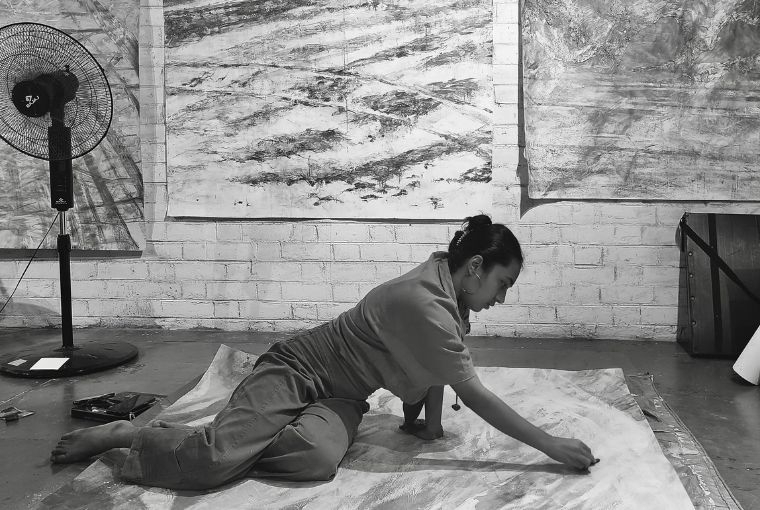
At the Studio, Space Studio Baroda, 2025. Credits: Antara Dey.
You are an Elizabeth Greensheilds Grant Awardee. How did that come about for you, and what has it meant for your work and the way you see yourself as an artist going forward?
The Elizabeth Greensheilds Grant came as an unexpected, serendipitous surprise. As I am living in France for my masters, I desperately have been trying to find part-time work in my small city called Bourges to help finance my studies and travel abroad. One day, I was rejected from a job interview at a bakery due to my unavailability in the summer break, and on the bus back home, I received an email that my grant application had been selected! I took it as a sign for me to keep doing what I do, because I no longer needed to spend my free time doing a job unaligned to my interests. And could also finance my ambitious proposal to travel to Japan and spend 2 months at a residency in the countryside. This has really reinforced my trust in my own process, research, and sense of aesthetics; and has also provided me with space to question and transform my practice in the way I see fit, since the EG Foundation sees me as a student and emerging artist, and doesn't have any specific artistic expectations from me.
What are you working on next?
I am currently at the aforementioned art residency in Japan, which looks onto Lake Harunako. I have been exploring nature and the lifestyle in the countryside; going hiking, foraging and boating; trying to salvage my fear of being distanced from nature. The mist, the rain, the water, the flora and fauna have all been inspiring me to paint an ode to them like the traditional nihonga (Japanese style painting with natural pigments) painters do. Having known the art in India and France, I am keen on understanding the Japanese sensibilities, and the causes behind it. I am also fascinated by the large number of abandoned houses (called ‘akiya’) in the countryside and hope that I can somehow work with and in these now wastelands with such rich histories and the feral evolution of the beings living in it. I want to take forward my traditional yet slightly radical ways of working with drawing, and look also into the idea of unfolding (like the Japanese scroll), the use of negative/ background space, and the use of the window primarily as a source of light (through paper screens or frosted glass) rather than a display of the outside world.
Words Nidhi Soni
Date 20.7.2026
‘Approaching Sandstorm’, Graphite on paper, 2024.