'What if every sound continues to reverberate, long after it has passed beyond our hearing? Reena Saini Kallat invites us to consider the universe as an expansive archive of soundwaves, in which the chirping of extinct birds and murmurs of dried-up rivers, continue to linger after their sources have disappeared.
Her major new installation, Spectral Frequencies: Breathlines (2025-26), gathers lost birdsongs, reactivating them through new material and sculptural forms that extend our perception beyond the limits of our human faculties. Within the installation, the solitary call of the Hawaiian Kaua’I ‘O’o bird, last recorded in 1987 looking for his absent mate, echoes through the gallery, among the long bamboo flutes that fill the space. While the flutes themselves remain silent, Kallat evokes the vanished bird and its lost cry by translating the calls into a waveform.
Thirteen extinct birdcalls take shape as large-scale, floating sculptures, their names and dates of last recording poignantly inscribed in salt across the gallery floor. These thirteen emerge from a longer, continuous stream of 130 species’ names, written in pencil along the gallery walls, like a baseline frequency encircling the space. Together, they draw attention to endangered species whose sounds and habitats are disappearing, while suggesting that their traces can be reactivated through the creative possibilities of the archive. Sound and image enter into a process of recursion: each birdcall is translated into a waveform and given sculptural form, through the interplay of breath and resonance. Each iteration reflects the other, opening new ways of encountering what is no longer there.
Read through Jacques Derrida’s concept of the trace, Kallat’s work explores how sound persists beyond the presence of its source. The cries of extinct birds are translated into new material and sonic form without claiming to restore the original beings. Moreover, Kallat she extends this enquiry into the outdoor sculpture Last Seen in Light (2025–26), translating the twelve soundwaves into a large-scale sundial. A series of photographs captures people interacting with it at different times of day, bringing the cyclical rhythms of sunlight and human activity into dialogue with the irreversibility of extinction.
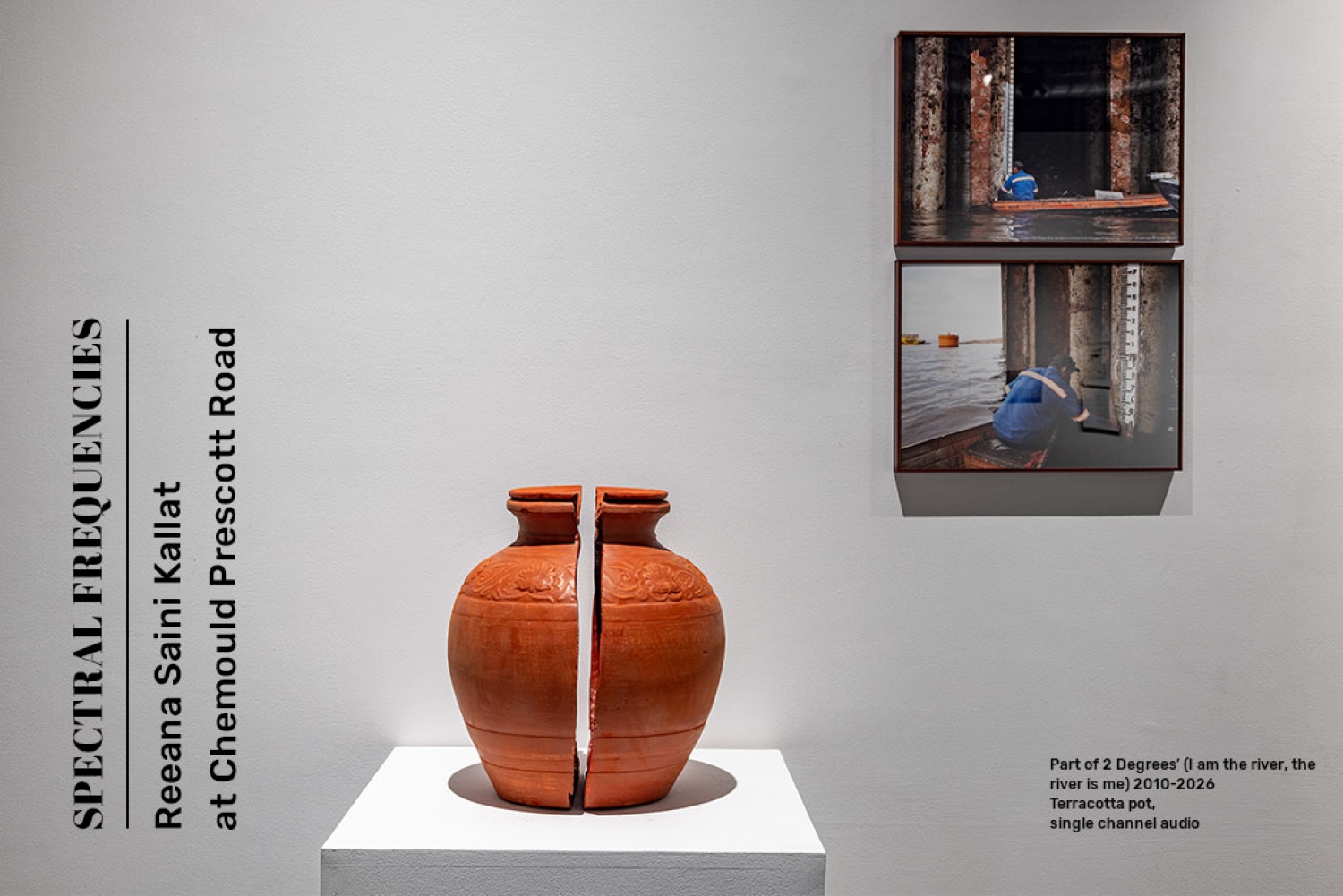
In a year that has seen severe draughts and floods, the poignancy of absence is amplified in the series of works on paper River Morphologies (2025). Here, the dry beds of the Zayandeh, Limpopo and Yellow rivers, for instance, are pierced by laser-cut soundwave forms derived from archival field recordings of their former flows. They evoke ecosystems out of balance, offering a visual metaphor for the fading pulse of these bodies of water, that are, at the same time, essential to planetary life. Nearby, a solitary river gauge and a split pot, from the series 2 Degrees (2010), offer a stark reminder of the consequences of climate change. Overall, Spectral Frequencies invites us to listen across species and temporalities, reimagining an archive of extinction as a resource for interspecies futures.'
Text Courtesy Emily Butler
Date 26.10.2026