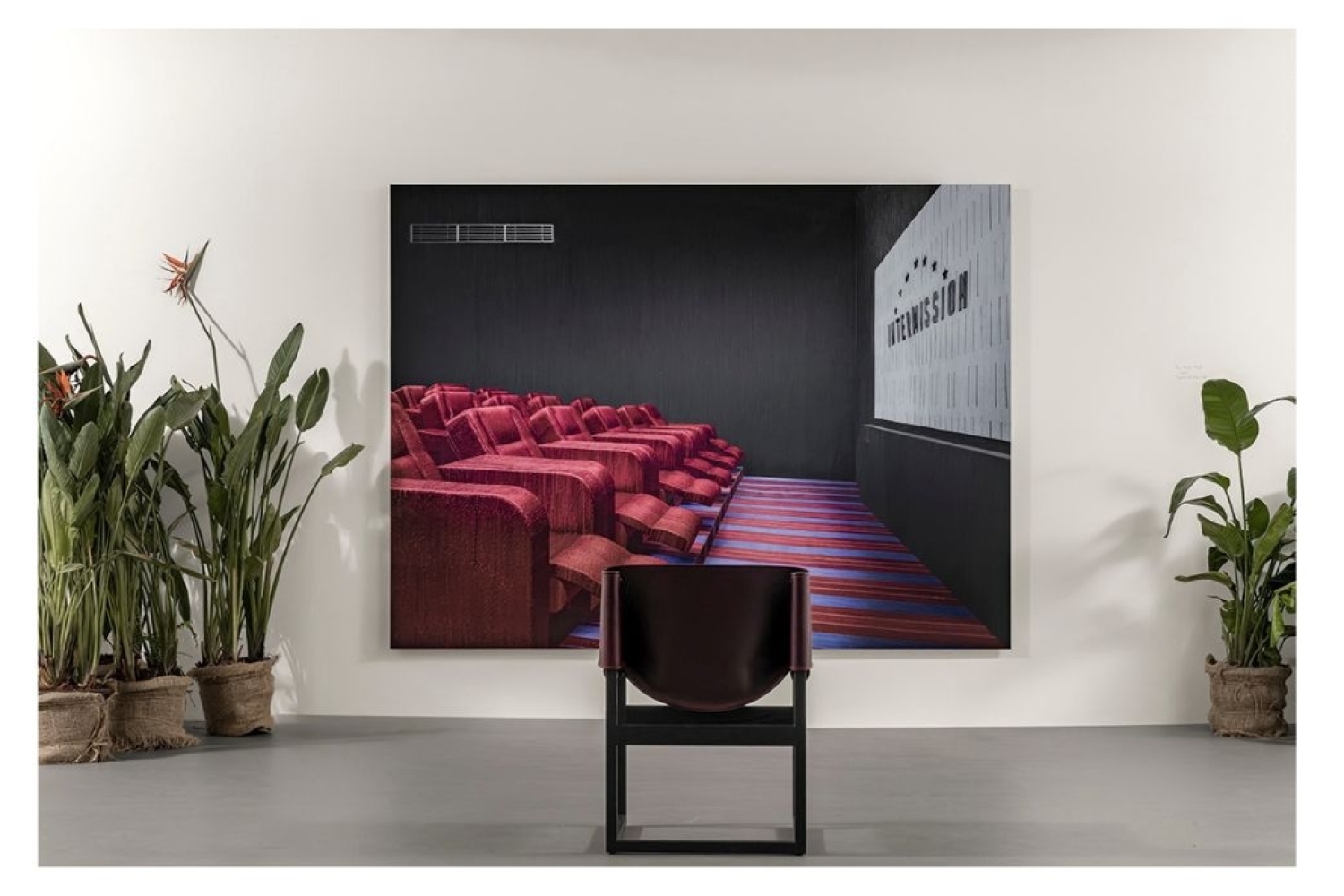
CINEMA by Dia Mehhta Bhupal with furniture by Phantom Hands
CINEMA by Dia Mehhta Bhupal with furniture by Phantom Hands
The lift doors slide open onto a foyer, where the words I Dwell in Possibility, a collaboration between GALLERYSKE and Museum of Contemporary Art Ahmedabad, unfold across the wall in graphic typography. The second floor of an office building, now serving as the satellite venue for the MCAA, may once have been a storage room, but today it feels as though someone has taken Emily Dickinson’s poem, opened it out corner by corner and painted between the lines.
Sudarshan Shetty’s marble sculpture, part of A Breath Held Long and previously shown at the Serendipity Arts Festival, greets you at the door, setting the tone for what awaits.
Take a right and you’ll find a plant by landscape designer Priyesh Patel right behind which a selection of books on a pedestal, chosen by academic Arjun Jayadev alongside a pair of headphones playing music selected by archivist Nishant Mittal. Both become quiet companions to the art on the walls, the intricate and deeply imaginative works of Avinash Veeraraghavan.
I found The Beatles’ Strawberry Fields Forever in Avinash’s work, a feeling that a place can exist as much in the mind as it does in the real world, IRL so to say. The artworks seem tangible yet dreamlike. He uses materials like embroidery, collaging to create textures that only deepen the effect of inhabitation and fiction.
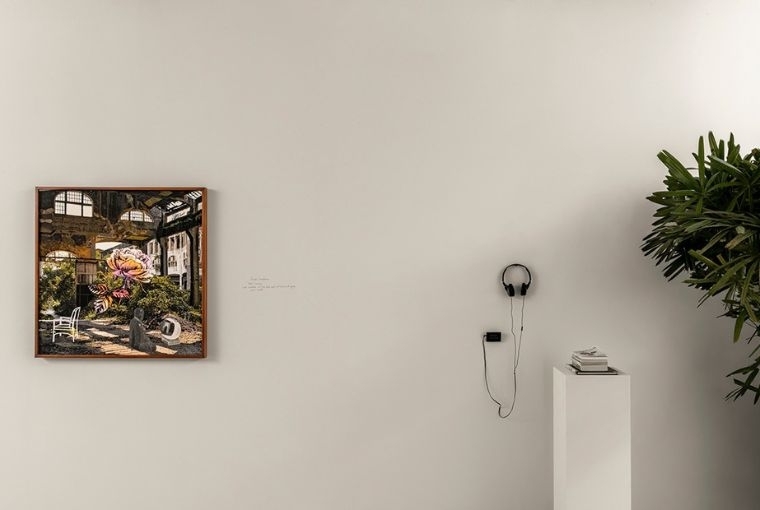
Root Elect by Avinash Veeraraghavan with an audio piece by Nishant Mittal and books selection by Arjun Jayadev | Artwork by Sunil Padwal
Rounding the corner, more botanical forms emerge, alongside a round table scattered with books and a few chairs. Furniture from Phantom Design’s Bawa Collection offers more than a place to pause. It creates an invitation to sit, linger and take in Dia Mehhta Bhupal’s works across the room.
Dia takes people out of the mundane public and private spaces she creates in her works, leaving behind only architecture, objects and traces of what might have happened there. What happens to a room when no one is inside it? What remains when the people and the routines that give a space its purpose disappear?
Perhaps an answer lies in the work of Sheetal Bhatt, a culinary chronicler, writer and researcher, whose contribution turns to rituals of the Gujarati household. Her reflection on the everyday lunch menu, “Mondays mean tuvar. Wednesdays are for moong, Fridays for chana, Saturdays for urad”, reminding us that spaces are also shaped by the rituals that happen within them.
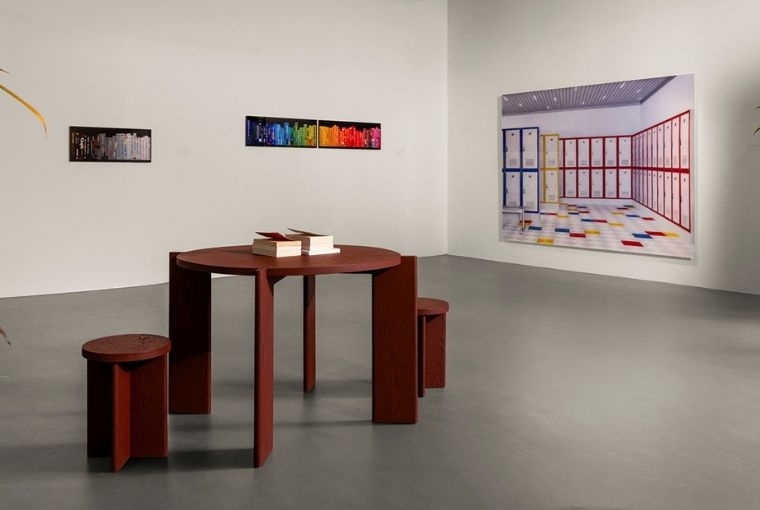
Artworks by Dia Mehhta Bhupal | Furniture by Phantom Hands
Opposite Dia’s works, Buddhadev Mukherjee’s satirical pieces use humour as an effortless way of examining social constructs and societal norms. The artworks light up the room with a joke that quietly points to something larger, as though someone has left a book open on the table, the punchline neatly marked out for you to find. Funny at first but revealing something far more pointed once you stop to read between the lines.
Sitting across from Sundarshan Shetty’s installation, Sometimes When We Travel We Forget Who We Are, on Phantom Design’s furniture, Aneri Patel, the Founder of MCAA, commented on the exhibiton, “We are thrilled to be collaborating with one of India’s leading galleries [GALLERYSKE] for our first-ever exhibition. Through this show and the accompanying programme, we are setting the stage for a gradual reveal of our vision for an institutional space and cultural hub that will inspire new ways of seeing and creating. Ahmedabad is a particularly apt backdrop for this, with its legacy as a hub for creative practices, pedagogy and patronage. With MCAA, we are working towards establishing a cultural destination that will foster an appreciation of contemporary art among local audiences, putting Ahmedabad on the world art map through opportunities for connections and cultural exchange.”
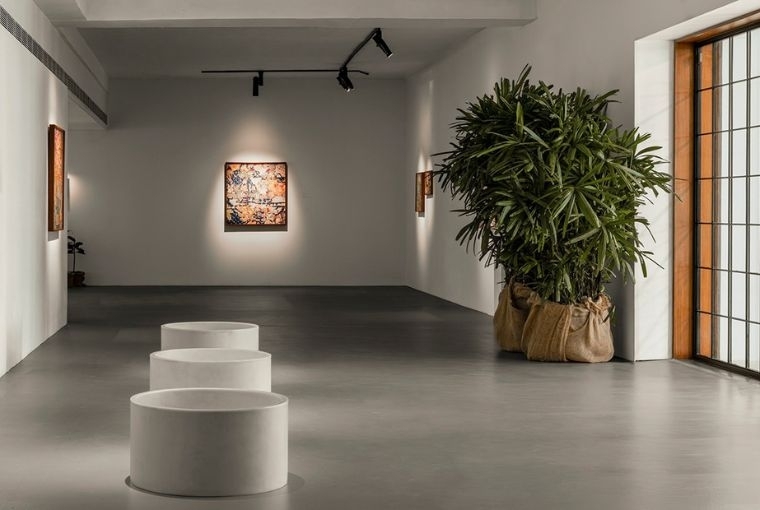
Artworks by Sudarshan Shetty and Avinash Veeraraghavan
At the other end of the space, much like the limitless rooms of Inception, Sunil Padwal’s artworks use frames as an integral part of their storytelling, embodying fluidity and blurring where one ends and another begins, like the shifting purpose of a room, which expands and grows with those who inhabit it.
I Dwell in Possibility is somewhere between a room, a gallery, a satellite museum venue and a dream. It asks you to slow down, to look at the art, the objects, the text, the surrounding plants with a fresh perspective. Maybe ask the questions you haven’t asked before, because then art stops being something that’s framed in front of you and starts becoming something more tangible, something alive. In the end, the poem refuses to stay on the page. It finds a wall, then another, another, until it fills the room.
Words Samiksha Sharma
Images Courtesy GALLERYSKE & Museum of Contemporary Art Ahmedabad
Date 2.10.2026