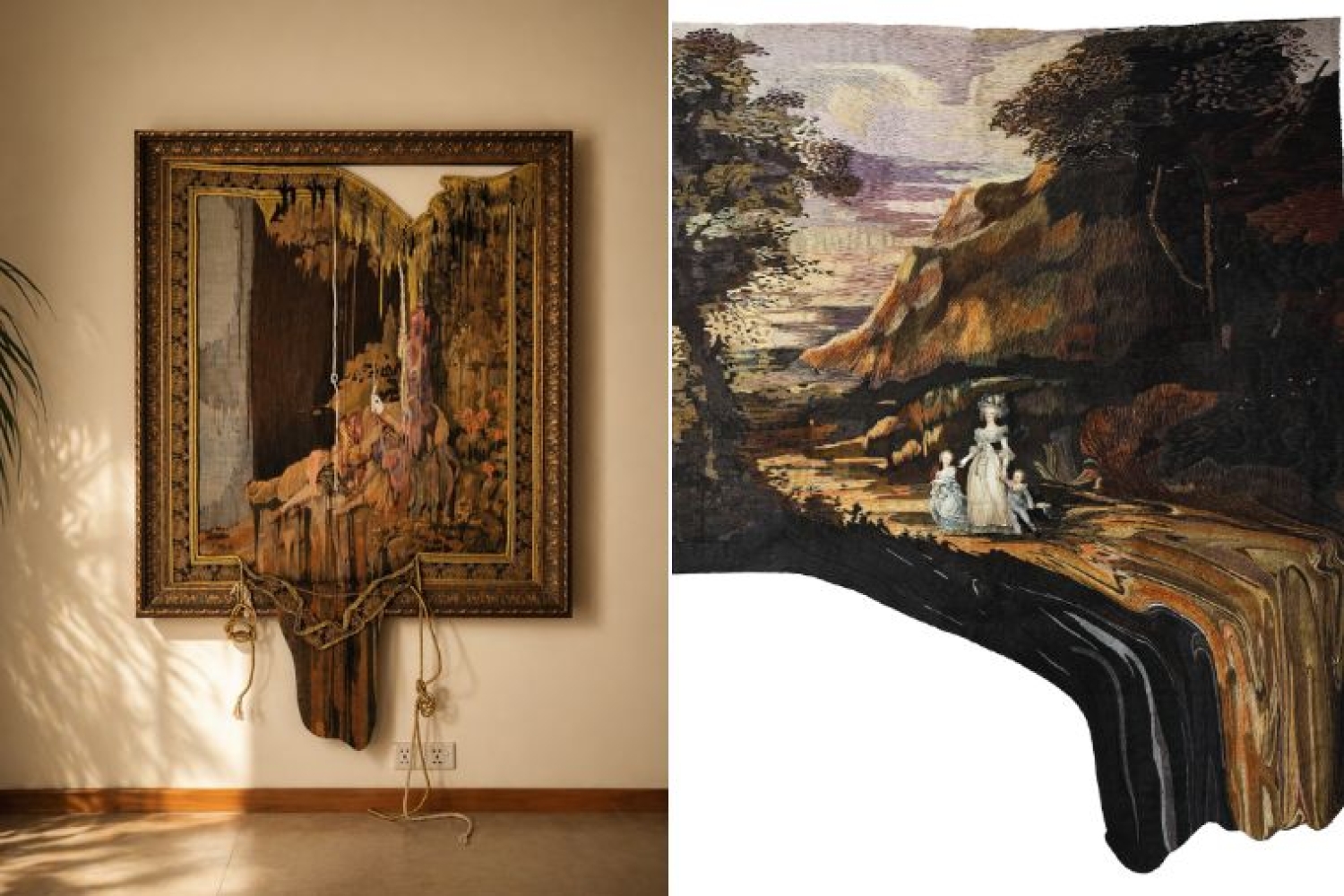
L: Marium Agha, A Courtier in Love, a Two Dimensional Portrait (2015), 245 × 130 cm, Yarn and rope on reclaimed tapestry R: Marium Agha, Solitude in the Sublime 18 x 18 in, Tapestry
L: Marium Agha, A Courtier in Love, a Two Dimensional Portrait (2015), 245 × 130 cm, Yarn and rope on reclaimed tapestry R: Marium Agha, Solitude in the Sublime 18 x 18 in, Tapestry
An archive begins with a hand. History lives in the fold of a textile and in the legacy of a repeated motif. Artistic acts of making carry memory across time, and in Hunar, APRE Art House’s art exhibition, they manifest through pigment and ornament. Borrowing the Urdu meaning of 'skill' and Allama Iqbal's poem Din o Hunar, the exhibition reimagines the word as more than mastery, a way of keeping histories alive. Curated by Noor Ahmed, who’s also curating the Karachi Biennale 2027, it brings together Marium Agha, Abid Aslam, Masuma Halai Khwaja, and Zahra Mansoor from Pakistan, and Arieno Kera from Nagaland. Spanning painting, drawing, and tapestries, the exhibition shares a South Asian visual language. As Hunar moves into its final week before closing on 7th August, we got to know more about the artists behind the work.
Abid Aslam
‘What brings together artists from different backgrounds under one roof?’ For Lahore-based artist Abid Aslam, the answer lay in technique. Trained in miniature painting and metal engraving, Abid wants to invite viewers to look twice at what they think they are seeing.
‘I believe my technique is one absolute aspect that leaves a lasting impact on the viewer other than the visual itself. The process of punching patterns on paper makes the viewer question more about its making, intricacy and the whole concept behind it; either the work is considered as a contemporary miniature, or it falls under another category’, he says.
Having exhibited widely across Pakistan and internationally, Abid strays away from ideas of craftsmanship as nostalgia but more as a way of expanding the possibilities of what we inherit.
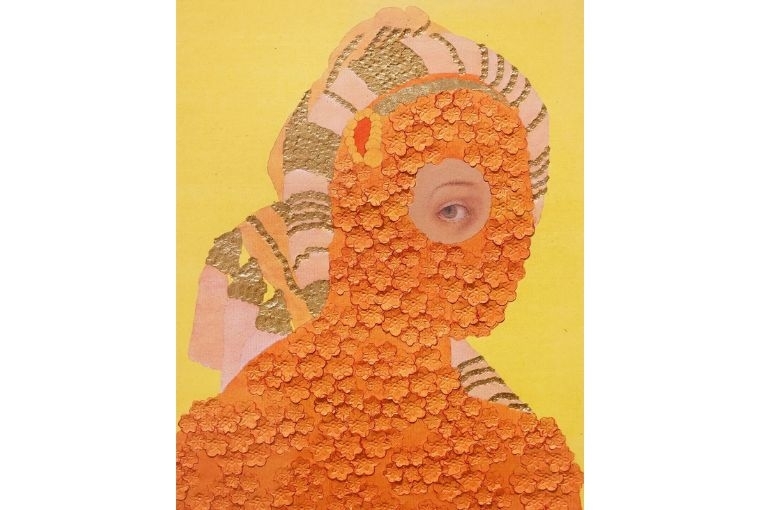
Abid Aslam, Into Pieces II, 11 X 16 in, Gouache, Punching and Gel pen on acid free paper
Arieno Kera
Rooted in her indigenous background from Nagaland, Arieno Kera’s practice begins with a curiosity about what the body remembers. She works in painting, drawing, installation and video, ‘asking how knowledge, memory and identity are carried across generations and through the body. Whether through the act of weaving, the metaphor of the rhododendron or the instability of self-portraiture, I believe the works question how we inherit traditions, cultural memory and ways of seeing ourselves.’ She adopts traditional forms such as Naga weaving and folklore to further the idea that ‘identity and tradition are never fixed’.
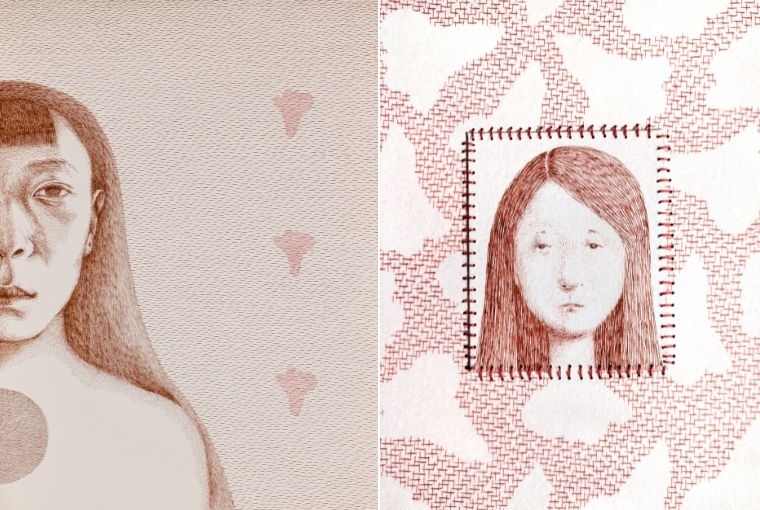
Arieno Kera, Looking at Rhododendrons Again, 16 X 11.5 in, pigment liner, dried flower and stitchwork on paper
Marium Agha
With Indo-Persian miniature painting, popular culture and personal histories, Marium Agha uses thread as both a poetic and political medium to question ideas of romance, representation and female agency. Edified by feminist discourse and postcolonial critique, Marium approaches cultural inheritance as something that must forever be questioned, reimagined and given new formations.
‘Hunar [for me] is the ability to perceive, to understand that love itself is a craft and that its deconstruction is an equally demanding one. Both require hunar. Neither offers a definitive truth because hunar, like love, is ultimately subjective…If the work can alter the way they look at love, memory, beauty or cultural inheritance, even briefly, then it has done its job.’
Masuma Halai Khwaja
A practising artist, curator and educator, Masuma has spent decades exploring the possibilities of fibre, embroidery and textile. Her works try to move beyond the idea of textiles as decorative and instead as living stories of labour, culture and collective experience.
‘I document stories that are not recorded in archives and accounts facing erasure. For me, art is as much about expression as it is about documenting the ethos of the age the artist is living in. I buy used and damaged embroideries, tapestries and kilims from flea markets and I cut them up to form imagery relevant to my narrative. In this way, I give those faded embroideries and the torn tapestries a new life, preserving old embroidery traditions in a contemporary setting. My embroidered artworks in running stitch carry forward the tradition of the Kaantha, embodying resilience and paying tribute to the women of Bengal who archived their accounts within repurposed garments.’
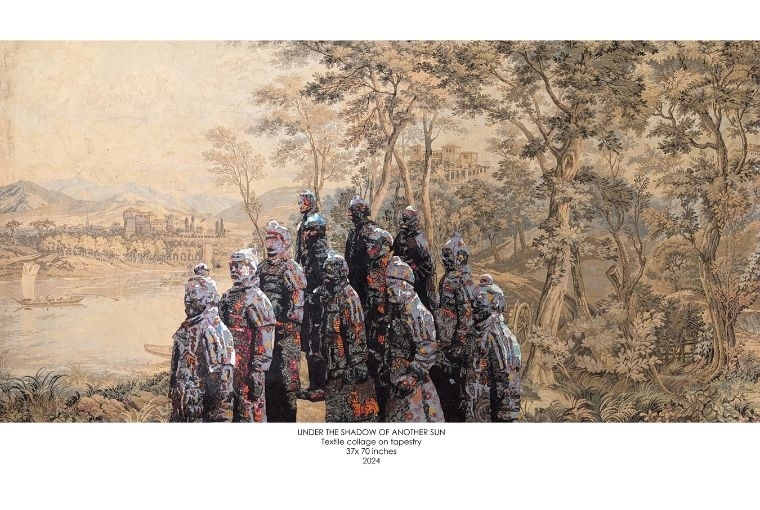
Masuma Halai Khwaja, Reconfiguring The Landscape, textile collage on tapestry, 36 x 68 in
Zahra Mansoor
Sufi thought, metaphysics and Jungian theory all marry to create dreamlike worlds in Zahra Mansoor’s practice where figures appear both connected and distant. For Hunar, she turns to muslin and textiles as a way of looking at the tension between revealing and concealing. ‘The way of stretching your own supports and playing with textile and medium combinations is a tradition I'm carrying forward. Additionally, intervening on carpets acknowledges the historically cross-cultural nature of carpet design, as well as historically being a fruit of female labour. I want viewers to feel soft, sensual, curious, to be able to access their own tenderness and recall their own memories as they view my pieces or leave with the image in their mind.’
Words Nidhi Soni
Date 3.8.2026
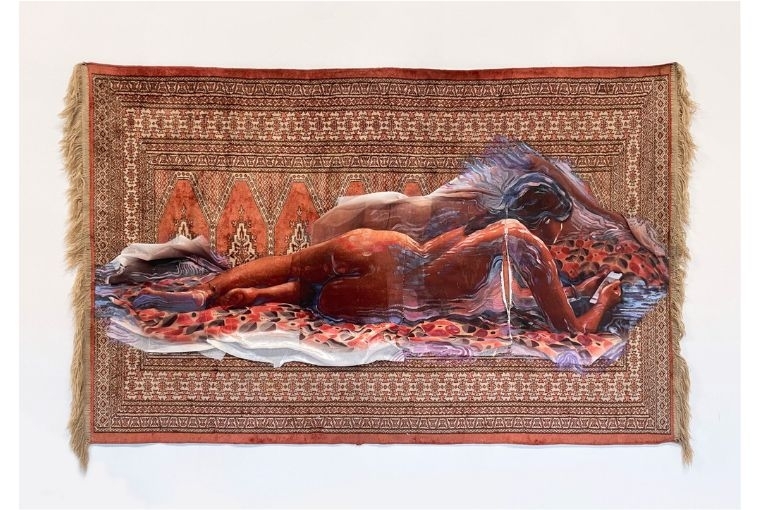
Zahra Mansoor, I have a question...are you actually a princess? Oil paint, sublimation print, velvet, and polyester on Indo-persian silk carpet 59.06 X 39.37 in