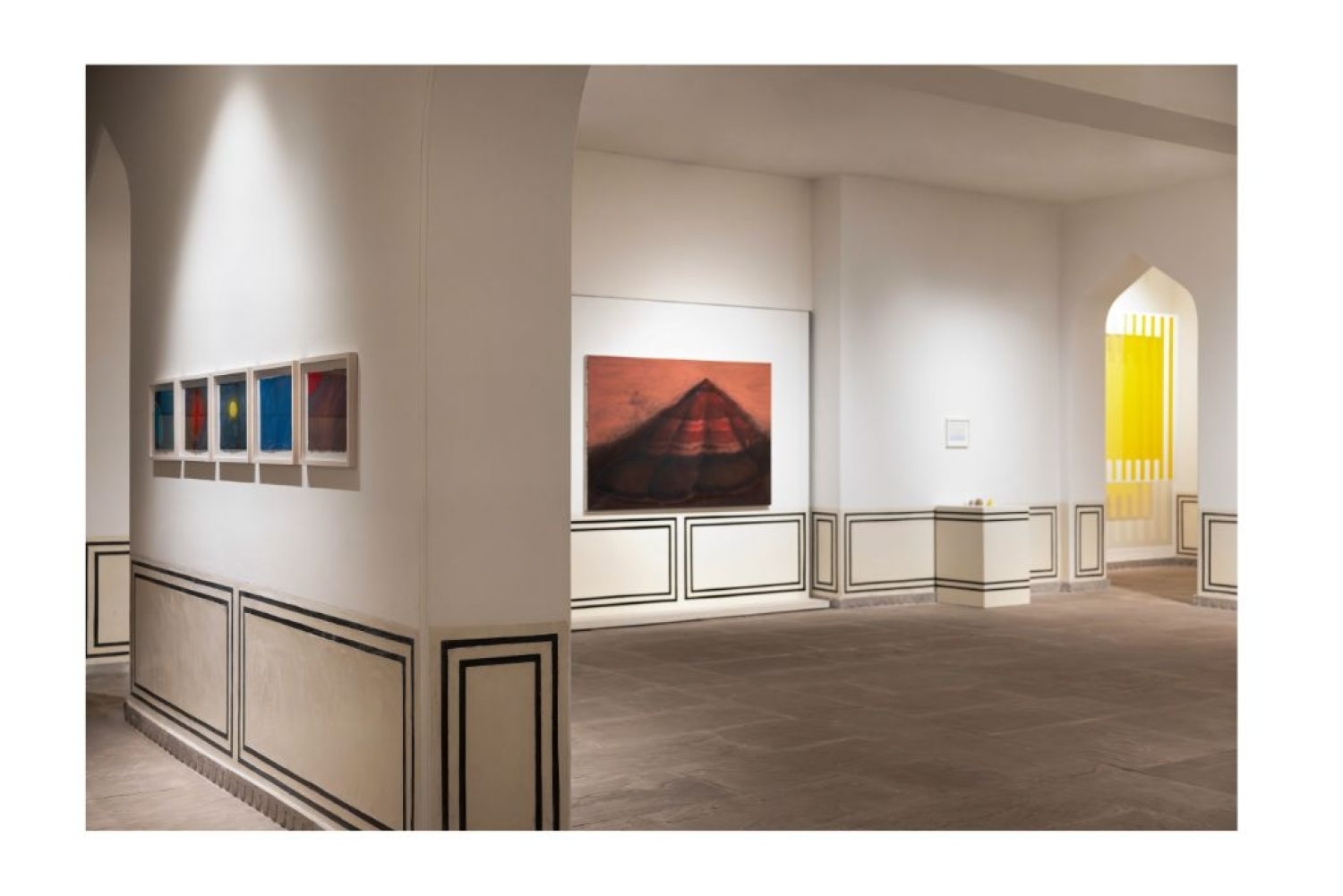
©Nedko Solakov, ©Alejandro Campins, ©Daniel Buren. Courtesy Galleria Continua. Photo Credits Lodovico Colli di Felizzano
©Nedko Solakov, ©Alejandro Campins, ©Daniel Buren. Courtesy Galleria Continua. Photo Credits Lodovico Colli di Felizzano
'Jaipur Centre for Art (JCA) presents Annotations on Colour, an exhibition that brings together leading modern and contemporary artists to explore colour not as decoration or symbol, but as an active force: an event that unfolds across time and space, and is completed through the viewer’s presence. On view from February 15 to May 31, 2026, the exhibition takes Jaipur’s chromatic identity as its starting point, positioning the Pink City not as backdrop, but as premise.
Ever since the city of Jaipur took on its distinctive pink identity, chromatic uniformity has been maintained as an urban mandate. More than an architectural curiosity, the Pink City functions as a civic syntax: colour here is not background, but a public language. Jaipur is a city trained in pigment, where colour regulates atmosphere, perception, and social comportment. Annotations on Colour begins from this condition, approaching colour as a living structure of perception rather than a descriptive attribute.
The exhibition traces an expanded chromatic field across modern and contemporary practices, bringing together works by Ai Weiwei, Anita Dube, Astha Butail, Anish Kapoor, Alejandro Campins, Daniel Buren, Hans Op de Beeck, Hanif Kureshi, Julio Le Parc, Nedko Solakov, Nicola Durvasula, Pascale Marthine Tayou, and Thukral & Tagra. Spanning dense, absorptive surfaces and void-like colour zones, kinetic and optical propositions where spectatorship becomes the medium, and dispersed constellations of pigment and light, the works gathered here insist on colour as material intensity and spatial experience. In each case, colour is not inert. It acts.
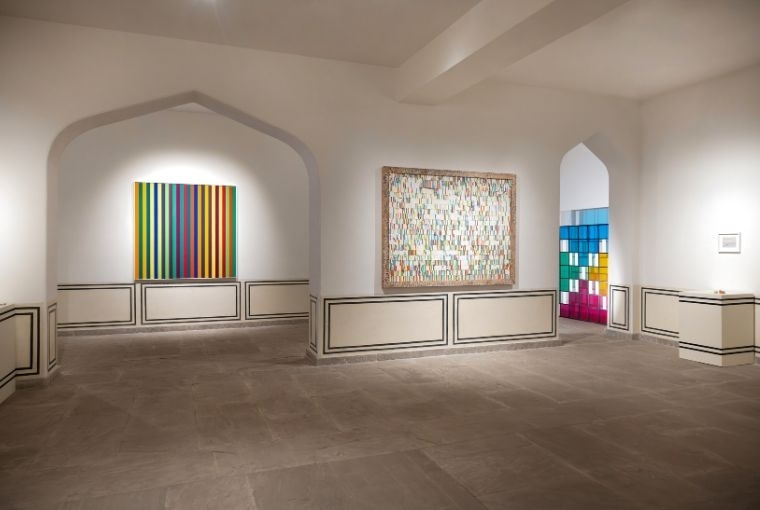
©Julio Le Parc, ©Pascale Marthine Tayou, ©Daniel Buren. Courtesy Galleria Continua. Photo Credits Lodovico Colli di Felizzano
Across the history of abstraction, artists have long argued for colour’s affective and psychological force. Vasily Kandinsky famously described colour as 'a power which directly influences the soul,' likening it to music: an immaterial vibration capable of producing inner resonance. In minimalist and installation-based practices, colour and luminosity become immersive phenomena, capable of transforming architecture, attention, and the embodied experience of viewing. In Jaipur, where light is vertical, unforgiving, and revelatory, this perceptual instability becomes central to how colour is encountered and understood.
Ultimately, Annotations on Colour positions colour as both ancient and urgently contemporary because it is deeply human. Colour is biological, rooted in the physics of light and the physiology of vision, and cultural, shaped by history, belief, and collective memory. In a world saturated by algorithmic images and flattened chromatics, these works insist on colour as lived experience: slow, demanding, and irreducible. Situated within Jaipur, a city already governed by pigment and light, the exhibition proposes colour as a site of relation, where perception, emotion, and shared experience continuously evolve.'
'Jaipur has always spoken through colour, through pigment, light, and the rhythms of daily life,' says HH Maharaja Sawai Padmanabh Singh of Jaipur, Co-Founder, JCA.
'Annotations on Colour builds on Jaipur’s living heritage and the city’s very specific relationship to colour as something felt and encountered, not merely observed. We are proud to present an exhibition that brings global artistic voices into dialogue with the city’s distinctive visual identity.' At JCA, we are interested in how perception is shaped by place, by history, and by the sensory conditions we inhabit,” says Noelle Kadar, Co-Founder, JCA. 'This exhibition approaches colour in relationship to Jaipur: as not just a descriptor but as its own entity.'
Annotations on Colour on view until May 31st at Jaipur Centre for Art.
Date 18.2.2026