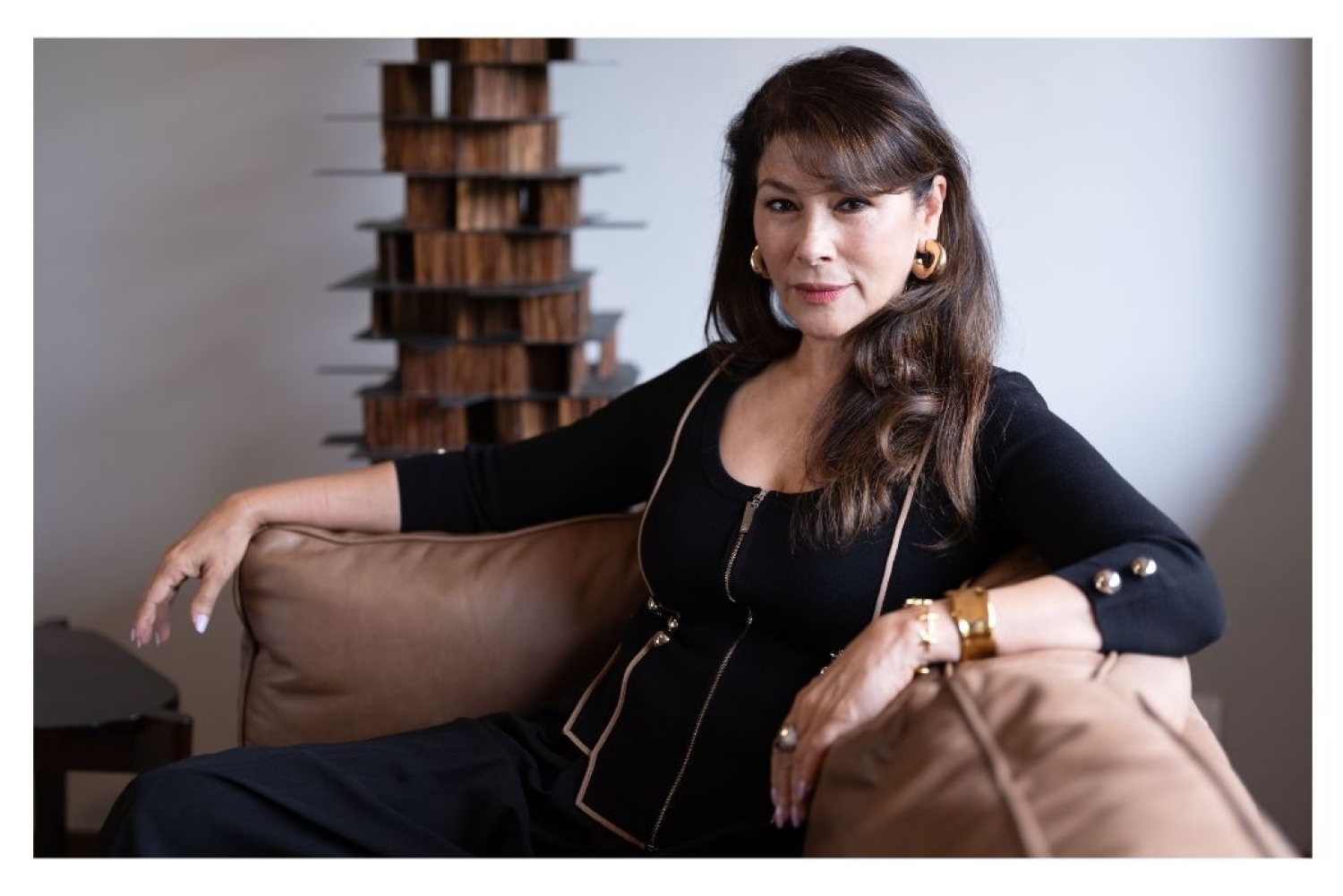
Photography by Siya Singh
Photography by Siya Singh
Curator, Traveller, Art Enthusiast but above all Cultural Communicator, Feroze Gujral is at a phase in her life where after a lot of introspection, she is ready for a bigger purpose. In between two massive Satish Gujral shows, one, the centenary and the other, The Gujral House, Feroze found herself confronting a lot of very strange emotions. ‘While putting the show together, I found a lot of regret that I had not asked both Satish and Kiran a lot of questions. The last five to seven years, they were there, but there was no intellectual exchange. He was ninety five, so my big thing was that I wish I had more conversations. I wish I had documented more. I wish I had written down what they were saying or just taped it. The length and breadth of the archiving was a huge thing because you suddenly saw their lives, not as these old, happy people who are successful, but really, you see the struggles. You see the different phases, you see their personality over time.’
In the midst of all these questions and introspection, Feroze found herself bedridden due to a diving accident. Sipping from a straw, no reading glasses and sixteen hours of solitary thinking found her coming inward, into a quieter moment. ‘It was a funny revelation because I thought of all the people I’d like to say sorry to. I found all the things I would like to do. I found all the missing links in my memory. I remembered things I had totally forgotten. But there was a lot of internalisation at that point. And I’ve kind of come out with saying, I mustn’t lose all the essential things that I thought of. I think dealing with Satish’s archive and getting to know him better, in spite of me being in this house from when I was eighteen years old, made me realise that I didn’t really know him. And that’s a really weird feeling. Ours was a loving relationship and definitely one of ease and happiness, but I think there was a barrier because he was a very prolific artist. He used to work a lot. And secondly, because of his being deaf, you did have a bit of a gap. You didn’t have time to talk about inconsequential things. The interactions were very focused. He was a very unusual man. He was very joyous. I was always surprised by how much joy he had in spite of coming out of the Partition. They were excellent at jokes. He had an excellent memory, and both of them had a lot of internal intelligence and depth for the arts. She had a long, extremely deep knowledge of textile, jewellery, gemstone history.’
Even though Feroze was married into a family of art masters, the arts were always in her DNA. Her mother used to paint, and hailed from a South Indian family, where there was much focus on tradition, arts and crafts. She grew up in Paris and Egypt, and so was exposed to art and culture on a very high level. ‘My mother used to have these camps for artists from Andhra and feed them for two weeks. She would give them all the material and everything, or she would have exhibitions for them. She was always being charitable. Her whole thing was social work. And I think also being from the South makes a big difference because we are focussed on our long traditions of dance, music, food, dress and iconography.
Other than that, being Muslim, we have that tradition of Zak. We give away 10% of everything. We are not allowed to charge interest for anything. So as a result, those two very simple things are familiar, very small. We are told that, when you get Eidi, you have to give some to the poor people. In Eid, the bakra is always cut into four parts. You give one part away to charity. There is a very strong sense of giving to charity. So I think giving is very important to me.’
As a curator, that sensibility and the larger purpose of giving seeped into her process. However, the element of fun and curiosity drove her to experiment and explore various eclectic conversations that artists communicated through her curation. ‘I remember Tejal showing at Documentar, and I was shocked that nobody was showing those films here. I understood they were erotic films, but why aren’t they being seen? They’ve been curated into the highest platform in the world. So I wanted to show her work. Raqs Media were incredible, so brilliant, like contemporary philosophers, more than artists to me. And I wanted them to do something bizarre. So they did a constellation of our conversations, and we mapped it onto the building. My ideas were always very fun. I don’t think of it like, “Is this right? Is this serious?” I also believe every idea has a time, and I feel what I was doing then was right for that time and what I should do now is completely different.’
And that got us talking about India and Feroze 2.0. With the new resurgence of craft and the amalgamation of it in design and art, India is celebrating this indigenous language and that is one of the things that is exciting Feroze. ‘We are watching carefully. That’s why we’re doing a phulkari show and looking at genre furniture. The Ladakh Biennale is also on her drawing board along with various pop-ups, books, collaborations, Satish Gujral, the show travelling to NGMA Bombay and to Chandigarh. There’s lots on the schedule.
Feroze is at a very prolific stage in her life where her contribution to the arts and culture is going deeper in asking hard questions, for example, ‘Why is the Ganga still not clean? Why are parking lots not being utilised for a different, more community approach in the evenings when there are no cars? What are the stories of people residing in Lajpat Nagar, a refugee colony that till date houses Afghanis, Bhutanese, Rangiyars etc’. Other than that she is creating a culture design lab that is exploring two different polarised points of interest. ‘The first one I am doing is with a friend of mine, who’s an architect, and we are looking at houseboats. I come from Kerala and he is Kashmiri. Houseboats are an integral part of both these worlds. We are talking about the houseboats in both those places. I am always looking for a thought that is current. Through politics, art, and life, because they are all interconnected.
It’s so interesting to interact with cultural enthusiasts who want to integrate themselves as part of the city. Those who not only talk the talk, but convert their talk into action. ‘How do we impact the city in a creative, cultural way? Through our foundation, as Mohit [Feroze’s husband] is an architect, he has already written to the city to say that we would like to redo the Lodhi crematorium, pro bono. I am appalled at the state. Burying or burning is part of culture. We are trying to think out of the box in a big-small way to think about how we change the landscape with obvious gaps. I am at that intersection. I love math, I love physics. I like the words. I like a lot of academia. My happy place is reading, writing or discovering something. I’m a little different.’
And on that note, I wanted to know more about what makes Feroze different. We conversed about her ideologies, plans and process; however, keeping that aside, I couldn’t find a better way to understand her more than to see what she holds close to her heart. And as she brought out her trove, each had a story, a memory and a deep connection.
Words Shruti Kapur Malhotra
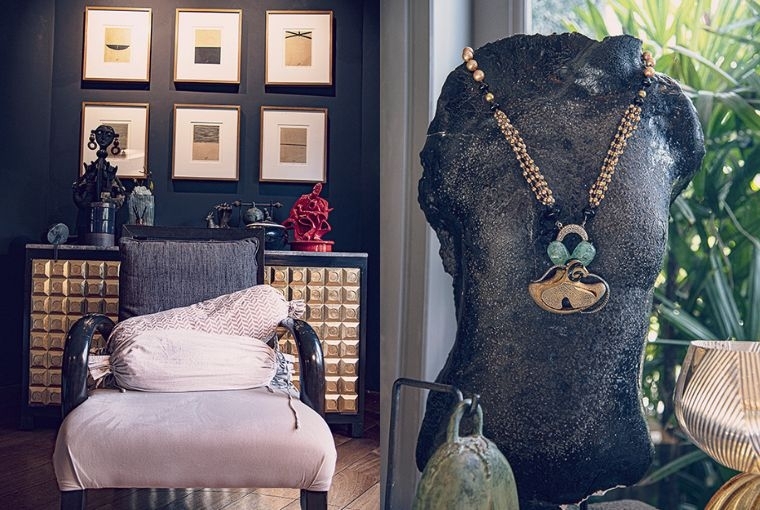
Left: ‘I have two Gao takiyas [bolsters] made of things of my sister-in-law who passed away many years ago. It’s a very old Muslim tradition, where we make a Gao takiya of somebody’s past. I have one of my dad and one of my sister-in-law, Anita Jain. Both of those are on my bed every day and I have one mother-in-law, but that is in Goa. I like these Gao takiyas because they’re not just a Takya, they’re a keepsake that I can take anywhere. I have one of my grandfather and grandmother. My dad’s one is made of his fleece and the little pillow that he used to have under his neck. It has his scarf too, which he used to wear as a cravat all the time.’
Right: ‘I have a piece of jewellery made by my father-in-law. It’s jewellery, so it’s not his art.’
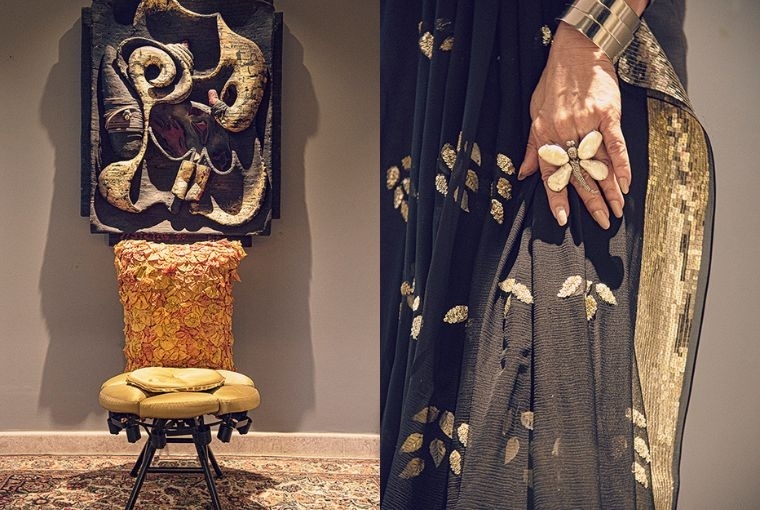
Left: ‘This sari by Ravi Bajaj is my most favourite. I wore it for the first Chanel opening in India, many years ago. It’s the one sari I wear every single year. If I had to run out of my house, I would pick up a set of underwear and that one sari and run out.’
Right: ‘I have always championed Gunjan and love the thought behind her designs. This is one of Gunjan Gupta’s first chairs, which I saw, before she started the throne.’
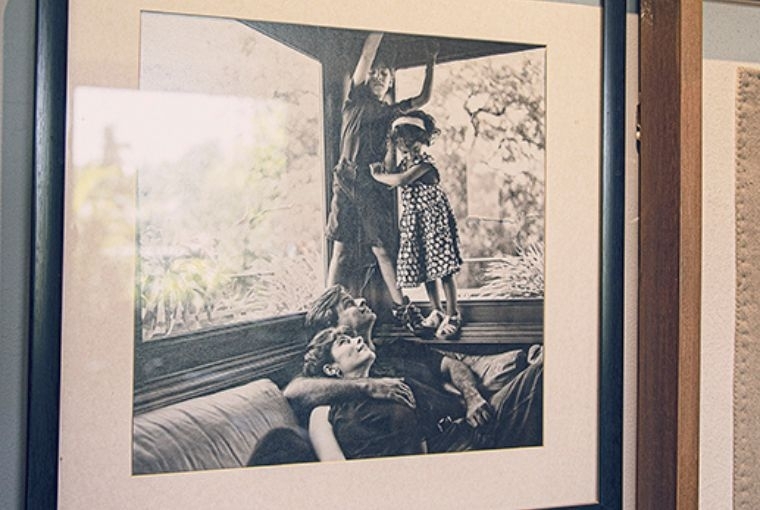
‘Nixie, as in Dayanita Singh, was senior to me in Sanawar. She was in the art department and I was also doing art. I met her then, and I was like a puppy. I just loved her. We became very friendly, but then she went to NID and got to know Mohit very well because he was in Ahmedabad. Her mother and Mohit’s whole family became good family friends. And we live right next to each other in Kasauli. There are many connections. When the kids were really small, she photographed them multiple times at various places, but she did this shoot for us, and then submitted that for something called a series of portraits of a family for Granta Magazine. She won a big prize for it, but it was one of her first shows.’
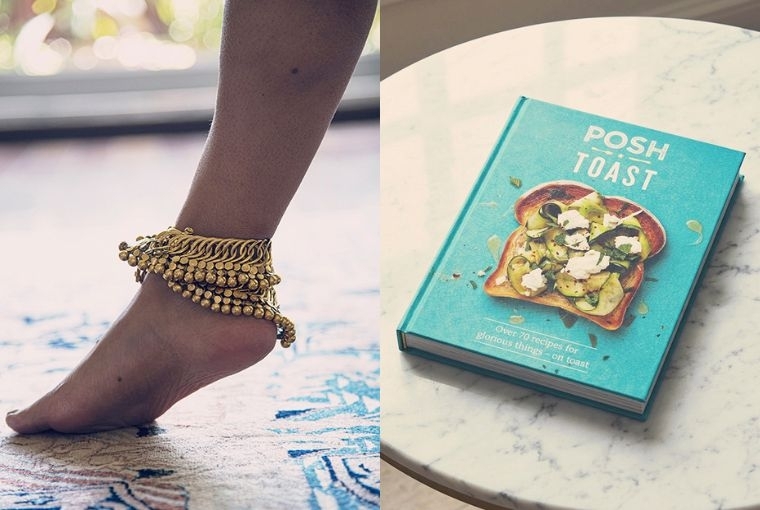
Left: ‘I have these paijebs that belonged to my great great grandfather’s mother. I wear it as a necklace.’
Right: ‘Posh Toast – I cannot cook at all but I love toast. During COVID, I was housebound in London with no help, so my daughter, who always finds the most thoughtful and appropriate gifts, gave me Posh Toast [the book] and I managed to make one every day. At night, I make lists in my head of what it is that I would run out of the house with, if I need and Posh Toast is definitely on my list.’
Words Shruti Kapur Malhotra
Photography Samiksha Sharma
Date 14.9.2026
This is an article from Platform's May 2026 Bookazine. For more such stories, grab a copy here.