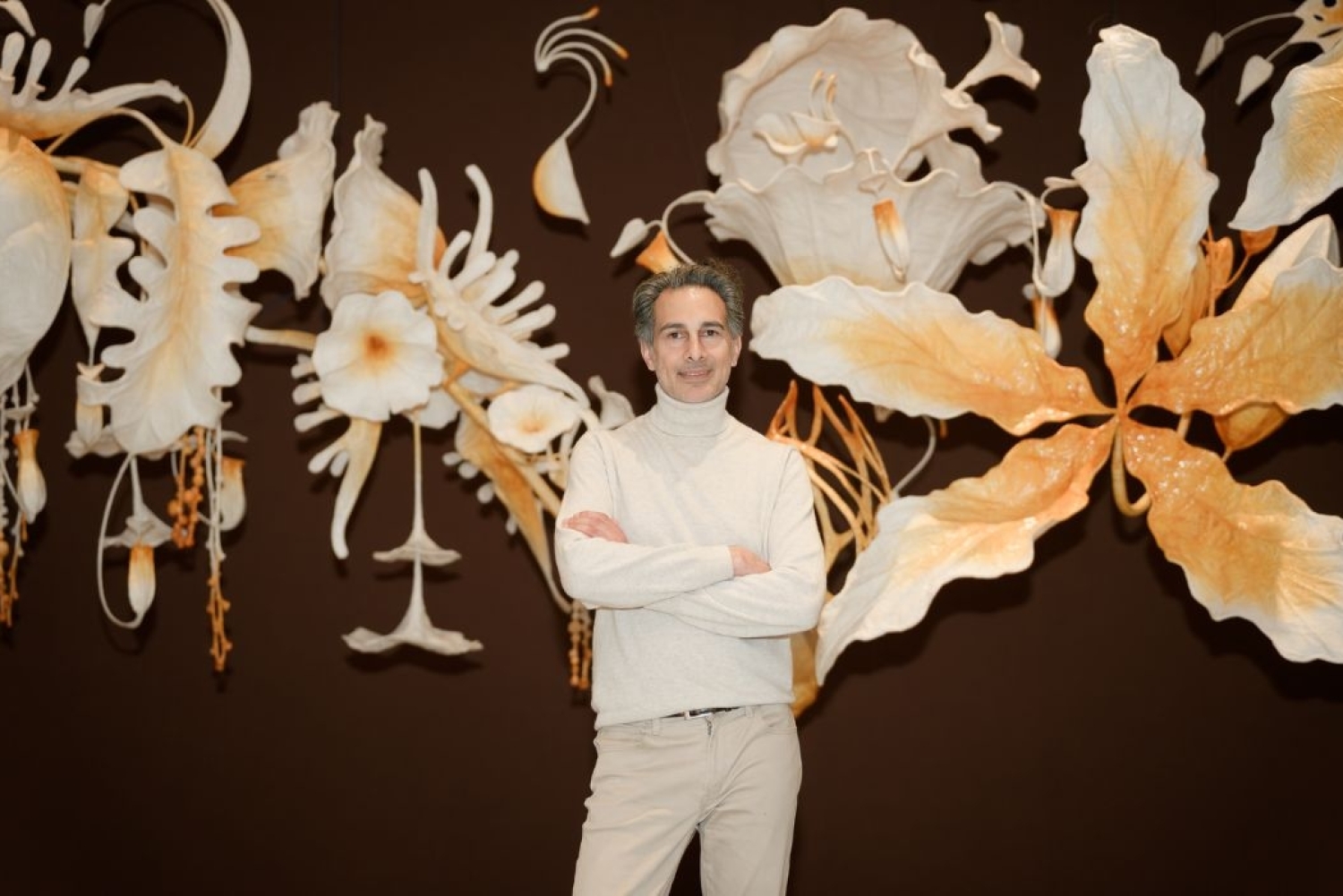
Dr. Amin Jaffer, pictured with Ranjani Shettar’s Under the same sky. © Andrea Avezzu
Dr. Amin Jaffer, pictured with Ranjani Shettar’s Under the same sky. © Andrea Avezzu
Born in east-central Africa, to a family of Indian origins, Dr. Amin Jaffer has lived, travelled and worked globally, which has shaped his pursuits as an art historian, academic and curator. From Canada and England, where he pursued higher education in the arts, to Europe, where he has been based for some time working with institutions, a study of Asian arts has remained an abiding interest. He is captivated by objects and artworks that stem from cultural exchanges, whose hybrid features and hyphenated contextual bearings proffer a relook at the complexities underlying our often-flattened histories.
Dr. Jaffer’s focus on intercontinental trade, migration and colonialism gathers in its folds the accompanying fascinations, assimilations and dilemmas, as evidenced by curations such as Encounters: The Meeting of Asia and Europe, 1500-1800 (2004) and Maharaja: The Splendour of India’s Royal Courts (2009). Exhibitions such as Ethereal (2014) have also delved into sensorium, spirituality and the transient human condition, where contemporary practices from India, Pakistan and Bangladesh and their diasporas have offset the notions of eastern traditions and western modernist sensibilities. Within the exhibition as a public platform, selected works often act as portals to social relations that lie forgotten, practices that resist capitalist acceleration and neat categorisation, and quotidian fragilities that are overlooked. In doing so, Dr. Jaffer foregrounds the multitudes that shape selfhood and objecthood, constitute society and inform placemaking.
In this email interview, Dr. Jaffer shares his curatorial beginnings and approaches, leading to the formulation of the India Pavilion at the 61st Biennale di Venezia in Italy.
As a curator and art historian, you have worked with several important cultural institutions, such as the Victoria and Albert Museum in London, Christie’s and The Islamic Arts Biennale 2025, and continue to direct the Al Thani Collection. What got you interested in curation?
My first visit to a museum was the Louvre aged six. From my copious purchases of postcards, posters and souvenirs in the museum shop (including a pen with a cap shaped like Napoleon’s tricorn hat), my mother understood that the experience was deeply formative for me. What followed were visits to museums in London and Brussels and when I was nine, a long trip to Italy, where I was able to see the great museums and churches of Venice, Florence and Rome. With such exposure, I quickly developed ideas about how works of art and artefacts could be presented in order to inform, educate and inspire. In my generation, curatorship was not at all a defined career path. The role devolved on me as a student on the V&A-RCA History of Design Course and subsequently as a curator at the V&A, where I was given the opportunity to develop a major exhibition about the meeting of Europe and Asia in the period 1500-1800.
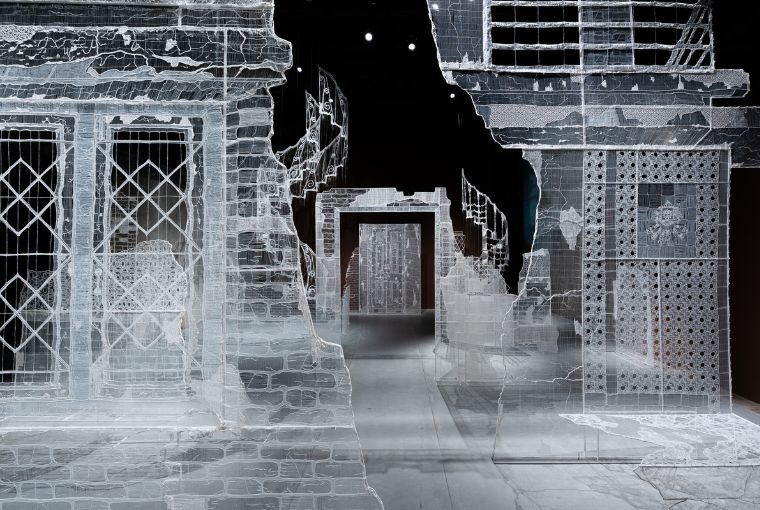
Sumakshi Singh, Permanent Address (c) Joe Habben
Could you briefly share the process of working with the Ministry of Culture, Nita Mukesh Ambani Cultural Centre and Serendipity Arts Foundation in conceiving the forthcoming India Pavilion at the 61st International Art Exhibition of La Biennale di Venezia titled Geographies of Distance: remembering home?
The process has been a truly collaborative public-private partnership that brings together and amplifies the strengths and capabilities of the three different partners. The Ministry of Culture takes the lead in ensuring the project meets the cultural objectives of the Government of India. The teams of the Nita Mukesh Ambani Cultural Centre and Serendipity Arts Foundation are extremely experienced in executing large-scale projects, staging performances and engaging audiences. Together with myself and a curatorial team we form a task force dedicated to delivering the Pavilion with the highest standard of quality from a logistical and artistic point of view.
What institutional expectations, experiences as part of the Indian diasporic community, encounters with Indian culture and contemporary conditions guided your curatorial premise, artist choice and artworks?
My proposal for the National Pavilion of India was shaped by three main beliefs. The first was a deep conviction that the project, while being fully representative of India today, must be understood and felt by every visitor, wherever they may be from. In this sense I wished to avoid concepts or imagery intelligible only to people who understand Indian culture. The second was a conviction that the art works must be contemporary in their expression but that their materials and techniques should be deeply rooted in Indian civilisation. In other words, I immediately ruled out techniques not invented in India, such as photography, video, digital art or oil painting on canvas. Finally, I felt that the Pavilion should represent not only Indians born and raised in India, but all people of Indian origin, who collectively represent nearly 18% of the world.
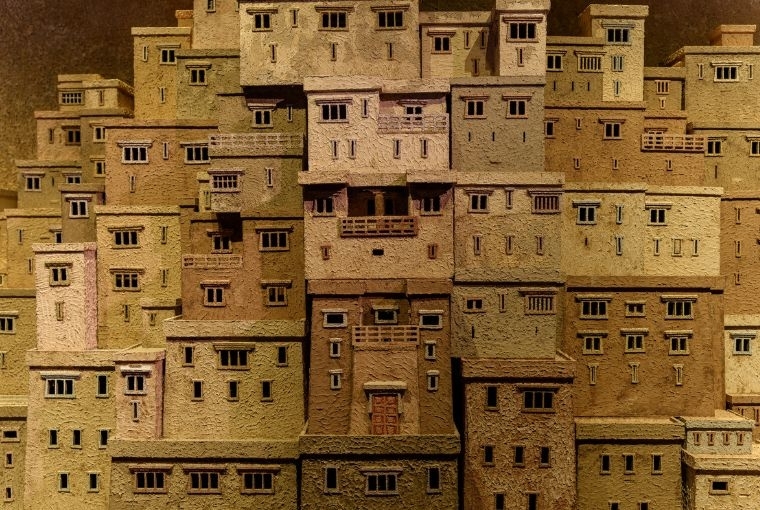
Skarma Sonam Tashi, Echoes of Home (2026). Pavilion of India at the 61st International Art Exhibition – La Biennale di Venezia 2026 © Andrea Avezzu
What understandings of ‘minor’ does the pavilion foreground within Koyo Kouoh’s larger framework of In Minor Keys for the Biennale, which holds space for introspection, imagination, resilience and hope?
The India Pavilion’s use of organic, natural materials worked by hand aligns perfectly with the notion of ‘minor keys’ while the theme of remembering home resonates deeply with the notion of introspection and self-searching.
What aspects of manual and durational artistic processes involving quotidian materials like thread, terracotta and recycled organic matter pique your interest when ruminating on home, fragility and rootedness?
Given that we are increasingly surrounded by seemingly indestructible materials such as complex plastics and metals, electronic and digital products. I wished to evoke the notion of home in India using materials closely associated with our civilisation through time. This project is deeply autobiographical; let us say that my own life is rooted in a domestic environment where water was stored in a mutka, milk expired within the day and domestic work was done by hand. It was this material authenticity I wished to evoke in the projects of the five chosen artists.
Ranjani Shettar and Asim Waqif’s works often engage uniquely with indoor and outdoor spaces. How do their and others’ works interact with spaces of the maritime, threshold-like site of the Arsenale and what experiences do they usher?
With the context of Geographies of Distance: Remembering Home, Ranjani Shettar’s work evokes the rich floral culture of India through an aerially-suspended garden. Asim Waqif’s scaffolding-inspired bamboo scaffolding represents the continuous change that characterises India’s towns and cities, which reflect the country’s dynamic economic and demographic growth. The two projects play a critical role in representing the home that was and the home that will be, alongside Sumakshi Singh’s thread house, Bala’s [Alwar Balasubramaniam] fractured earth panels and Tashi’s [Skarma Sonam Tashi] Himalayan townscape.
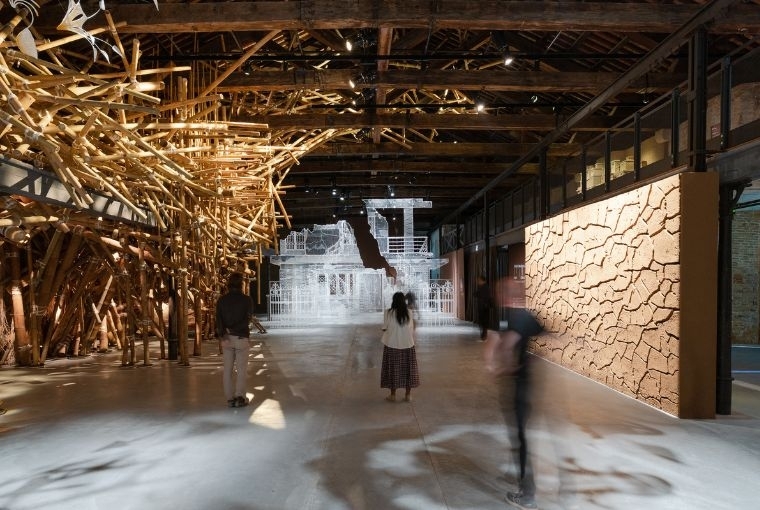
India Pavilion at the 61st International Art Exhibition, La Biennale di Venezia (c) Joe Habben
The press release announces programming as a significant highlight of the curation. Why was it important to pair the exhibition with programming? What kinds of performative practices, collaborations and conversations can one expect?
The India Pavilion is committed to complementing the works on display with a serious of performances that will take place throughout Venice. In keeping with the overall Biennale theme, In Minor Keys, these will range from poetry recitals and readings to music and dance staged by Serendipity Arts Foundation in unexpected and seemingly improvised ways, so as to touch passers-by and residents of Venice in the natural course of their lives.
Lastly, are there any plans to bring the curation to India? If yes, what possible forms could the presentation take?
Talks are underway for bringing the India Pavilion at the 61st Biennale di Venezia to India, retaining the original curation.
This article is an exclusive excerpt from our upcoming May 2026 Bookazine, featuring the entire conversation. For more such stories, have a look at our Bookazines here.
Words Stuti Bhavsar
Date 9.5.2026
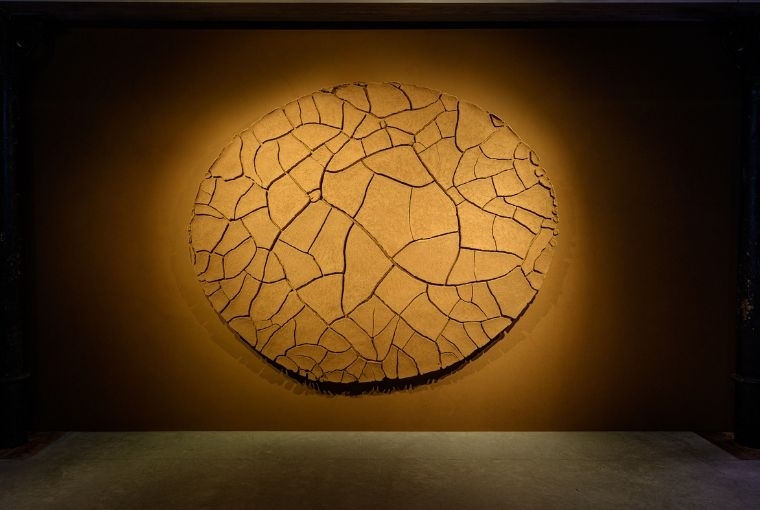
Alwar Balasubramaniam, Not Just for Us (2026). Pavilion of India at the 61st International Art Exhibition – La Biennale di Venezia 2026 © Andrea Avezzu