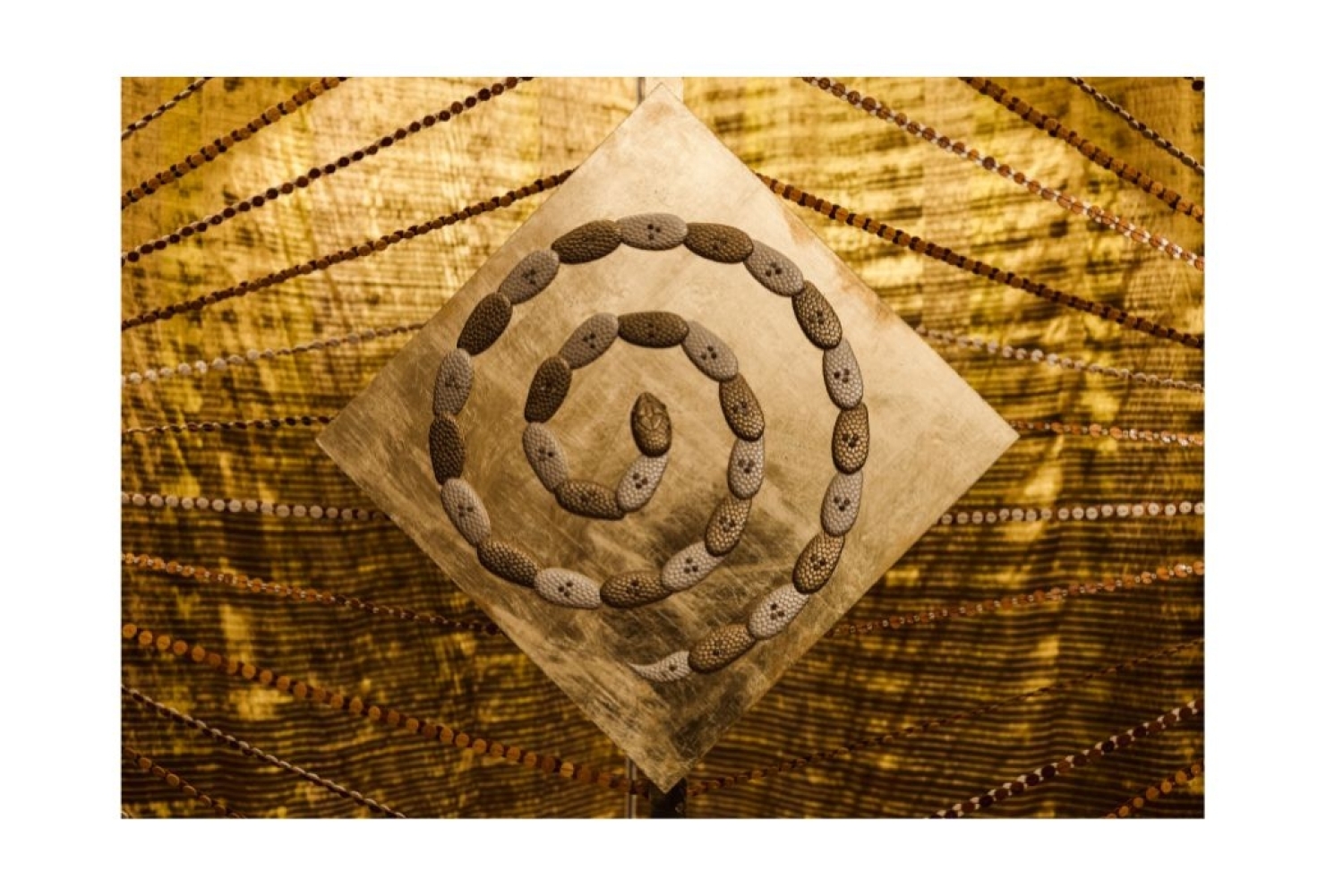
Lakshmi Madhavan’s journey of making art a way of life culminated powerfully in her installation for De Beers Group at their debut at the India Art Fair. By bringing together the luminosity of diamonds and the cultural resonance of the kasavu textile, she created a meditative dialogue around identity, memory, community, and belonging.
In this work, she spotlights kasavu and diamonds as parallel carriers of time, one rooted in human histories and cultural memory, the other born of deep geological processes. The installation becomes a luminous site where questions of belonging, community, and the politics of cloth and body are refracted through light, shadow, and material transformation. We sat with her during a packed Fair to understand how she put it all together.
Talk to us about the journey of making art a way of life.
So art really happened to me very accidentally. I didn’t study art. The plan was never to be an artist. It was always something that I was passionately interested in, but long story short, coming from a very traditional South Indian family, art was never a viable career option. And, not to blame my parents, I never had a better articulation of what I would do by becoming an artist. So I think it was a bit of a long, winding journey in finding art; I dabbled in lots of other things.
I had a corporate career, I did a corporate job. And it was really difficult being away from home. I moved to Copenhagen with my husband. I couldn’t find work there. And, on this really dark Scandinavian winter day, I was just so frustrated with my life. I said, you know what, if there’s one thing that I can pick up again, it’s my drawing pad. And I think the first time I did it back then was after probably a gap of 10 years. I didn’t know if I had any art left in me. But that, in some ways, was my foray back into art.
From then it has been a long journey. I’ve dabbled with lots of different materials and worked with artists because I didn’t have an art school background. It was always a quest of: how do I educate myself? I worked in a lot of artists’ studios. And finally, I feel like working with the material that I currently work with, Kasava, was a bit of a homecoming. Because I’m from Kerala, for somebody who’s lived, travelled, and kind of made homes in so many different countries, this whole question of: what is my identity, where do I belong, was always very complex. The one person who anchored it for me was my grandmother, my Ammama. I was very close to her. She’s the reason I stayed connected to Kerala, to my homeland, my roots, my culture.
And the reason that Kasava today even stays on in my practice is because she wore the Kasava throughout her life. When I did a project almost six years back to unravel the idea of home, that’s when this material entered my work. It was almost like a dedication to her, and I never thought I would stay with it. But I’ve only scratched the surface. Kasava almost became like this umbilical cord to find my way back home, to sort of even address my own questions of identity, belonging, and memory.
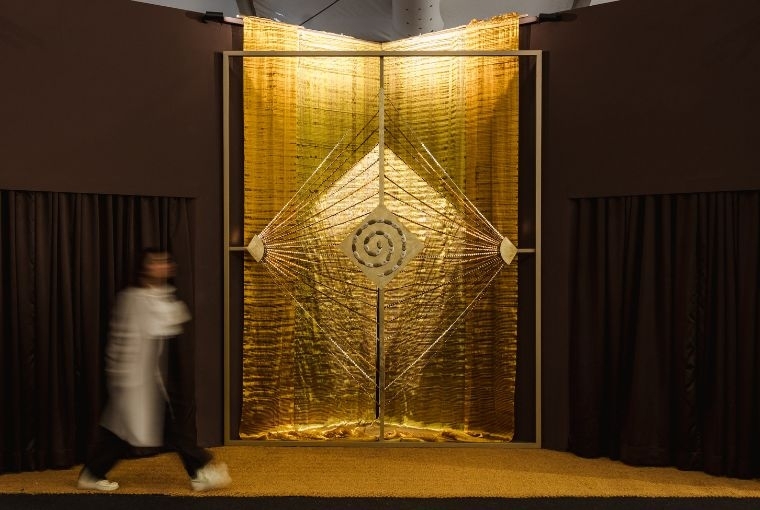
For De Beers’ debut at the India Art Fair, you created a striking textile installation that placed diamonds and kasava in dialogue. How did you bring these two elements together?
It was actually an outcome of a lot of conversations. When we started, I was very unclear about how diamond and Kasava even came into dialogue. A lot of people also have a lot of myths about diamonds. The team at De Beers was really, really gracious to spend a lot of time with me. Even the film that you see inside was the first film that was sent to me. They did speak to me about a lot of things that they’re doing in terms of community activations across different parts of the region that they’re sourcing diamonds from. And slowly, as I was talking to them, I realized that there’s this seamless synergy in both materials. I’m an artist who works with the community. The textile that I’m working with really comes from nature. From the cotton to the yarn to the cloth, it’s really shaped by human touch, by this community. It’s a similar story with diamonds. It’s something that’s formed deep in the crust of the earth.
And then its whole journey into acquiring meaning is purely because it’s transformed by human hands, by community, and then finally in contact with the body. And that’s the same for Kasava as a material, too. And as an artist, one of my longstanding inquiries has always been this connection between cloth and body and the politics of cloth and body. So you can say that a body wears a cloth, but a cloth also wears a body. A cloth is one of the first defining markers of who you are, how I perceive you, and your standing in society. If you think about Kasavu, it has a very, very long history of not being a very inclusive cloth. Who could wear it, how you could wear it, defined who you were in society. How does this cloth then get meaning from the perspective of identity, memory, and belonging? And those are the same themes that I found even in the journey of diamonds. So it was really simple for me to get them in dialogue and it came together beautifully and naturally.
At the center of this installation sits a serpent. What is its significance?
De Beers has already shown this work at Frieze Art Fair. But it was in a very, very different format. It was a lot chunkier, a lot more solid. And when we started working with the team, what I loved was that they gave me a lot of creative freedom in saying, 'it is up to you how you want to interpret it'. I wanted to lose some of that hardness to the plate. I stripped that down. I really liked the idea of the beads coming from this community in Botswana. It was absolutely fabulous and beautiful to look through those ostrich eggshells and the diamond strings that they form. And then it was really about thinking about how I see this connection. Both of the materials carry so much of a sense of time. Diamonds carry geological time. Kasavu carries human time, because it is through generations that this cloth has transformed and acquired meaning and become this cultural object in that region. So I said, let me play with that idea of time through light and shadow. And how do I get both of these materials to be in conversation, but in a very ephemeral way? It is really only through the shadow that they meet.
So for me as an artist, that was really interesting to work around. It looks very simple, but it is pretty complex when you are working with light. I do a lot of work with light, even when I am working with my material. So the choice of how we wove in the threads, we have gone very sheer. We really stripped down the thread count so that we can get light to pass through and play through. That has all been years of technical innovation that we have managed to develop with the community. The serpentine is also part of what De Beers, as a group, has in this original plate. It is crusted with diamonds. It is the rawest form of diamonds. In that form, I believe, and this is what I have been told by them, it is not as precious as when it goes through multiple layers of being chipped and cleaned and going from a rough diamond to a more refined form. So if you see all of the materials that make the artwork, they are the rawest at the starting point of the journey of these materials. So that was interesting for me as an artist, because I have got to learn a lot more about another material, but very similar to my artistic enquiries.
Words Hansika Lohani
Date 11.2.2026