Julien Segard
Julien Segard
Shift returns, not as the gentle, conscious fashion label it once was, but as a live, evolving system for art-making. After years of shaping wardrobes through Shift and then reimagining streetwear at Bhaane, designer Nimish Shah now turns his attention from garments to ideas, using his fashion vocabulary to build a new kind of residency in a remote part of Gujarat.
Rooted in his family’s textile-printing facility, the residency treats the factory floor as studio, archive and laboratory, inviting artists to respond to industrial-scale screen printing as both medium and metaphor. Nimish’s long-standing preoccupation with sustainability, repetition and mechanised craft now extends beyond clothes into a shared, cross-disciplinary space, where a curator-led collective tests how Shift can exist as philosophy and narrative rather than just product.
What inspired you to start an artist residency under Shift after working in fashion for so many years?
Being at Bhaane was an amazing opportunity because we were applying the same philosophy of my brand Shift on a scalable operation. Everything amplified faster, with faster response and real-time feedback as to what works and what doesn’t. As we built it, we were also leading the market. There was a lot of editorial work in terms of how we projected our brand, which I didn’t spend so much time on during Shift. It was a different time altogether. We did two campaigns a year, and had our lookbooks. Those things were not enough during Bhaane. The whole dialogue turned to how do we engage, how do we build and layer community. That was an amazing learning opportunity to deliver. It was beautiful at Bhaane to do all of these things in the same segment.
After running that for five years, I wanted to take a break, to rediscover what I wanted to do and take a step back because I really enjoy and love fashion and lifestyle. I never questioned that, but it was time, because I’d been working for 15 years, to pause and reinvent, to understand how to continue, find a new energy, shake the bottle, and redo what we love. I was always fond of fine art right from the beginning and passively learning about fine art, artists and practices. When I was considering the next step for Shift, I knew the functionality and structure it needed to have: to become a creative studio, to work with other brands, to have our own novelty shop and product line, but also to work on various projects across lifestyle and fashion through brand strategy. That was active in my head. It was about how to start cultivating this identity and ethos again. Then the reflection point: it could no longer be just me. I’ve said enough about what Shift means; most people know what Shift is. Now it was time to bring in a collective voice and like- minded people responding to things where Shift applies without product. We wanted to build a philosophy of Shift. Through that, I found artist residency the most amazing way to gather people to engage, respond to a brief, build something of their own, and continue in their own practice while Shift documents and narrates the discourse that comes out of these creative workshops. That’s where it was shortlisted, hosting an artist residency to build a collective voice.
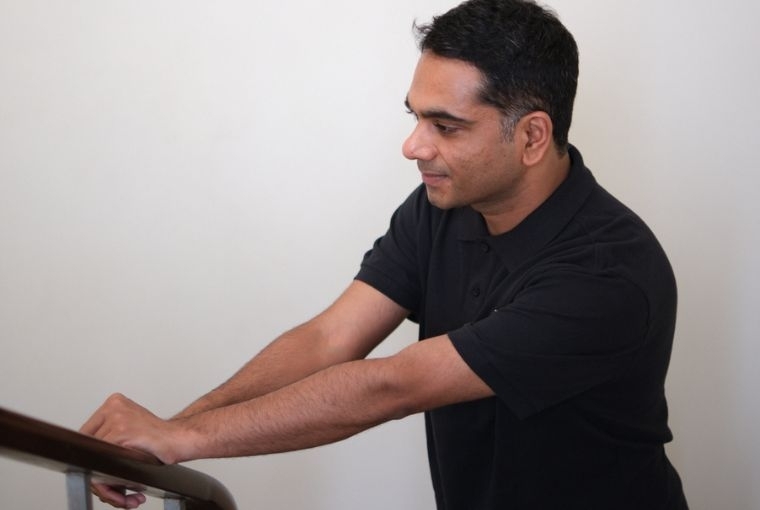
Nimish Shah
Could you talk about the purpose behind this residency?
We have a beautiful facility in remote Gujarat where our family business is in textile printing which is where we based the residency. So then finding this medium of textile printing became very strong. I wanted everybody to respond to the brief through the medium of textile printing or screen printing. The objects that they make have an element of screen printing, preferably textile works but we wanted to swing it and see what, whoever is comfortable with doing whatever. And we want to keep that as an open- ended thing. It’s not just a textile printing residency. But that is a preferred medium because then it becomes very site-specific. It becomes specific to this particular residency where they get to engage with the industrial scale of textile printing to create these art objects, which is a very one-off opportunity for an artist to have access to something like this.
How was the first edition and how did the artists react to the space?
We invited three artists who were immediately very excited to explore. I did this with Veerangana [Solanki], who is a super-talented curator. She curated the entire program and led the project in terms of the brief, working closely with each artist to develop final works of art. It’s very important for me to engage with a curator who comes with this eye, versus me where my eyes are still nascent for fine art. And then obviously, I bring in like a fashion or lifestyle perspective to this particular conversation. Veerangana structured the whole thing because she knows what other residencies lack and what we can provide compared to other residencies. I would love to invite an artist who’s working with a completely different medium, as long as they address screen printing in their process, anything that becomes site specific, because there’s so much that this particular site provides that one needs to be able to absorb something from here. It’s not a retreat, you must engage with the resident curator.
I’m hoping to host this at least once, if not twice a year. But obviously, we worked online quite rigorously before arriving at the facility, because once you’re here, it’s really about fine-tuning work and then going into production straight away, which is just factory time. So, very good experience in terms of listening.
And also, what is amazing is that each artist sort of becomes a peer review process. Because there are three artists, everybody’s talking to each other. It’s amazing to see how one shares insight with another. It turned out to be a great workshop.
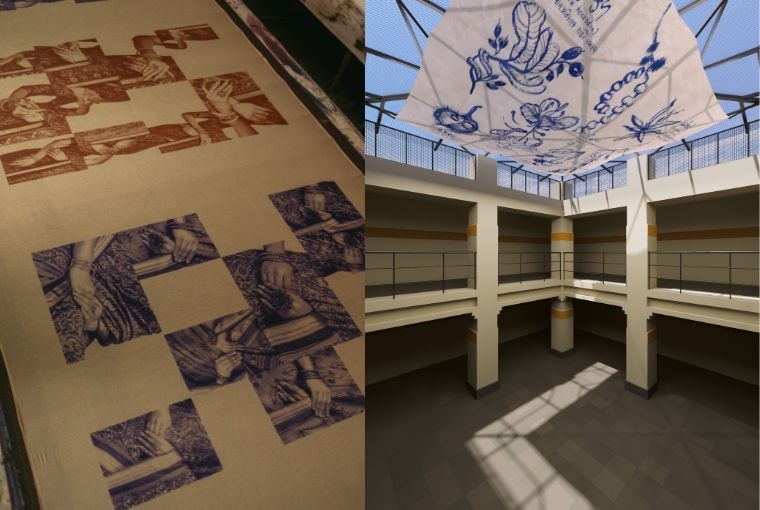
L: Kaamna Patel R: Edugraphic Canopy at Anjali Hospital, Ranasan Site Specific by Garima Gupta
What is the narrative you’re trying to reiterate through this residency?
I am trying to lead a narrative of what Shift means through this residency. We researched at Calico Museum and looked at Pichai as these objects which were technically mass-produced, but they were mass artisanal practices that now have been replicated by machine. So the discourse was about repetition and when an artist continues to repeat, how that classifies as artwork, versus when a machine replicates that. The beauty of the machine is the fact that the machine is handmade by man and it is perfected by man to be able to repeat this. We want to put this out for people to reflect. And that is what the residency gets out, where Shift every year puts out this creative dossier, or we put out a residency dossier, which then becomes a reflecting point for people who are engaged within the community. And then obviously each artist takes this forward into their work. So this is a very passive push by Shift for starting a narrative.
What happens to the artworks created at the residency? Is there a thought behind retaining them to enhance Shift?
So there’s a combination of things. One of the reasons why I didn’t want to bring that up, since it was our first residency, is that I wasn’t attached to that idea, or I was indifferent to that notion of retaining works or engaging them for Shift. I really just wanted to start this without having that conversation, because that conversation goes in multiple directions: whether it is to retain work, or whether it is to use work, because then Shift will produce commercial works.
Then that becomes artist commissions, and that fine art space and the production of finite objects need to stay sacred to what Shift does, which is more of a consumer product. But they do inspire each other. As soon as I feel like I need to work with this particular artist, that becomes a different commercial engagement altogether. While we are hosting right now, there are other important questions left to be answered, because there’s no call to action, which has been a problem. At some point, I’m hoping to do a show, but we’ll see. I think that will evolve on its own. I’m not putting the cart in front of the horse right now.
This is an excerpt from the January EZ. For more such stories, read the EZ here.
Words Hansika Lohani
Date 29.1.2026