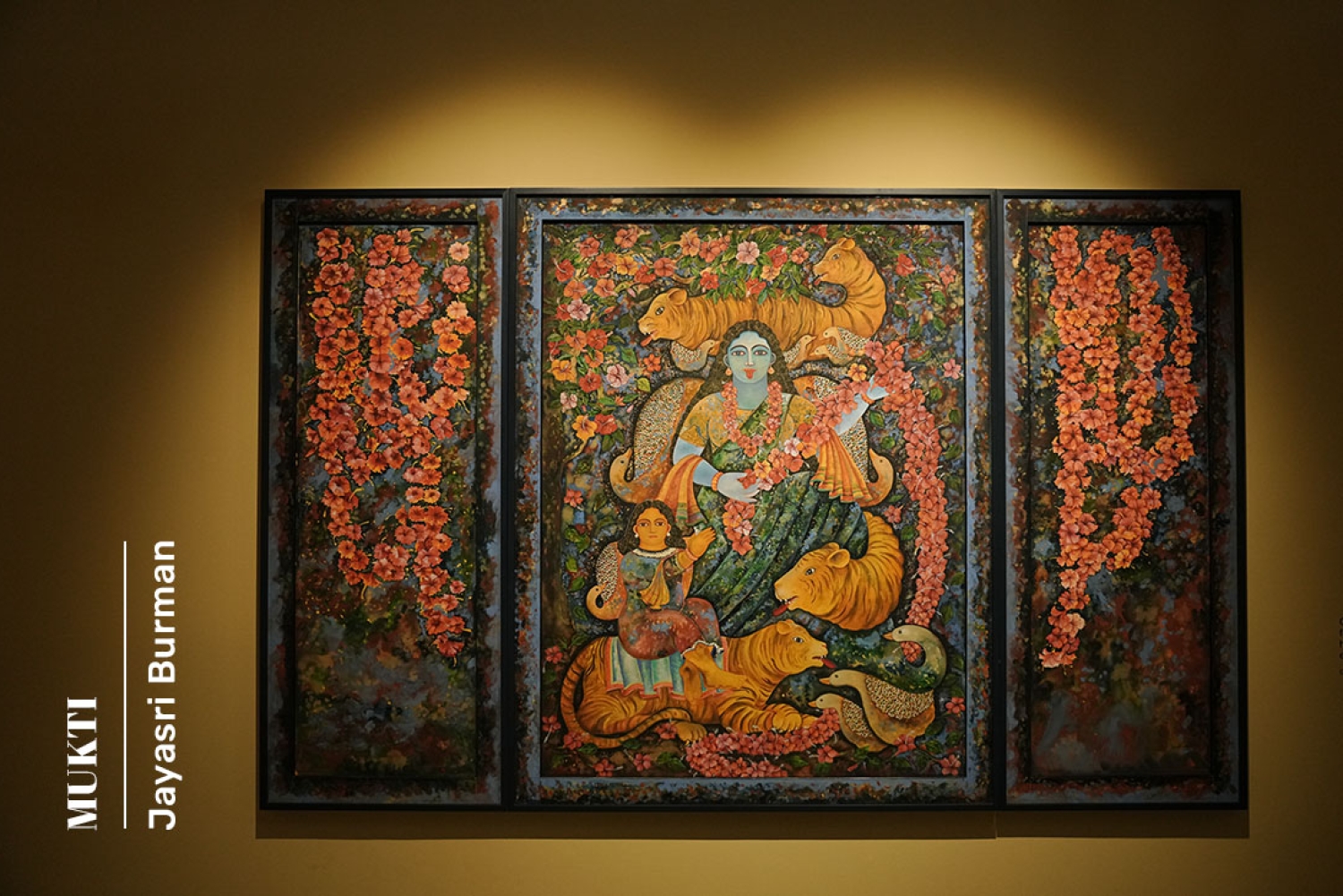
'Titled after Rabindranath Tagore’s song Amar Mukti Aloy Aloy, Mukti draws on the idea of liberation through participation rather than renunciation. The song has remained a constant in Jayasri Burman’s life since childhood, gradually shaping her understanding of freedom and informing her artistic practice. For Burman, liberation is discovered not by withdrawing from the world, but by engaging with it through work, relationships, compassion and the experiences that shape human life. The exhibition brings together women protagonists from mythology, literature and folklore whose stories address the moral and social concerns of the present.
Their narratives engage with issues such as unchecked materialism, caste discrimination, prejudice, violence against women and the fragile relationship between humanity and nature. Tagore’s Nandini stands against the violence of materialism, while Krishnakali challenges inherited ideas of beauty and prejudice. Chandalika speaks to the dignity denied by caste, and Bonobibi represents the balance between humanity and nature. Manasa embodies feminine power, Behula represents endurance, and Sarvamangala destroys only to protect life. Kali, Chhinnamasta, Draupadi, Sita and other women in the exhibition embody compassion, sacrifice, resistance and renewal. Rooted in contemporary realities, Burman’s paintings respond to ecological crises, displacement, fractured communities and the pursuit of material fulfilment. Her studio becomes a space of sadhana, understood as a lifelong practice of attentive mindfulness, where painting serves as a means of transforming lived experience into expressions of hope and beauty.
Flowers, rivers, birds and other elements of the natural world recur throughout the works, with women occupying the centre of the pictorial narrative as bearers of memory, tenderness and transformation. Through these figures and motifs, Mukti examines the relationship between individual freedom and collective well-being, suggesting that liberation cannot exist where greed overrides compassion or nature is treated as possession rather than kinship.'
Text and Images Courtesy Saffron Art, Chawla Art Gallery and Snowball Studios
Date 23.11.2026