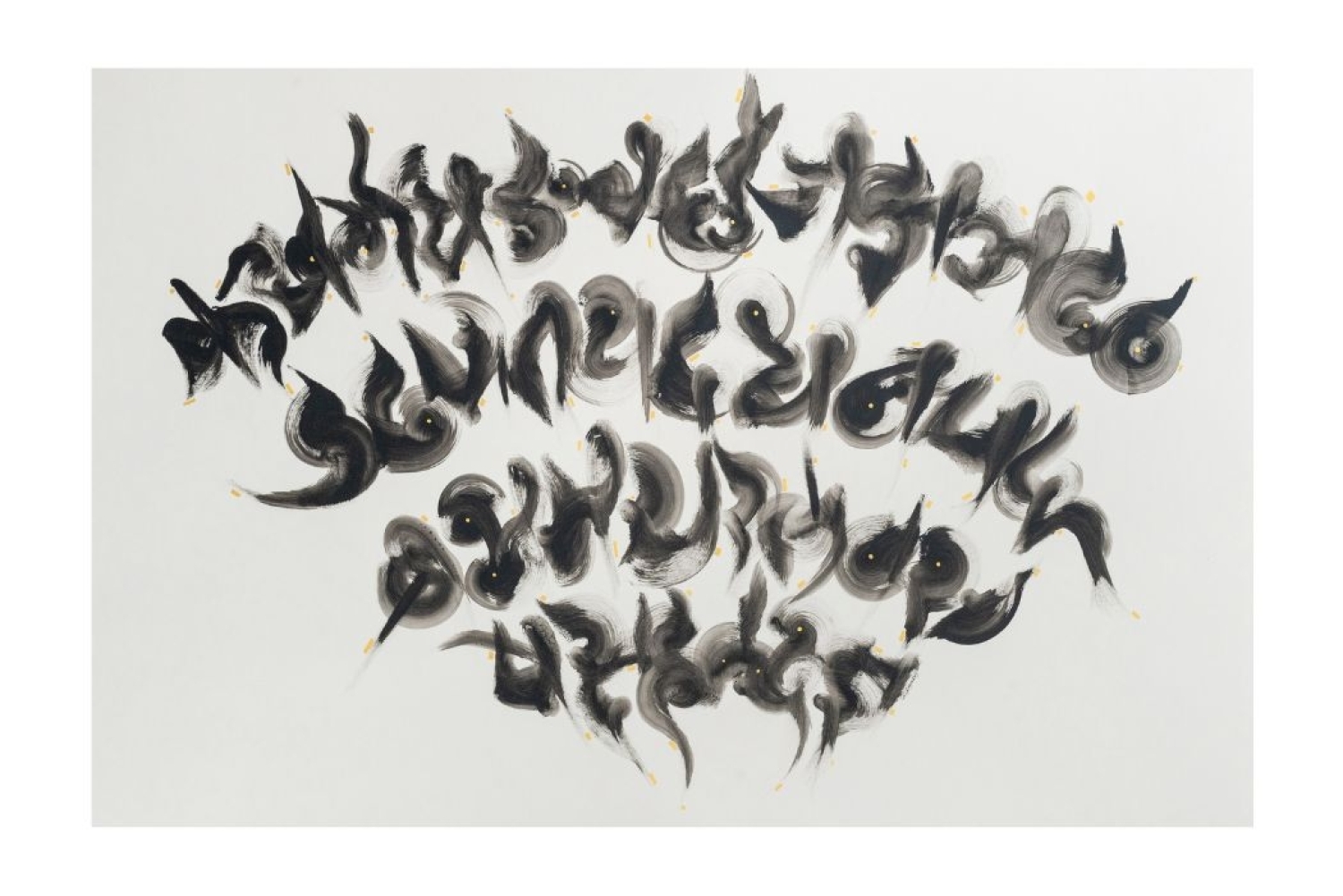
Orchestra
Orchestra
A couple years ago, I sat down with Nikheel Aphale to talk about Devanagari, the script of his mother tongue Marathi and what it meant to him as an artist finding his footing. What struck me then was the conviction of someone who had chosen an uncommonly narrow path of one specific script. He chose to explore it with patience and believed that it had more to say than the world had yet allowed it to.
A lot has changed since. Nikheel is now represented by Artisera and working with Creators at Collective. His practice has expanded into collaboration with an architect, into workshop modules for high school students, into a new body of work that he describes as going deeper in concept, in form, in medium. And yet, a lot remains unchanged with him. The same meditative attentiveness to process. The same refusal to treat the script as an ornament rather than an argument. The same belief that Devanagari, given the right conditions, can hold its own on any stage in the world.
How do you think you have evolved as an artist in the past few years and what has Devanagari script, your primary art form, manifested into?
Being the script of my mother tongue, Marathi, I have been exposed to the sounds and visuals of Devanagari since birth. For me, it is not just a writing system, it represents my cultural identity. It naturally becomes a medium of my art practice through which I think, feel, and respond to the world, and carries the memory and lived experiences. I draw upon Devanagari letterforms and their grammatical structures as a means to explore and articulate the concepts. Despite differences in sound, shape, and weight, these unbiased letters work cohesively creating a beautiful language and culture. The elements like barahkhadi (vowel variants) suggest togetherness, conjunct letters show symbiosis, the absence of case distinctions symbolise equality and inclusivity, no silent letters in the system implies voice for all, and many more.
It allows the script to move beyond its conventional function as text and enter the realm of visual expression. In that sense, it is not about preserving the script in a fixed form, but about carrying forward its identity, its spirit, while allowing it to evolve and remain relevant within today’s visual culture. I am still evolving as a human being alongside the journey of my art. As I delve deeper into the Devanagari script and investigate its nuances through the lens of humanity, it has changed my perception of social concerns and made me more sensitive and aware. Through this art practice, I have connected more deeply with my roots, which has helped me develop my own visual language and, eventually, my own voice. For me, Devanagari is no longer just a writing system or script; it is a powerful medium of expression and dialogue. Through my art, I make a humble attempt to showcase the potential of our Indian script on a global platform.
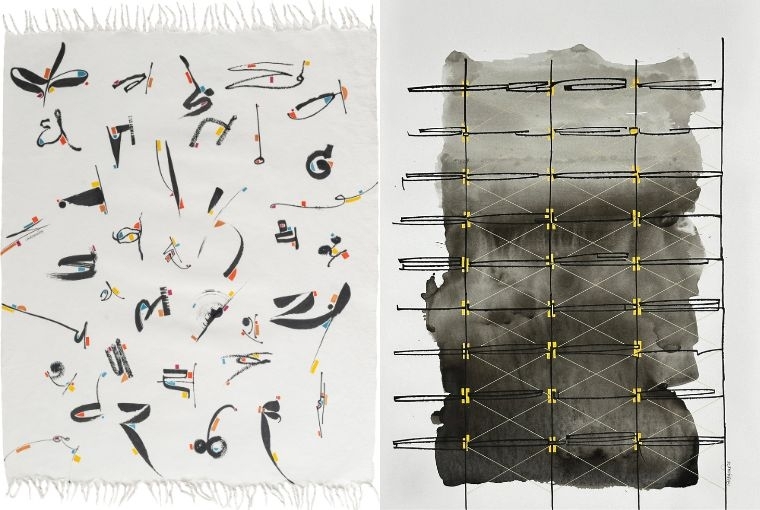
L: Delhi Picnic R: Scaffolding
What is your creative process as an artist? Where does it begin and end? When do you know that an artwork is done?
My process always starts with thinking and ideating using a pencil and sketchbook. Most of the time, I plan the work before moving on to the final piece. The subject, theme, or brief I work with determines the feel, mood, and shapes of the letters, and guides my choice of tools and medium.
More than the outcome, I enjoy the process of creation. It’s meditative. While working on a piece, several elements, mind, hand, posture, the fluidity of ink, and the tactility of the surface come together harmoniously to create a satisfying experience. Loading ink onto a tool and making a mark requires mindful attention, yet the response of the medium remains uncertain; that is what excites me the most. The uncertainty, the risk involved, and the occasional happy accidents that occur while making the work all contribute to creating a spiritual experience within me.
Whether the work has turned out satisfying or fallen short is scrutinised by both technical and intangible factors. Sometimes it can be an idea that would have excited me but did not manifest on paper or it could be the quality of texture, shapes of letters, uninterrupted ink strokes, balance of white space that feel either unsatisfactory or acceptable. Stepping away from the work for a day, two, or even a week and then looking at it again after some interval gives me new insights and clarity to judge if the work is up to my satisfaction.
Your use of found tools like coconut husk and bank cards feels almost ritualistic. Do you choose the tool before you know what you'll make, or does the subject of a piece tell you what to pick up?
I work with both traditional tools, such as reed pens, ruling pens, and brushes, as well as everyday objects like toothbrushes, scrubbers, coconut husks, and discarded bank cards. The subject, theme, or brief I work with decide the feel, mood, and shapes of the letters, and directs my choice of tools and medium. Each tool requires different handling and offers its own texture, flow, and hence the expressions. For instance, if I want to convey the emotion of rage, I might choose something edgy and rough, like a scrubber or a coconut husk, instead of a dip pen. The flat, smooth nib of a dip pen has its limitations when it comes to expressing temper, whereas the coarse, irregular nature of these unconventional tools better communicates force and vigour.
On the other hand, I would use a dip pen or a brush for a subject related to elegance, tradition, or history, where control and refinement become essential. Sometimes, it’s fun to explore tools beyond their conventional capacity; such experiments often lead to unexpected letterforms.
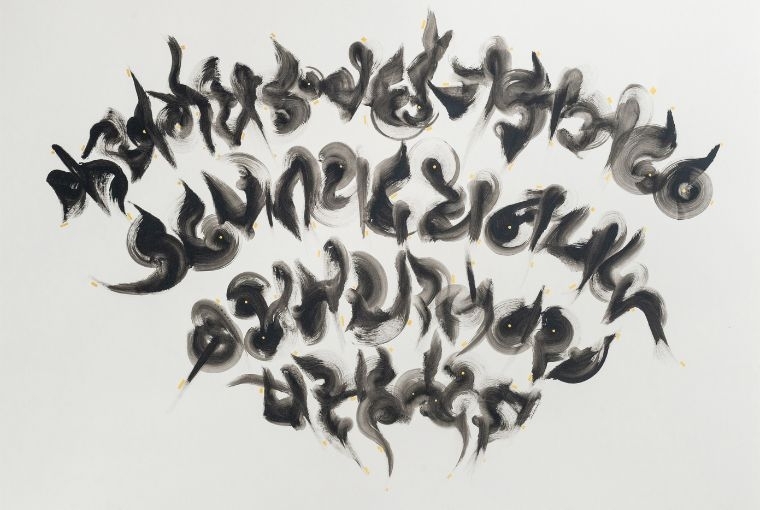
Niramaya
You've noted that Japanese, Persian, and Chinese calligraphy have global recognition that Devanagari lacks. Do you think that gap is closing, and what would it actually take for Indian scripts to be seen on the same stage internationally?
I am optimistic that the situation is beginning to change, and that Devanagari is gradually gaining recognition in the world of calligraphy. Of course, there is still a long way to go before Devanagari (or most of the Indian scripts) is firmly established in the contemporary art world. The process needs to begin at home. In India, audiences are becoming increasingly aware of calligraphy and engaging with it, whether as a hobby or a profession. There are several platforms where people are learning about, exploring, and experiencing Indian calligraphy, scripts, and languages. Events like KaChaTaThaPa, Callifest, and Akshar Mahotsav have made calligraphy more accessible, allowing audiences to meet and interact with practitioners from across India who work with diverse scripts.
At the same time, agencies and media houses are beginning to recognise the potential of this art form and are keen to use it in commercial projects and design work, which has helped expand its reach. Many design students are interested in designing typefaces for Indian scripts. Many typographers and designers are working with Indic scripts, developing fonts for Indian languages. It is an important area as many global players are entering into Indian market and they need to communicate in our language. There are also organisations that actively support artists in taking their work forward. I am currently represented by Artisera, a Bangalore-based art gallery, along with the talent management company Creators at Collective. Both have played an important role in bringing my art form to a wider audience.
I also see a growing number of Indian artists incorporating their native languages and scripts into their practice. Using vernacular text becomes a reflection of their identity and roots, making the work more authentic and personal. I believe that in the coming years, Indian text- and script-based art will emerge as a strong and independent discipline, much like textiles, ceramics, or performance art.
What are you working on currently?
I am currently working on a collaborative project with an architect. We are combining our individual practices, skills, and strengths to develop an installation piece using paper as the primary medium. It is fascinating to see my letterforms translated into a different medium through the added perspective of another creative practitioner. I am also developing a new body of work. Although it is an extension of my current practice, it goes deeper in terms of concept, form, and medium. In addition, I am working on a calligraphy workshop module for high school students who are interested in art.
Words Hansika Lohani
Date 27.5.2026
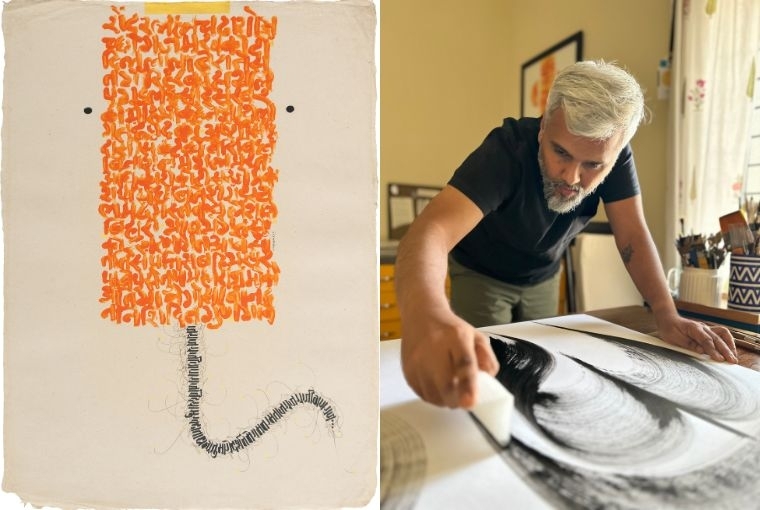
L: MarksofDevotion R: Nikheel Aphale