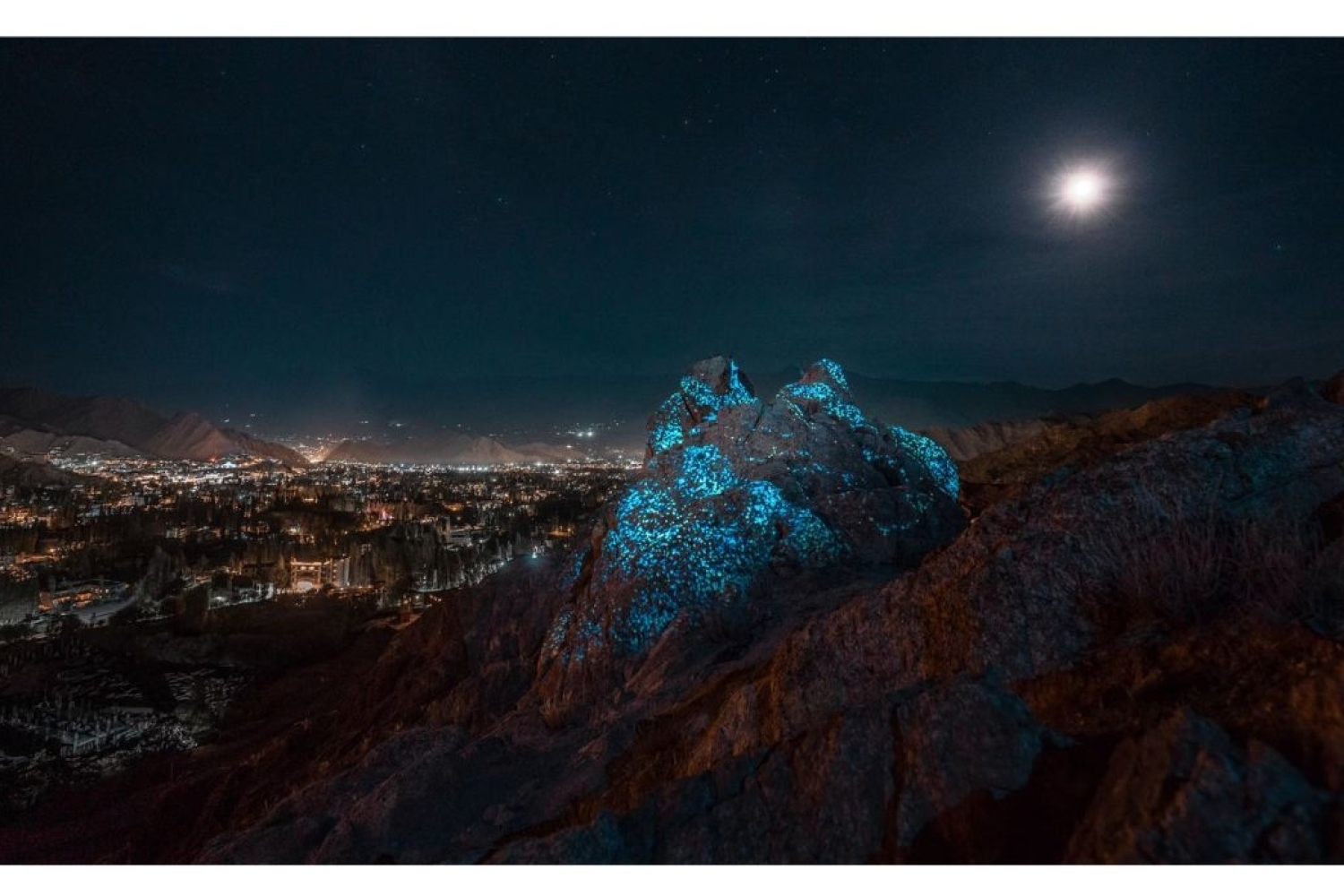
There is no front gate to walk through or a map telling you where to start. You could find yourself hiking toward a monastery one moment, beside a river the next, or pulling over someplace on the Leh-Kargil Road to experience site-specific artworks at 11,000 feet. That's how the sa Ladakh Biennale wants to be experienced.
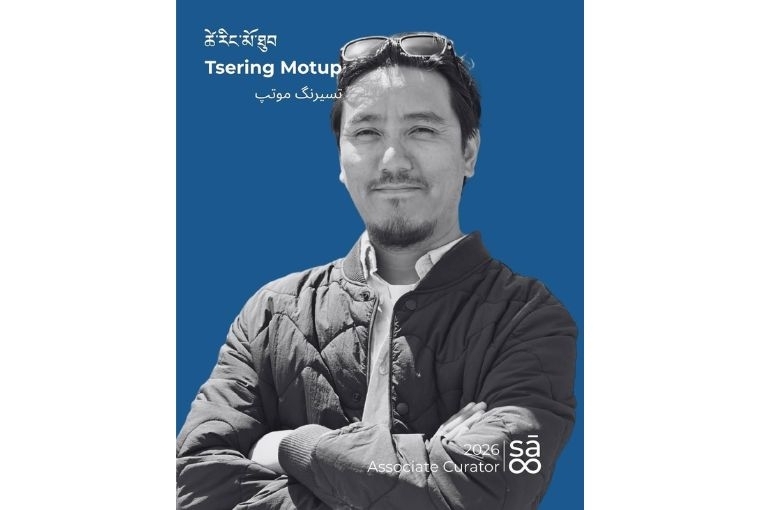
Now in its second edition and the first as a full-fledged biennale, sa spans eight sites and over 200 kilometres, bringing together twenty-six artists from Ladakh and around the world. Curated by Vishal K Dar, with Tsering Motup Siddho as Associate Curator, this year's theme, Signals from Another Star, unfolds through paintings, installations, research and sculpture. It is equally interested in conversations with local communities, exchanges of knowledge and the changing realities of a landscape so deeply shaped by its historical memory and climate.
In our conversation with Tsering, he told us how it all came together.
What was the vision behind this year’s Biennale?
Not as an institutional practice but more informal, more on the community level. This would be the first sa Biennale; it used to be [just] sa Ladakh before. They used to organise a land art exhibition at the Disco Valley Park. And then slowly over time, they started building friendships and networks around here. And that's how it started. So, my introduction to sa was quite later, when they decided that I could come in as an associate curator. My part here was my intervention into Ladakhi artists, as per the 70-30% ratio that they had for artists' participation, wherein we have two special projects between Leh and Kargil. And we also have six main sites: Bazgo, Likir, Nurla, Lamayuru, Mulbekh, Henasku, and finally the Hunderman of the Kargil region. Apart from that, we have the Old Town project, which is below and all the artists are selected based on their skills, and most of them also live around the old [Leh] town.
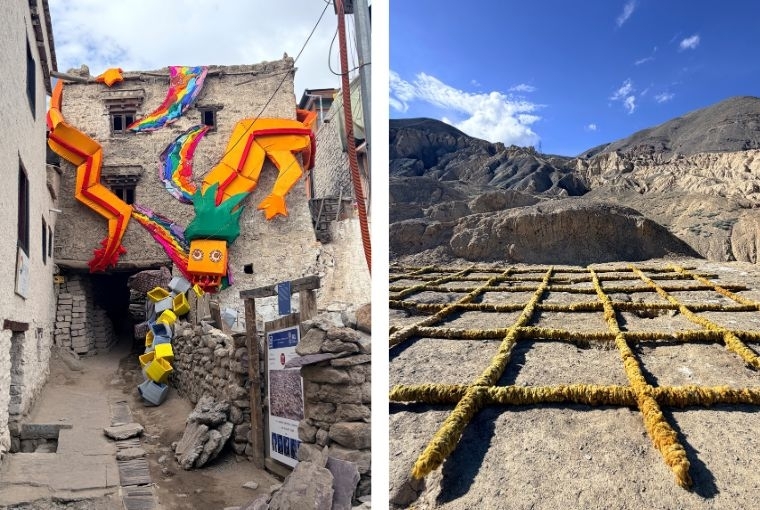
L: Za s Chu Thungse by Tashi Namgyal R: Ground Control by Studio Eidola
Regeneration and community are key ideas behind this edition. What does meaningful engagement with these ideas look like for this biennale?
Regeneration and community have been the founding principles of this year. An artwork that has been done in Lamayuru, for example, has a lot of community involvement, wherein the village people are also equally supportive in coming together. For instance, people wanted to do the roofs of the houses where they are living. Since 2010, we've seen a lot more rainfall in the region. And to be honest, Ladakhi roofs are very flat. It's not like the Kashmiri ones with the tinted roof. But it's a flat roof, because it's a trans-Himalayan region and rain doesn't fall here much. At the same time, there is less snowfall as compared to other parts of the region. So, roof making from sa’s end was sort of an exchange. For the people in the region, there is always this give-and-take idea. When they asked, how are we going to benefit from these things? We said our expertise is in making roofs for people. In Lamayuru, the houses that got their roof redone were done as a community where everybody participated. Thus, Regenerative is something I'm talking about in the context of a community: how we are not a foreigner who gives money and spoils the play for everyone, but this is something that we very mindfully thought about, as to how else we can give back to society. In that manner, there'll be more mindful tourism and exchanges that we want.
There is also a potter family in the region. International artist Shupi works with the liquid pottery guy and shares her knowledge with him. There is a girl in Likir who, after her graduation, has completely dedicated herself to doing agricultural practice in this harsh climate. She's really researching this agricultural practice, wherein a lot of people are moving away from the agricultural practices. Overall, there is no gap between the community and the artists, but it is co-working and co-learning.
How do the ideas of Memory and Ecology play into this year?
As an institution, sa’s main focus was initially land art. And now, that has also shifted its perception towards the fragile ecology and every aspect of the political scenario right now. And also how local artists are responding to these ideas. As for memory, most of the artists have had their academics outside of Ladakh; even me, as an artist, a lot of my work also talks about the idea of memory, longing and home. Now, how that ‘home’ is being explored after coming back, what sort of ideas are generating, how does one see their own hometown, and these conversations are also touching upon the recent political scenario that is shaping it.
The 26 exhibiting artists are a mix of Ladakhi and International artists. What kinds of conversations did you hope that mix would create?
We had the idea of exchange and co-learning between international artists as well as the local artists, directly or indirectly. Vishal and I had this idea of not putting them in conversation directly, but their works coexisting beside each other and how they carry that in their own work.
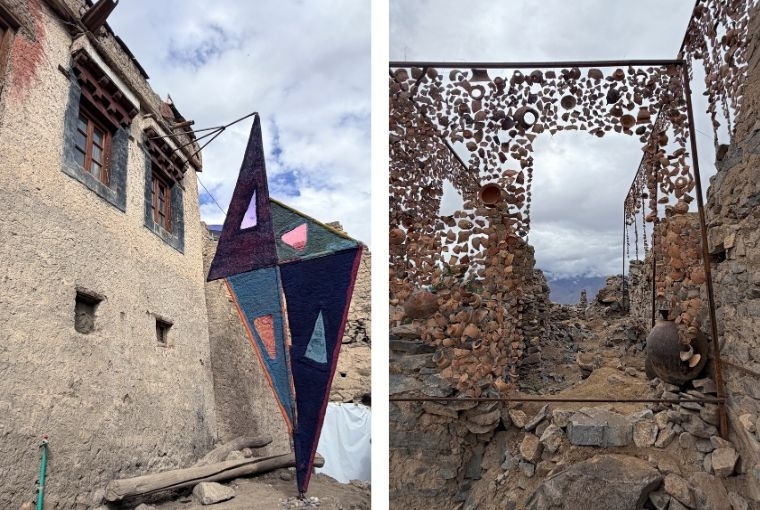
L: Ways of Protection by Arunima Dazess Wangchuk R: Kaktse sNam by Tundup Dorjey:
Are the artists working across mediums?
I'll segregate two parts. One is the Old Town project. That's a special project, which is supported by Munisha Ahmed, wherein we have five sites on the route of Old Town which is a historical walk. And in that path, all of these artists have responded either through installation or painting. So, in the Old Town, you will see more of this painterly work. But for the main sites it's specific. For Basgo, it's sculptural. Likhil has this whole vibe of traditional Ladakhi pottery. International artist Tundup is a potter, and he has his studio in his own village and is responding to the Ladakhi pottery. And then there is this one sculptor who's done a landscape sort of work at Nurla with slate stone. And then further on, there’s a six-flag project by Museum in Progress.
This is an excerpt from the August EZ. For more such stories, read the EZ here.
Words Nidhi Soni
Photography Dipti Anand Nakai
Date 6.8.2026