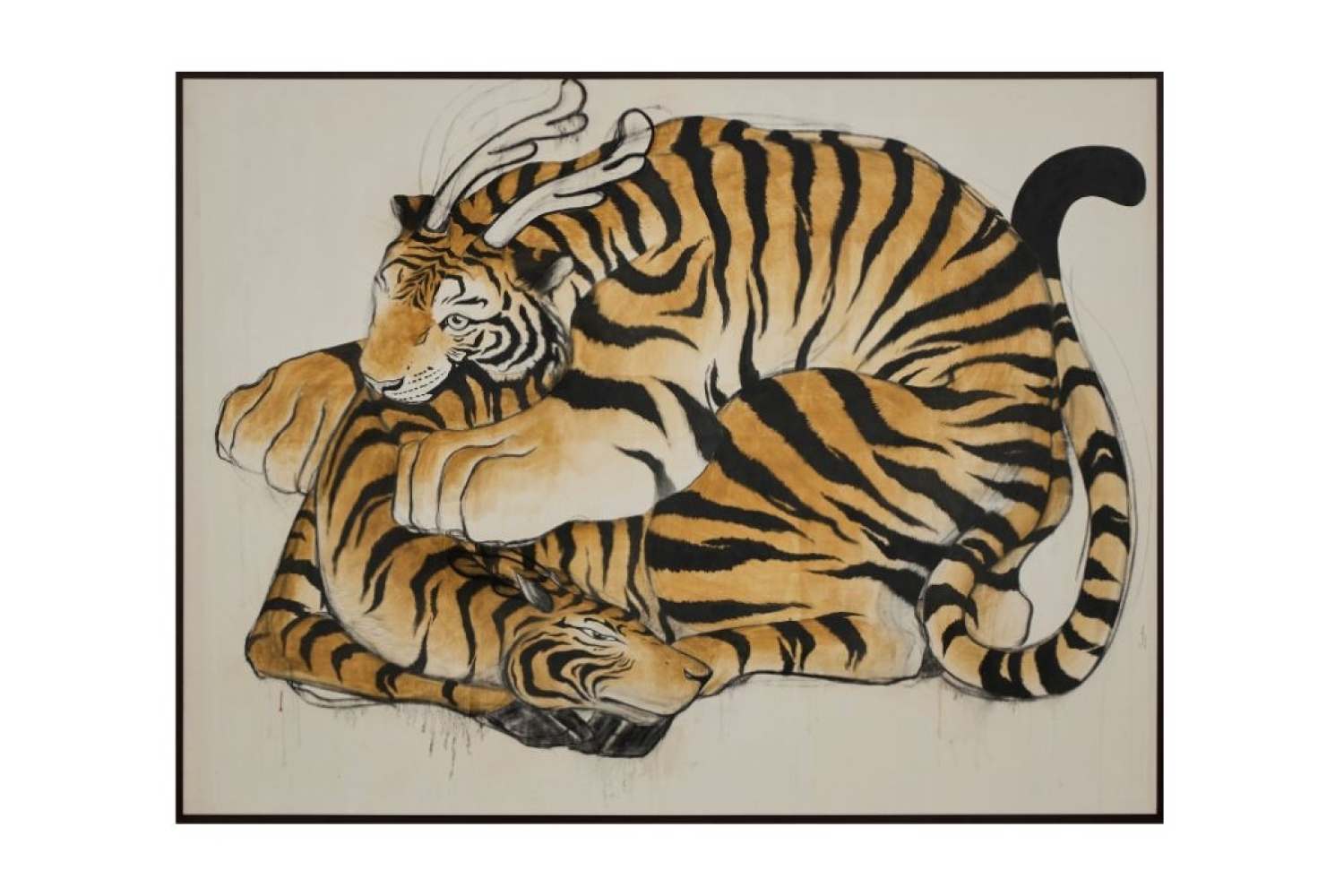
Dear Tiger 1D, 2026. 56 x 74 in, 142.2 x 188 cm. Saa-tchen on rhay-shing.
Dear Tiger 1D, 2026. 56 x 74 in, 142.2 x 188 cm. Saa-tchen on rhay-shing.
Between who we are and who we were made to be, there is a gap we spend most of our lives not looking at directly. The gap between instinct and choice. Zimbiri looks at it directly. Dear Tiger, her new solo exhibition at Nature Morte, Mumbai, is built around a cast of recurring figures. A tiger wears a deer's mask. A deer wears a tiger's. Predators borrow the faces of prey, and certainty is the first thing to disappear. They stand in a landscape painted in Bhutanese earth pigments ground from the same soil Zimbiri grew up in, the colours unpredictable and a little temperamental, the way memory tends to be. The masks for Zimbiri are not a disguise or a transformation but a third tender thing. Sometimes the adult is the deer and the child the tiger. The masks, she says, are about recognising how much of who you already are came from elsewhere, pressed into you by every force that left a mark before you knew you were being marked.
The background came first, built in close collaboration with Zeko, a traditional Bhutanese artist, then the deer arrived, and when a tiger cub appeared where a fawn should have been, she knew that it had always been a tiger. Tigers in Zimbiri's work have been her ‘faithful companion’ for years, appearing as strong motifs that carry all her questions in every canvas they inhabit. They appear trapped in maze-tails, divided into puzzle fragments or transformed into a boxed enclosure of their own ?esh, tracing the self through a constant interplay of inheritance, influence, and choice.
Could you give us an insight into the genesis of Dear Tiger? What was the first image, question, or feeling that led to this exhibition?
The genesis of Dear Tiger began with an image rather than a concept. I wanted to create a painting with a traditional Bhutanese-style background and worked closely with the traditional painter Zeko to bring that vision to life. Once the background was complete, the image of a deer and a tiger cub emerged. A baby deer didn't feel right; it felt as though the tiger cub had always belonged there. When my work begins as an image, I often have to spend time understanding what it is trying to tell me. Through that first painting, I realized I was exploring questions of inherited and inherent identity, and the many forces that shape who we become.
The deer and tiger are recurring symbols in my work. I am fascinated by the relationship between predator and prey and the tension it creates. At the same time, they represent a duality within ourselves; the potential to be both predator and prey depending on the situation; I see them as symbols of opposing yet interconnected aspects of ourselves. Like the animals in the paintings, we all contain the potential to be both predator and prey depending on the circumstances. What interests me is our ability to challenge our learnt reactions, and to instead choose how we respond to it. The exhibition became a way of reflecting on the space between instinct and choice, and on how identity is continually shaped through that negotiation.
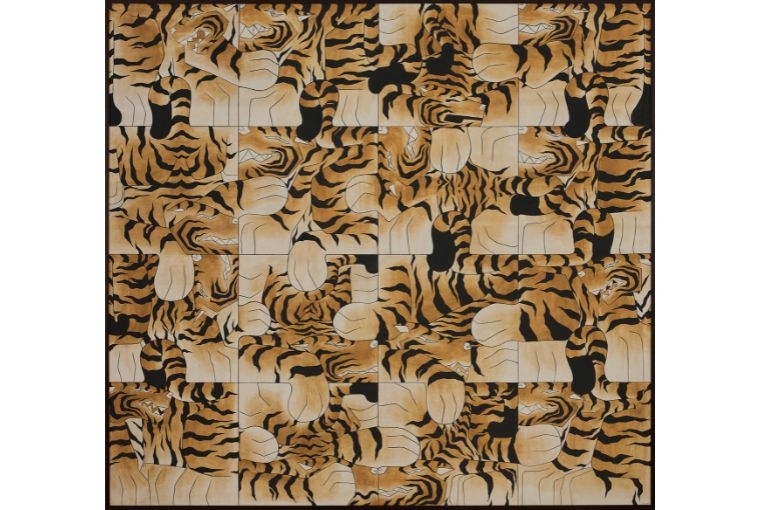
Puzzle 6B, 2026. 65 x 70 in, 165.1 x 177.8 cm. Saa-tchen on rhay-shing.
The exhibition revolves around questions of identity, inheritance, and influence. Why did these themes feel important for you to explore at this moment in your practice?
My work often begins with personal questions, and identity, inheritance, and influence are questions I continue to return to. I am fascinated by the process of becoming, how our sense of self is shaped by family, culture, relationships, experiences, and the stories we tell ourselves.
Identity can feel both deeply personal and surprisingly inherited. Much of who we are is formed long before we become aware of it. Through Dear Tiger, I wanted to explore that tension: where the self ends and influence begins. The exhibition became a way of examining the visible and invisible forces that shape us, while asking which aspects of our identity we choose to embrace, question, or redefine. I once read that “I am” are the two most powerful words because what follows them defines you. That idea resonates with me because so much of my practice is rooted in understanding what comes after those words and how that answer evolves throughout our lives.
The deer and tiger wear one another's masks throughout the exhibition. Why was the idea of exchanging identities important to explore?
While the masks may appear to suggest an exchange of identities, that wasn't my primary intention. I was more interested in exploring how identity is shaped through influence and how the people around us leave lasting impressions on who we become. Throughout the exhibition, the deer and tiger wear one another's masks as a way of reflecting the influences we inherit from family, community, culture, and relationships. Sometimes the adult is a deer and the child a tiger; other times the roles are reversed. This was important because influence is not always determined by strength, authority, or perceived power. The masks are not disguises but symbols of influence, belonging, and adaptation. They speak to how we absorb values, behaviours, and beliefs through observation and experience. While many of these influences begin in childhood, they do not end there. We continue to be shaped by the people we encounter throughout our lives, often carrying traces of those influences long after the moment has passed. The works are less about becoming someone else and more an invitation to reflect on the process of how we become who we are.
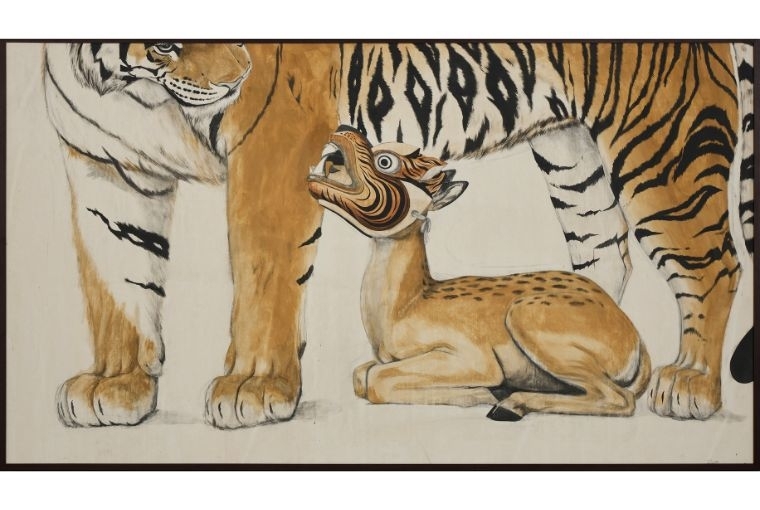
Dear Tiger 1B, 2026. 39.5 x 70 in, 100.3 x 177.8 cm. Saa-tchen on rhay-shing.
Do you see Dear Tiger as a continuation of Me: Internal Conversations, or as something new? Tell us about that.
I see Dear Tiger very much as a continuation of Me: Internal Conversations. In fact, I see all of my work as part of an ongoing dialogue. One question leads to another, one experience opens the door to the next, and sometimes a new body of work feels like an evolution of ideas that have been present for years. The Boxed Tiger explored the individual contemplating boundaries and limitations in isolation. In Limit, the focus began to shift from ‘I’ to ‘we,’ examining our relationship with others and the structures around us. The Puzzle series expanded this further, looking at how individuals fit within larger collective systems and communities. Dear Tiger continues that journey. While earlier works often focused on the self and our internal narratives, this exhibition asks how those narratives are formed in the first place. It explores identity not as something that exists independently, but as something shaped by inheritance, influence, relationships, and culture. I think of my practice as a river rather than a series of separate projects. The landscape changes, new tributaries appear, and the river may take unexpected turns, but it is still the same body of water moving forward. Each exhibition grows out of the one before it, carrying previous questions while making space for new ones.
The tiger has been one of your most enduring motifs. What keeps bringing you back to it? How has your relationship with this symbol evolved?
The tiger has remained a constant in my work because, for me, it symbolizes self-love, confidence, independence, and self-acceptance. I began painting tigers at a time in my life when I was trying to cultivate those qualities within myself. In many ways, they started as reminders, aspirations embodied in a form that I could continually return to. Over time, the tiger became less of a subject and more of a language. While the tiger represents self-love in my work, each painting tells a different story. Whether I am exploring personal narratives, social structures, identity, belonging, or the stories we tell ourselves, those ideas often arrive in the form of a tiger. The maze-tail works, the boxed tigers, the puzzle pieces each emerged from a different question, but they were all expressed through the same visual vocabulary. I don't really think of my relationship with the tiger as something that has evolved or changed dramatically. It feels more like a practice. Self-love is not something you learn once and move beyond; it is something that must be continually revisited and renewed. In that sense, the tiger is less like a destination and more like a compass, something I return to again and again as a way of navigating both my work and my life.
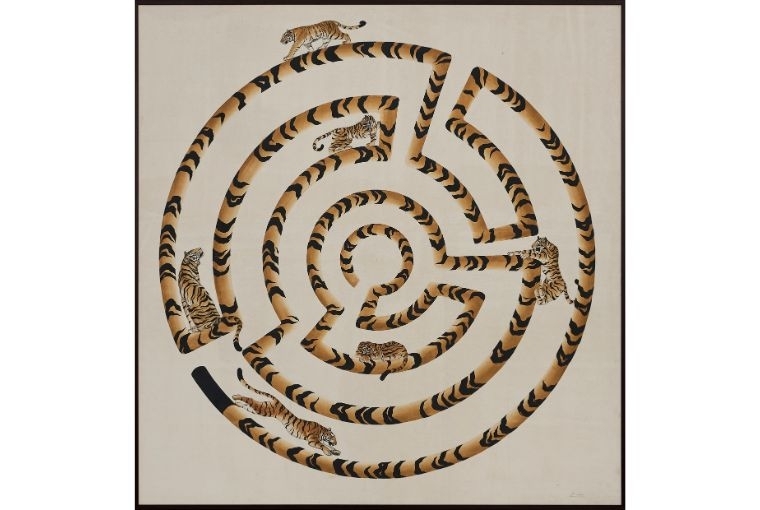
Maze 6B, 2026. 60 x 62 in, 152.4 x 157.5 cm. Saa-tchen on rhay-shing.
Traditional Bhutanese materials remain central to your practice. How do you carry Bhutan with you when you're making art?
For me, Bhutan is not something I consciously try to bring into the work; it is simply part of who I am. My experiences, perspectives, and way of seeing the world have all been shaped by growing up in Bhutan, so those influences naturally find their way into the paintings. I paint what I know, think, and feel, and Bhutan is inevitably woven into that.
The materials, however, are a very conscious choice. Over the years, Bhutanese earth pigments and traditional canvases have become dear companions in my practice. They are temperamental, unpredictable, and often challenging to work with, but that difficulty has given them an almost living presence for me.
More importantly, using these materials is my tribute to the generations of Bhutanese master artists who came before me. They created extraordinary works of art, many of which remain unsigned. In today's art world, where the artist's name can sometimes carry as much weight as the work itself, I find something deeply moving about that anonymity. Their legacy exists not through signatures but through the beauty, skill, and devotion embedded in their work. In many ways, my use of traditional materials is an homage to those artists. It is a small acknowledgement that my practice exists because of the foundation they helped create.
What do you hope audiences take away from Dear Tiger?
More than anything, I hope the exhibition encourages reflection. Dear Tiger is not trying to provide answers or tell people who they should be. Instead, it asks questions about identity, influence, inheritance, and the stories that shape our understanding of ourselves. I hope viewers leave with a greater awareness of the forces that have contributed to who they are whether those influences come from family, culture, community, relationships, or personal experience. Many of these influences operate quietly in the background, and simply becoming aware of them can be powerful. For me, awareness creates choice. Once we recognize the stories, beliefs, and patterns we have inherited, we can engage with them more consciously. We may choose to embrace them, challenge them, or redefine our relationship to them, but the important thing is recognizing that the choice exists. If Dear Tiger leaves viewers with anything, I hope it is a sense of curiosity about themselves and the understanding that identity is not something fixed, but something we continually participate in shaping.
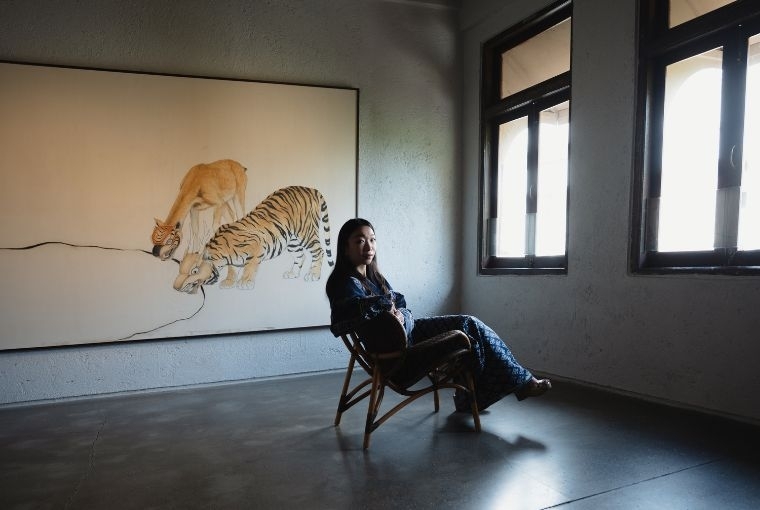
Images courtesy of the artist & Nature Morte, photographed by Akik Rahman.
Lastly, what’s next for you?
I've been asked this question a few times, and I think my answer will always be the same: I'm not sure. My practice is driven more by questions than answers, so what comes next will likely be more explorations, contemplations, realizations, and hopefully a few ‘aha’ moments along the way. Each body of work tends to emerge from the one before it, so I'm usually just following the thread of whatever question has captured my attention at the time.
For now, those questions are often expressed in the language of tigers. But who knows? One day they may arrive in an entirely different form. The tiger has been a faithful companion, but I try not to decide where the work should go before it gets there. Maybe I'll end up painting ducks.
Dear Tiger is open till Saturday, July 18th, 2026. Images courtesy of the artist & Nature Morte.
Words Nidhi Soni
Date 18.6.2026