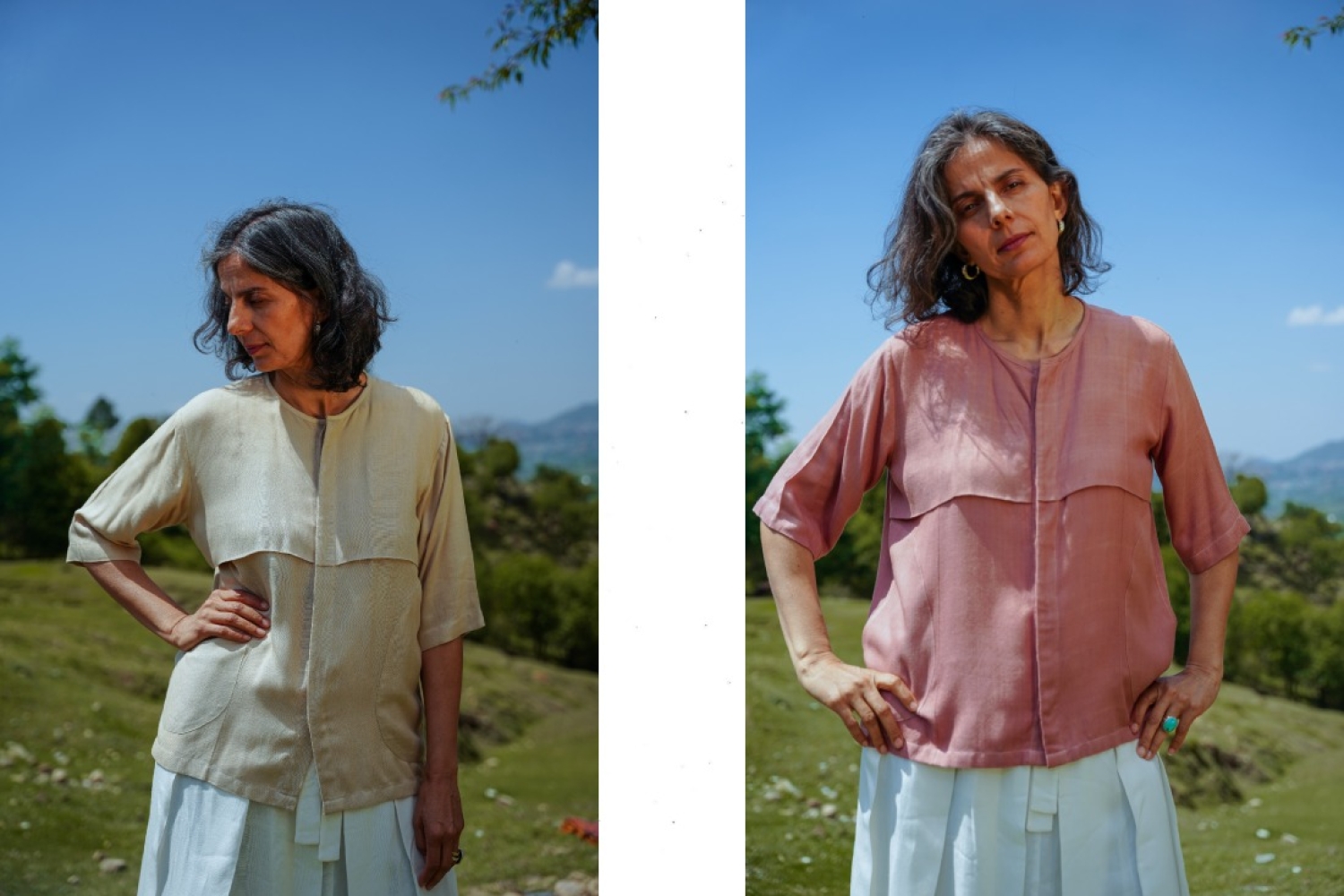
For co-founders Mahima Bargali and Himanshi, their label WhakatÅ came to them at a point when they had almost lost hope in the fashion industry. They were ready to shut shop and move away from it completely, yet held on in order to push for some significant change in how things function. They wished to create simpler solutions for complex issues and present them in a manner that urged everyone to take some action.
Their latest drop makes use of lotus silk that employs a lesser amount of water unlike cotton since the stems are loaded with moisture of their own post harvest. Traditionally made for the head Buddhist monks, the fibers are extracted from the stems of lotus in Myanmar. Subsequently, their fabric is woven on handlooms in Kullu, Himachal Pradesh, and the garments are designed and manufactured in the Himalayan foothills of Dharamshala. The label’s commitment to sustainability is also reflected in how they only design clothes that not only safely biodegrade but can also be recycled at the end of their shelf life. We’re in conversation with Mahima and Himanshi as they let us in on their process and more.
What were some of your initial thoughts for Whakato?
The more we learned about what real environmental sustainability meant for fashion businesses, the more we realised we didn't know. Over time, we came to understand that it would not be enough to use organic cotton in a t-shirt if that t-shirt was dyed with high-impact chemicals, sewn together with polyester thread, and finished with nylon labels and conventional cotton trims. There is something to be said for certain inputs like fabric being more environmentally friendly than the conventional approach, but if at the end of the garment’s life, it goes to a landfill anyway, then only part of the job is done.
To help us figure this out, we developed life cycle assessments for every garment and its components before they were even created to ensure the overall environmental and social impact was indeed better than the conventional alternative. The life cycle assessment takes into consideration regenerative fibers, chemical usage, carbon emissions, water usage, and human impact. It looks not just at how the garment came to be, but how it is worn and cared for as well as its end of life. It might mean sacrifices for us on the design end from time to time. For example, we haven't been able to find a zipper that can easily be removed for recycling or biodegraded safely. That means, for the time being, we don't use zippers in any of our designs! We've seen so much secrecy in the industry, we want to dip both our feet in TMI. With that thought, we know we need to see the trials and tribulations of running an honest and transparent brand firsthand.
What does your work in progress look like?
Whakato workspace changes like the days of the week. Working-with-waste days have us somewhere between “shambles' ' and “catastrophe”. Design and Research days are clean as fresh air. But mostly our workspace is our happy place with lots of morning light. It’s where we can be ourselves and be surrounded by the things we love. It's a repository for every doodle, every design, every test fit, and every waste fabric scrap we've ever had. Luckily, we're all morning people. So we're all at the studio early. To-do lists are made and partially followed. Mahima and I quickly go through emails and then we're with our pattern master and tailor. This is where we go through designs, decisions, and disagreements. The rest of the day is fluid — a mix of travel, follow-ups, client meetings, research, and buyer background checks. We make sure we end the day with some physical activity (some sport, exercise, dance) to keep our minds fresh for the next day.
As a designer, I previously thought design ideas should be primarily influenced by visual cues in order to be legitimate, and I think that was drummed in during design school. I’ve recently let go of that because it never felt right when I tried to force it. I can accept that it’s not laziness, it’s just my way. And I’m glad I can finally articulate it. The muse mostly is nature and the way it works. In terms of work, sometimes it takes the shape of a garment, sometimes it's a system for circularity that fires up hope, sometimes it's a cleanse to make way for something later.
Tell us more about your current collection?
Our first collection is made from Lotus silk. Fibers of lotus stem can be used to produce a fabric with the flawless virtues of silk and linen. Grown in the wetlands of Myanmar and Cambodia, one of the eco-friendly elements that come into play in terms of manufacturing is that the fibers are extracted and spun manually. It is almost mesmerising to watch the whole process. Women of Myanmar gather the stems in the mornings of harvest and remove the nubbly prickets with a coconut husk. A shallow knife cut is made around a cluster of five to six stems, which are quickly snapped off and twisted to reveal twenty to thirty fine white filaments, drawn and rolled into a single thread, and coiled onto the plate. Another cut is made at a three-inch distance and the process repeats. The fibers are then rubbed with rice and wax paste and left to dry. And if you are still with me, all of this is done within twenty-four to forty-eight hours of the harvest because otherwise the stems lose out on their natural moisture and start to break. And we thought our job was tough. With that thought, every time, we take these fibers from Myanmar to Himachal Pradesh, India, and experiment with yarn twists, handloom weaves, vegetable dyes, natural trims, and our love for the craft.
What do you think is lacking in Indian fashion right now?
The fashion industry is a major contributor to global air and water pollution, atrocious wastage, and animal and human exploitation — and that’s just the tip of the unethical iceberg. Fashion is kind of all about the idea of perpetual re-invention and newness, which is why it's such a lucrative industry. Fast fashion has accelerated the speed of this cycle, which has resulted in more clothing waste, problems with the second-hand market in developing nations, an almost uncanny discount culture, and numerous other things. It's out of control, to be honest.
On top of that, with the growing awareness of environmental and social issues, sustainability has become a key trend in the fashion industry. Now, I'm willing to bet you have come across thousands of brands claiming that. Green Fashion, Sustainable, Eco friendly. Buzzwords like these are thrown around like confetti these days. The fashion industry operates on a linear model of "take, make, waste". Circular design is a method of design that from inception to death, phases out harmful materials and all wastage in a continuing cycle. The idea that the way we create and consume is fundamentally flawed and that there is a better way is exactly why Whakato exists. We will not create any product that doesn't have a clear birth, life, and afterlife trajectory.
Most brands have a very close working relationship with their layer one teams (the Cut, Make, Trim part of what we do — the “made in”). However, the layer two team members (the makers of our fabrics) are often hidden under blankets of agents and wholesalers. And getting through to them is not an easy step. This means that learning more about the people and procedures involved in creating the fabrics we value so highly in our design process necessitates a little more digging and constant follow-up. For us, it's probably the most difficult part of the design development process, but it's also the most rewarding when we get it right. We believe in explaining clearly what/how/why we do to everyone involved in the process.
I've consistently found the fashion industry's production cycle to be convoluted and demanding. Autumn/Winter and Spring/Summer. For good measure, add a Pre-Fall or Resort collection. With the launch of Whakato, we didn't want to carry on these traditions without question. In fact, we decided to turn all of it on its head, beginning with just six products. Simple wardrobe essentials like comfortable shirts, multi-purpose scarves, and breathable dresses. That was over two years ago and we now have a full range of items that still subscribe to our original mantra. Wardrobe essentials that never go out of style. Pieces that can fit into your current wardrobe or entirely re-invent it. Clothes that are comfortable to wear, live in and feel amazing on your skin. Garments that are made like they should be, of high quality material combinations that make them exemplary candidates for an ecocentric economy.
Finally, what's coming up next?
We're launching some new (and old) fabrics after years of constant research, new surfaces, new designs, and the same old ideologies.
Words Unnati Saini
Date 29-06-2023