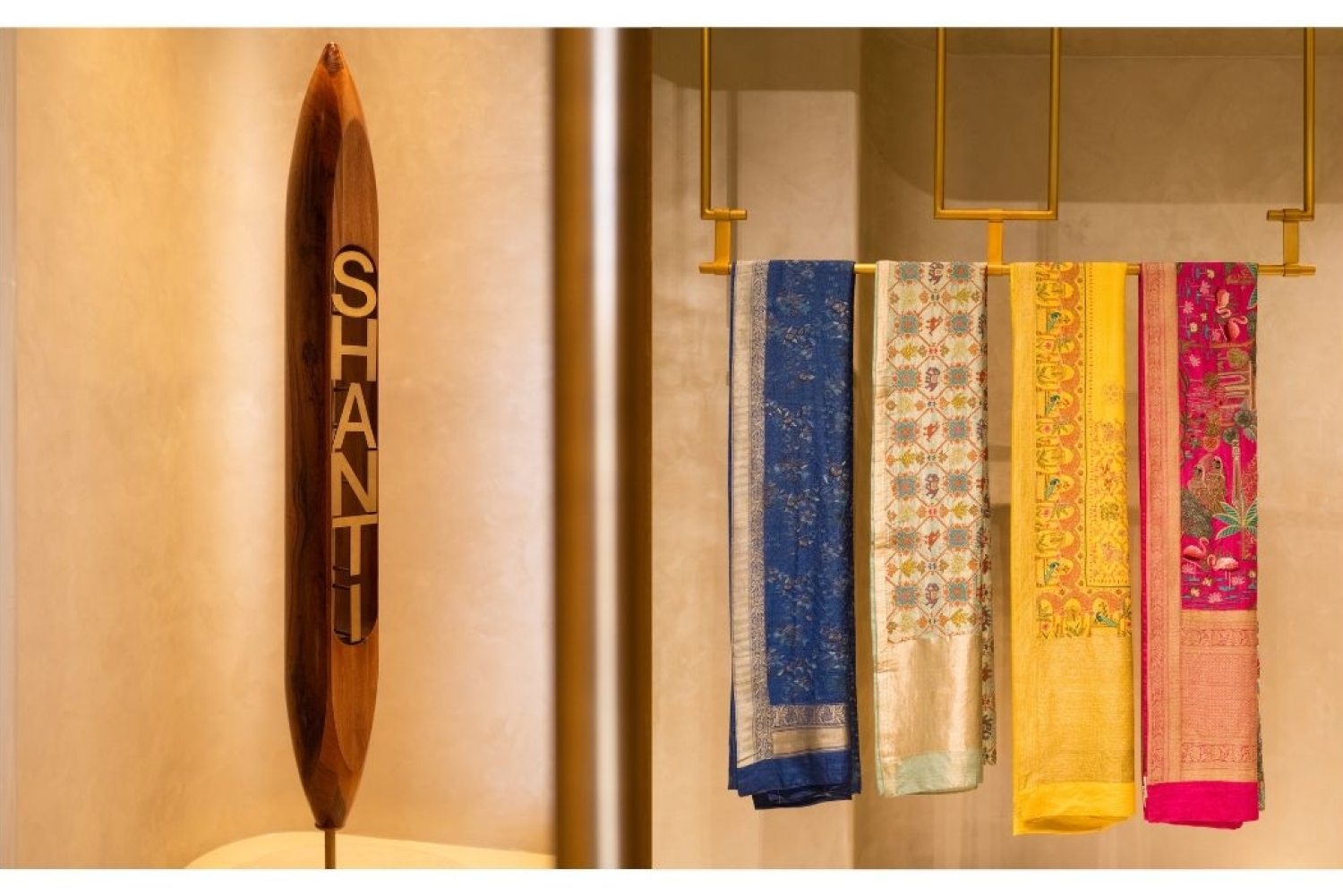
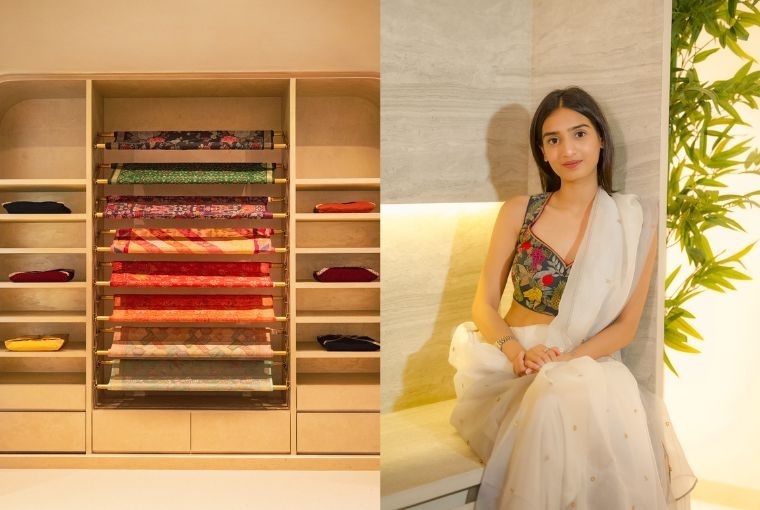
Khushi Shah of Shanti Banaras spoke to us about their brand new store in Delhi's Mehrauli neighbourhood, a space that channels the chaotic beauty of Banaras into a refined retail space. Five years after their first foray into the area, the label transforms tradition into something immersive with their new space. They have lots in store for their opening tonight, from aerial performances and unconventional music to sculptural chandeliers. They have put in a lot of attention to detail, which reflects Shanti's commitment to sustainability, weaver communities, and innovative design.
What inspired you to move Shanti Banaras to a new space and what made Mehrauli the ideal spot?
When we first opened in Mehrauli about five years ago, we were looking for a space in Delhi that felt truly traditional and historic. Just as Banares is seen as one of the oldest cities in the world, Mehrauli, with Qutub Minar, is among the oldest developed areas in Delhi. That history drew us in, and the space came together very naturally. Since we were already based in Mehrauli then, we didn’t want to leave the neighbourhood. We knew the people, our clients, and the local culture. Mehrauli also has a strong sense of craftsmanship, like the intricate work you see at Qutub Minar, which resonates deeply with us. We’ve even created a short podcast to be released after the launch, about why Shanti is in Mehrauli. It explores our connection to Qutub Minar and looks more closely at the monument’s craftsmanship. For us, Mehrauli is one of the most relevant areas in Delhi today. The blend of craft, the presence of exceptional designers, and the creative energy of the neighbourhood make it a natural fit for us.
Banares is a vibrant, high-energy city, there’s chaos in the streets, but also an incredible culture and craft scene. How did we translate that into the store?
We started working on this about three months ago, when we were planning the store launch. Our approach is always to do something different, whether it’s in our shoots or our spaces, so this time we chose to go back to our roots and think deeply about Banares itself. I spoke to several visitors, people coming to see the Kashi Vishwanath temple or to buy saris, to understand what the city made them feel. Their answers varied, but one idea kept returning: Banares is chaotic, yet beautiful. The sound of the looms, the busy streets, the narrow gullies, there’s a layered, sensory chaos you can only truly grasp once you’ve been there. Our work mirrors that. Before a sari comes alive, it moves through many stages and units in Benares. There’s a complex process behind every single piece. With the store, I wanted to move away from the traditional way Banarasi saris are shown, on gaddas, with customers seated on the floor while saris are opened one by one. When we opened our first retail format five or six years ago, people suggested modern versions of that setup, but it felt overused. I wanted to completely break from it. This new store is a shift in how we present Banarasi textiles. The city may feel chaotic, but what it produces is refined and streamlined, and that’s what the store reflects. The space is organized, symmetrical, and very clear, so you don’t feel overwhelmed or lost. It’s almost like a carefully planned maze: if you want to see suits, there’s a dedicated section for suits, with no visual noise. Our connection to Benares comes through in the details. One example is a chandelier inspired by the weaving punch cards, the 'bobby' cards used on looms. We’ve reinterpreted those cards in metal to create sculptural chandeliers. There are many such subtle touches throughout the space.
Shanti Banaras is known for experimenting with innovative techniques in traditional textiles. Have you explored any new approaches recently?
In terms of techniques, we work with just a handful that we keep revisiting and experimenting with, but where we really try to do something different each time is in our designs, as we always want to give every collection its own unique touch. If you look at our past work, we’ve done the Chau collection and the Roar collection, which focused on animals and served as our contemporary take on the Shikarga concept, where we created bold faces, used many metallic elements, and drew inspiration from details like tiger stripes to turn them into beautiful saris, and that is the kind of experimentation we enjoy. The way we actually make the sari mostly stays the same, whether it is a Kadwa, a Rangkat, or a Tanchoi, so the basic format does not change, but our interpretation of it always does. For example, another collection we did was The Line, a modern and more geometric collection in which the entire concept was built around clean lines and structured forms. We are currently working on a new collection, though it is still too early to share details, but you can always expect something fresh from us while we remain rooted in our traditional methods and forms of sari weaving.
I would say that for us, because we work with hundreds of weavers, this is not a recent shift. It is deeply ingrained in our family and in Shanti’s culture. We have been in this business for about 18 years, and it has been passed down through generations. The business began with our forefathers as a manufacturing setup and continues to run successfully today. We have a community of weavers who have worked with us and stayed with us through every stage, including COVID. At that time there was a lot of concern that weavers were not being paid and that things were extremely difficult, but our community has remained very strong. The people we work with have stood by us, and we have stood by them. I feel that the only way to truly support craft is to show it on different platforms, create a real need for it, and present it in a way that makes people want to buy it. Only then can we really bridge the gap for weavers. We are doing our best to promote Banarasi weaves and to do everything we can. When our community and customers understand how much work goes into each piece, they value it more, they buy it, and that keeps the cycle going. It is circular: if you like it, you buy it, and by doing that you directly support the weaver. Our weavers work with us almost around the clock, and we work closely with them. It is a constant, ongoing relationship.
There’s a lot of talk about sustainability in fashion, but how challenging is it to be truly sustainable?
I do not think it is challenging at all, because the foundation of our business is, I would say, sustainability. A Banarasi saree is entirely handwoven. Of course, now power looms and other machinery have taken over in many places, but we consciously refrain from engaging with that. In our business, we have remained largely sustainable, making everything by hand on looms and trying to use sustainable fabrics like khadi and silk, which are more responsible ways of producing sarees. I get this question a lot, but sustainability is so ingrained in what we do that we are not really trying to move into heavy machinery or mass mechanization. Our initial practices, the basic framework of our business, have always been sustainable. Over the years, of course, you deal with a lot of waste material and various challenges, and I feel we are now learning how to tackle those better.
Very interestingly, we did a small collaboration with Kartik Research. He reached out to us for our Banarasi scraps and then turned them into brocade suit sets, jackets, and so on. That is a kind of sustainable loop, where you reuse fabric in a more thoughtful way. I think there are many designers doing similar things, which I find very inspiring. We also try to use our leftover materials to create new products that people can buy or that we can gift, but always something with a real purpose. So for us, sustainability is an everyday practice. We are constantly and consciously trying to see how we can handle things better. As I said, the groundwork and the core of our business have always been sustainability.
Words Hansika Lohani
Date 10.4.2026