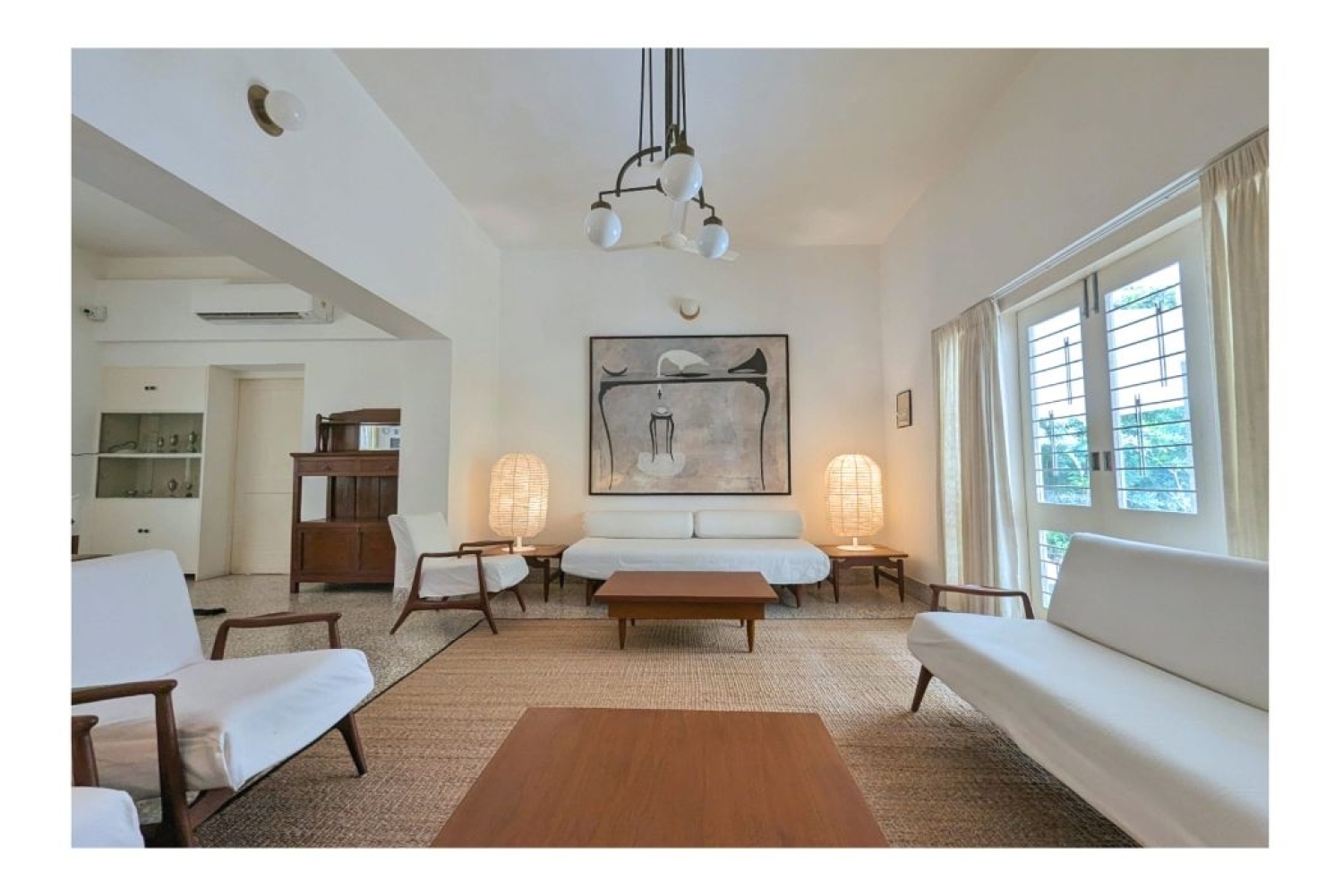
Until I encountered Fouzdar House, I had not realised how closely I had been holding myself together. Having been holed up in freezing Delhi for the past few weeks, I was really looking forward to a gentle Ahmedabad sun. It was very early in the morning, and my eyes were squinting because of the light as I entered the compound. The house seemed to inhale and exhale in slow, calm beats. I already knew that the villa had been restored by the architect Kunal Shah, but I had not imagined it to be so intimate, to him, or to myself, by the end of my trip. I was lucky enough to speak to him about the ethos of his work as I stayed there, as a result of which every explanation aligned with the energy of the house and the city.
The house is located in the peaceful neighbourhood of Navrangpura, surrounded by high-rises, making the art-deco style even more tender. It once belonged to Fouzdar kaka, a police inspector turned private detective, who bought it in 1971. His grandson later asked Kunal, a close friend, to restore it. Kunal informed me that he was attracted to the project as it incorporated all the factors he was interested in; modernist architecture, austerity, simplicity, local materials, an open and sincere approach to design. The house, he said, had good bones and his objective was to squeeze the greatest out of it by changing as little as possible. And by that, I knew exactly what he meant. The home does not entertain you. It just is, and that’s enough.
All of these principles also closely coincide with Lux Unlock's spirit. They specialise in locating these hidden gems, building trust in the owners of these inspired homes, and selectively offering them to niche travellers who appreciate antiquity, art, design and great service. All of their homes pay tribute to sustainability, preservation, heritage and design. Their larger mandate is to develop underserved tourism in attractive destinations across India through the low-impact homestay and villa model to scaffold their local economies in a sustainable way, bring social change through experiential tourism and do it in an environment-friendly manner.
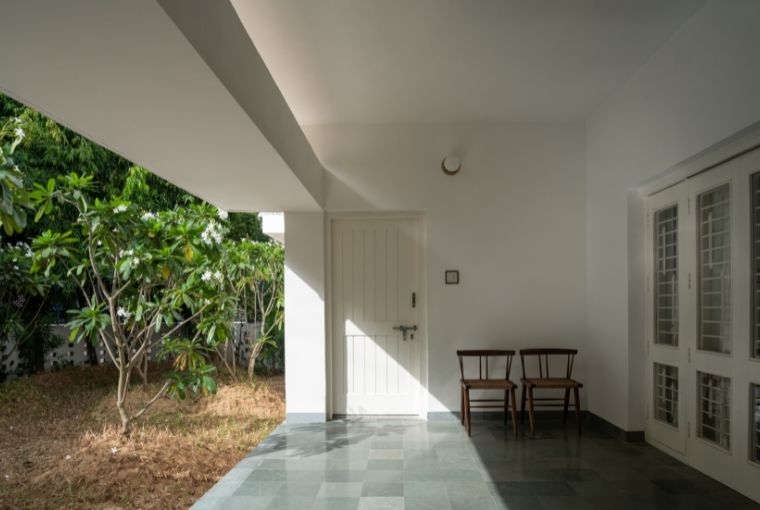
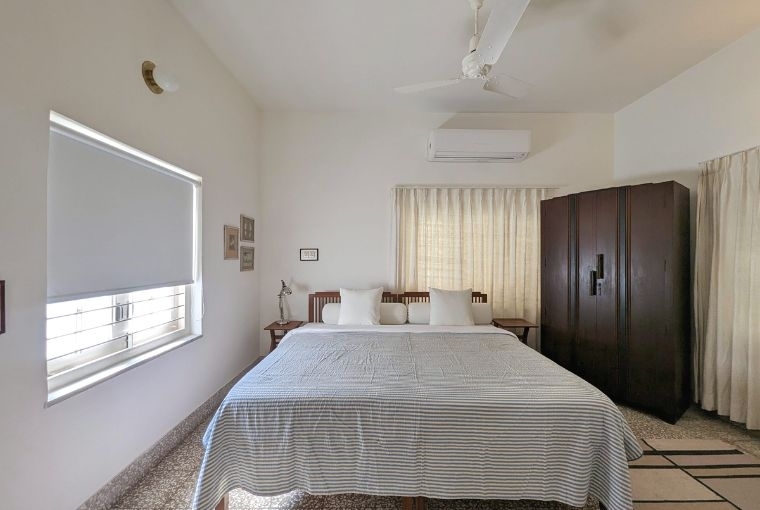
The villa makes you feel like it is telling you to slow down without uttering a word. Everything in the house is consciously crafted or refurbished: French windows, art deco grills, wooden cabinets with vintage fittings, mid-century armchairs that are built to sit cross-legged. Even the furniture that was presented by Kunal has a lineage. The chairs and the desks are based on the philosophy of letting the wood speak, developed by Nakashima, which is closely related to the history of the design of Ahmedabad. On that initial morning I wandered to and fro in the rooms, sat on the swings and leaned against hand made palangs, allowing the sun to touch my skin.
As I was sitting there in the verandah, I remembered what Kunal had told me about minimalism. When I mentioned the term to him he chuckled, nearly irritated at the loose way in which it is used by people. Minimalism, he said to me, is not just beige walls. “It is a way of thinking. It is having the knowledge of the precise amount of salt to add in a dish.” I understood then, why this house was so balanced. Nothing felt lacking. It was that perfect place that he referred to, the place of ‘optimalism’, which was the term he preferred, not minimalism.
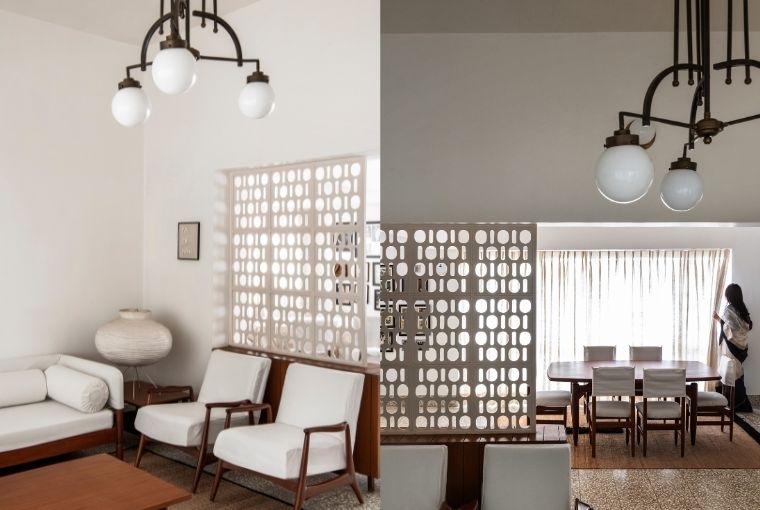
R: Photo Credits Suryan and Dang
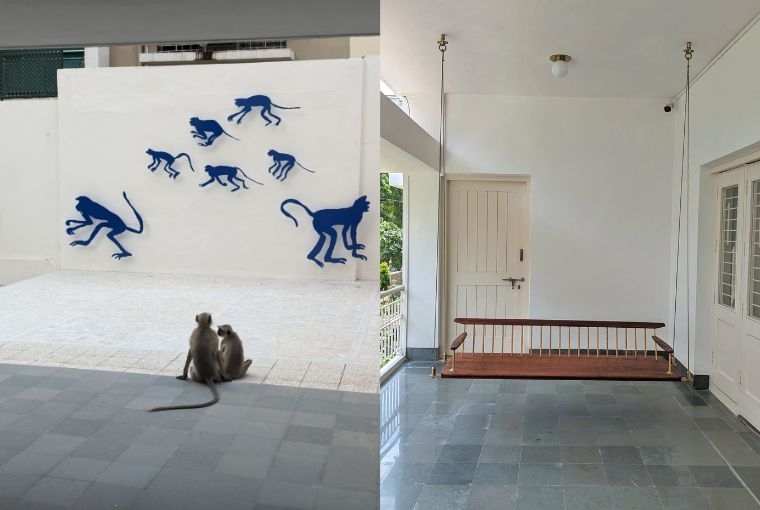
There is a prominence of the colour white because of which the house seemed, at first, nearly sacred to me, such that I had to walk silently, and speak in whispers. Then, I walked into the courtyard and there they were— bright blue monkeys who danced about the wall. I had seen images of these langurs even before I had arrived, but it was different to see them in person. They were mischievous, nearly alive, as though they were waiting till you relaxed your shoulders.
These were crafted by senior artist Amit Ambalal, whose monkeys have become as much a part of him as horses are of Husain, Kunal explained. He further elaborated on this decision, and shared how the villa would’ve been too serious without a jolt of happiness, and he did not wish to design a home that lacked joy, and was too self-conscious. According to Hindu philosophy, pleasure is just as godly an emotion as any other. So, he infused whimsy—like mithai to a thali. And hence, the house accommodated playfulness and did not bother its peaceful state by any means. The swing or Hichko, an aspect of the house that every Gujarati cherishes, is designed by Manish Jangid to be reversible, for quiet afternoon downtime. The swing is reversible so that one can face the monkeys or the garden, choosing to flip between two moods the way Gujaratis have been doing for generations. Kunal explained that old Gujarati swings were always reversible so the same piece of furniture could adapt to conversation, contemplation, or even a lazy afternoon nap.
The same evening I decided to take a short auto ride to Amdavad ni Gufa. It was the perfect introduction to Ahmedabad as a city—designed by the legendary BV Doshi, and featuring art by maestro MF Husain himself, the structure is underground, featuring interconnected dome-shaped or cellular forms supported by irregular, tree-like columns, inspired by natural cave systems and ancient Indian caves. There are no straight walls inside the gallery, creating a continuous space for art. The walls and ceilings are adorned with M.F. Husain's signature spontaneous, sketch-like figures and cutout drawings, blurring the lines between the building and the art it houses. The city allows for experimentation without a certain layer for pretension. I came back and rested in the Fouzdar Bedroom of the house, which was my home for the next two days. That night, I slept more peacefully than I have in months.
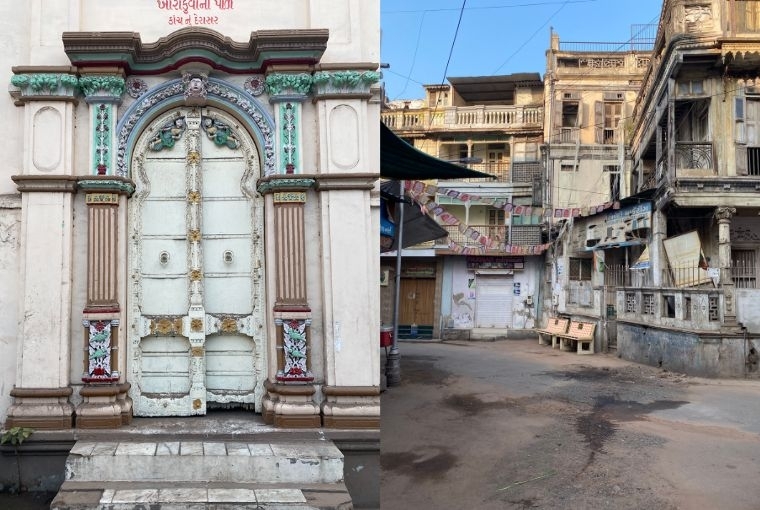
Given that I had a restful first day, the following day started bright and early, at 7AM. I ventured out on a heritage walk through old Ahmedabad. We started with the Swaminarayan Temple, built during the 19th century in Kalupur, and passed through the Calico Dome, a historic, unique structure that served as a showroom for Calico Mills, Doshivada ni Pol, known for its exquisite traditional wooden architecture and its long-standing association with the local goldsmith and Jain communities, and Fernandez Bridge, a historic British-era bridge best known for the extensive Chopda Bazaar book market located beneath it, among so many other locations of historical relevance. The walk ended at Jama Masjid, a stunning example of Indo-Islamic architecture. I stood in its courtyard thinking about Kunal’s desire to preserve small, human details in Fouzdar House — locally sourced tiles instead of large stone slabs, materials from in and around Gujarat instead of imported ones — decisions that protect tradition as well as the bodies of workers who build these spaces. And standing in a centuries-old mosque built by human hands, that sentiment felt especially true.
I kept going back to the title of the heritage walk, ’Mandir to Masjid’ — the emphasis on starting the walk at a temple and ending it at a mosque is a beautiful ode to the rich diversity of the city, and the unique ways in which each community contributes to keeping its eco-system running.
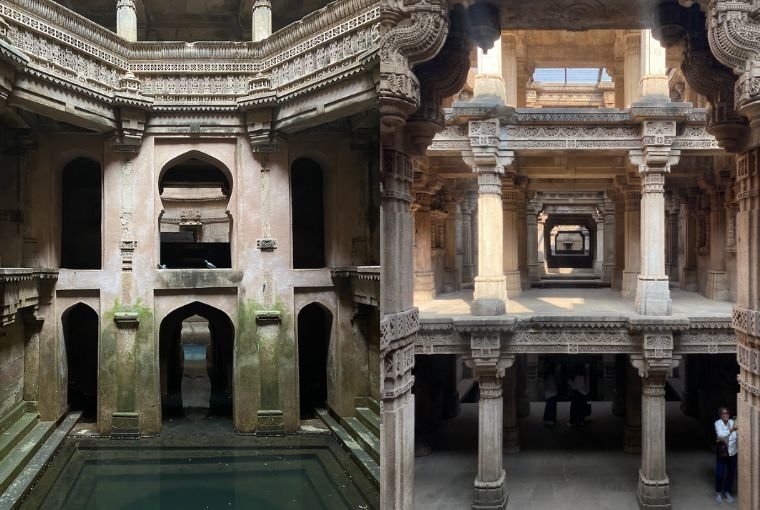
After this, I head on over to the part of my day that I was most excited for—the Adalaj Stepwell, a five-story structure built with sandstone, designed with an octagonal opening at the top that allows light and air to enter. The first time I was introduced to this structure was through Mani Ratnam’s Ok Kanmani, a cult-classic that depicts Ahmedabad briefly, but with a lot of love. Groups of people poured in, trying to find the perfect spot for a photo, one that captures the majesticity of the well. What I found most interesting is that the design ensures that direct sunlight touches the steps only for a brief period at noon, keeping the interior temperature several degrees cooler than the outside, offering a natural respite from the heat.
Next on the agenda was the Calico Textile Museum, a world renowned museum, established in 1949. It showcases India's rich textile heritage with a vast collection of rare fabrics, royal costumes, and artifacts. Located inside a lush campus with plenty of peacocks fluttering about and a canopy of trees providing ample shade, I observed some of the finest and most comprehensive collections of historical Indian textiles, including rare fabrics, royal Mughal costumes, Kashmiri shawls, and regional embroideries, preserved with utmost precision. Ahmedabad has always had this dual pulse: the romanticism of art and the pragmatism of commerce. Kunal said the city balances the two like no other, and after spending a day walking through it, I believed him.
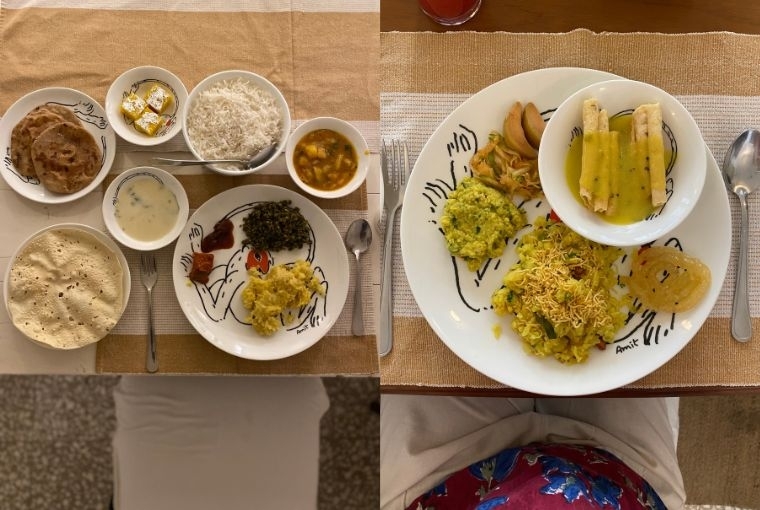
One of the most intimate ways to get to know a city is through its food, and the kitchen staff of Fouzdar House did not disappoint. For breakfast, lunch and dinner, the table filled up with mouth-watering Gujarati cuisine—bhakri, chawali, thepla, fafda, jalebi, hadua, makke ka roti, besan chilla, kadi, khichdi, and little squares of kopra pak that tasted like somebody’s family recipe. None of it felt flashy, and all of it came served on gorgeous ceramics designed by Ambalal, monkeys circling the rims in a way that made the meal feel playful and intimate.
After a long day, I was back at Fouzdar House, and my assessment of it was a little different. The restoration suddenly came into sharper focus: Khadi curtains filtering golden light, paper lamps with materials sourced from the Gandhi ashram, Godrej almirahs and handmade staircase railing — everything held hands with the city’s history. If you’re looking for a getaway from bustling cities and unending deadlines for the holiday season, spend a few days at LuxUnlock’s Fouzdar House, and you will keep going back for more.
To explore LuxUnlock's Fouzdar House, click here.
Words Neeraja Srinivasan
Date 9-12-2025