‘It is not down on any map; true places never are.’ ? Herman Melville, Moby-Dick
The first time I read Siddharth Dasgupta’s travelling poems was on a pristine, golden day, the sun glistening off the peaks of Kalatop, where the lyrical Lootera was shot. I remember being seated in the sprawling grass at the Forest Rest House, and being adrift across continents at the same time.
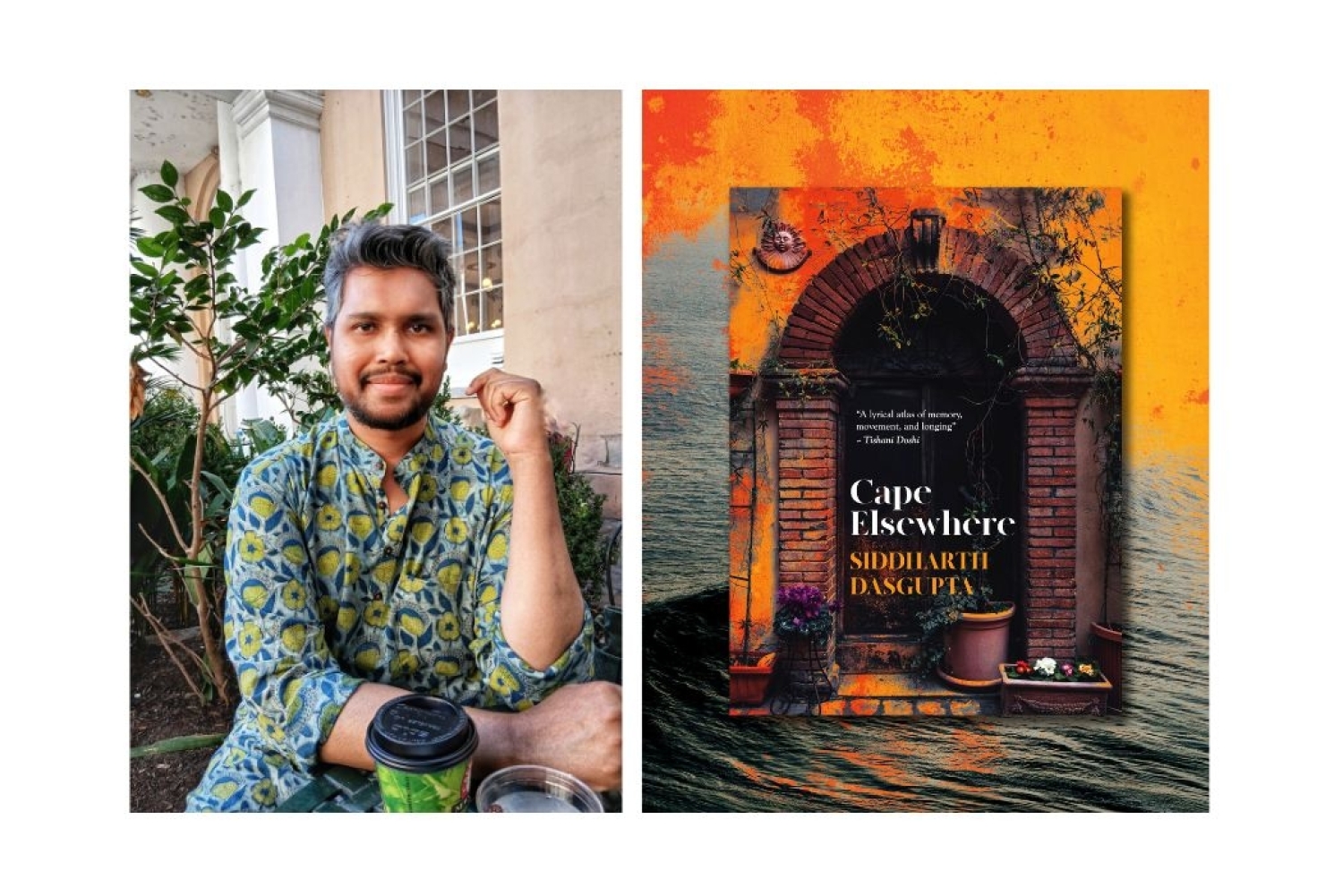
That was a few years ago with his book All These Places We’ve Known by Heart, and here we are today, with that same cadence which carries you by the hand, taking you into the poet’s rich worlds within and without, and inevitably, your own. His new collection, Cape Elsewhere (Red River), is a wandering mystic of music and meditations that glide between Poona, Paris, Calcutta, Isfahan, Bombay, Amsterdam, Lucknow, and Istanbul. Refusing to settle under the weight of the world, the verses breeze along beauty and brokenness, intimate yet infinite, feeling the pain and seeking pleasures between coast, city and myth.
The poetry of travel is an endangered creature in these times. If you must meet it, what must you not pack, I am compelled to ask him. ‘I grew up on the poetry of travel. Folk songs, The Little Prince; stories passed down in family lore. I suppose this poetry of travel has become endangered in an age of 15-second gratification. But if you do meet it, pack lightly. Leave out the to-do lists and the Instagram influencer suggestions. Carry a small journal. Step into an old café. Linger, strike up conversations. Take long walks, without agenda. Discard the need to jump between nine cities in four days. Remain in the one city, inhaling its aroma, listening to its brand of literature. There’s every chance you will return with stories and a full journal. A more immersive approach to life’s poetry.’
I smile to myself in agreement. But then I remember the predicament of being a poet; is it indeed a gift, or a burden, to be able to carry so many places within you all the time, the unbearable weight of an extended eternity? Siddharth offers reassurance. ‘As a writer, as a traveller, I end up carrying so many places within me constantly. When I was a younger writer, the thought of bearing all this would weigh me down at times. But now I’ve learned to think of this accumulation as a gift; this moving cartography that I get to dip into, draw from, constantly replenish through city and book. A familiar place of boulevards and paragraphs and charbagh and caravanserai that I get to call home.’
Siddharth’s subjects are a sensory celebration, palpable currents through the myriad geographies of mind and topographies of contemporary cultures, becoming a part of every place that he is called to…
‘A Sahara of sorrows; a Ganga of remembering, to forget; the Amazons of our amnesias; lagoons and Januarys; islands and driftwood; the Atacamas of our amazement; such tenderness of the Thar… An Antarctica of believing in things, and watching them dance into the ocean.’
The geographies of land and life are always a continuum in his writing. How does he decide where one book then ends, and another begins? ‘My literature is an always-growing compendium of humans and cities and journeys and triumphs and vulnerabilities. In that regard, this journey of land, words, and life is certainly a continuum. The books, as a result, have certain recurring motifs and human concerns, desire, the act of movement, nostalgia, the city. Perhaps that creates a very slight though perceptible overlap between the books, but then each book is coloured with its very specific language and canvas, its almirah of memories, its drawer of enigmas. In the end, each book becomes its own creature, inhabiting its own continent; held accountable to its own promises.’
Fair enough.
To my mind, the poems sometimes evoke a picture of Basho, losing his way only to find it again, navigating a complicated word to salvage whatever remains of beauty in this age of brutality. The eternal meets the fleeting, the melancholy the lightness, and the solitary mingles with myriad cultures. The poet’s alchemical lens converges reality and romance. In the midst of this embodiment of the twin-forced life-spirit, I am left wondering where he finds his centre. ‘The centre to myself, if I were to guess, is a mélange of all these contradictions and juxtapositions. The urge for movement; the joys in stillness. The longform placed against the ghazal. The sprawling against the intimate. The city with the quiet dramas of the coast. A retreat from attachment with an immersion into desire. It colours me, my life, my writing, with the textures and fabrics and urban longing that I’ve grown accustomed to.’
More than once, he speaks of a ‘lack of name’: ‘I have addresses in my heart that my mind lacks names for.’ ‘A city, then, is a feeling my mind lacks names for.’ It is perhaps an overrated belief that it is important to call each thing by its right name. ‘I feel the poet and the writer has a certain carte blanche, to draw things anew; to cast common things and known facts in uncommon light. But there’s much romance in particular in the thing that exists within an air of anonymity, the desire that can’t be named; the street without an address. The bookshop without a signboard. The love that no longer exists between two human beings,’ he offers.
I find his recollection of experiences as vast as Pangaea, but as distinct as feather and stone. I am curious to know if he is ever, then, completely present where he is, at any given time. ‘I try and remain present, at any given time. I fail miserably at times. But my general tendency is to gravitate towards stillness; a state where I’m allowed to hear, feel, and breathe with a sort of enhanced vividness. While in the heartbeat of a journey or a conversation or an experience, I’m not really keen to write either. The writing usually emerges later, birthed through reminiscence, via an architecture of words and streets and bodies and beliefs,’ he explains.
And when does the street turn into a river of thought, I ask. ‘Though I have written, framed, and sequenced entire collections when on the road or within the electricity of a specific passage in time, I rarely write when I am in the moment. It could be a journey or an experience or a dalliance, whatever the case. I might pen down a line or a stanza, a character sketch, a piece of dialogue. Much of it tends to arise later: days, several months, even years. I think language, both poetry and fiction, has its own gestation period. Part of the pleasure is in the waiting.’
Siddharth does not iron out the truths nor smoothens the edge of his experiences, but they land with a softness, a lightness characteristic only of a true traveller. But don’t be fooled by the tenderness of this elusive elsewhere, which, in fact, is everywhere and right here. At hand is a vast expanse of possibility, an unlimited access to memory of space, time and life, and unfathomable depths of the inescapable human condition through this visual delight of a book.
The poet is not a mere witness, but a bearer of the weight that he metamorphizes into wings, and cocoons into rare creatures of cadence that play out on delicately in pages designed by himself. ‘I’m a visual artist as well, and have ended up designing many of my books. But it’s always the words first. There can be no other way. It’s the topography and fabric of a collection that leads me towards shaping and designing the cover. Specific words or passages are the starting point for any visual anchors that may exist within a book. Of course, any journey, every encounter with a fabled old café or a centuries-old forest, is an instant channel to imagery and visual thought and photographic framing. How any of that might end up in a book has to do with the words. Everything begins with the words.’
Which brings us to a critical part about this path of passions. What are the biggest challenges for a poet today? ‘I am a poet, a fictionist, a visual artist, and a culture journalist. That’s the simple truth of things. It’s a wild, extreme time to be an artist in the world. But for me, and I suspect for millions of artists around the world, it is the calling we were meant to step into; a junoon built on bringing about some level of beauty and audacity to this world. It’s never easy, this road. There are financial hurdles. Periods of artistic doubt. The strictures of thin-skinned regimes. And, the fragility of one’s relationships. But you’re rewarded with much, if you manage to stay the path. The camaraderie of fellow writers. The bonhomie within festivals and soirees and such. The existential bliss in filling up a blank page, and then another, and another, with something that carries truth, hope. And this sense that you’re combatting the darkness in the world with something that exists as light and beauty and strength and truth. With something that thrives.’
‘Nocturna recognises no lie,’ declares Cape Elsewhere bravely.
Words Soumya Mukerji
Date 3.10.2026