Photography by Colston Julian
Photography by Colston Julian
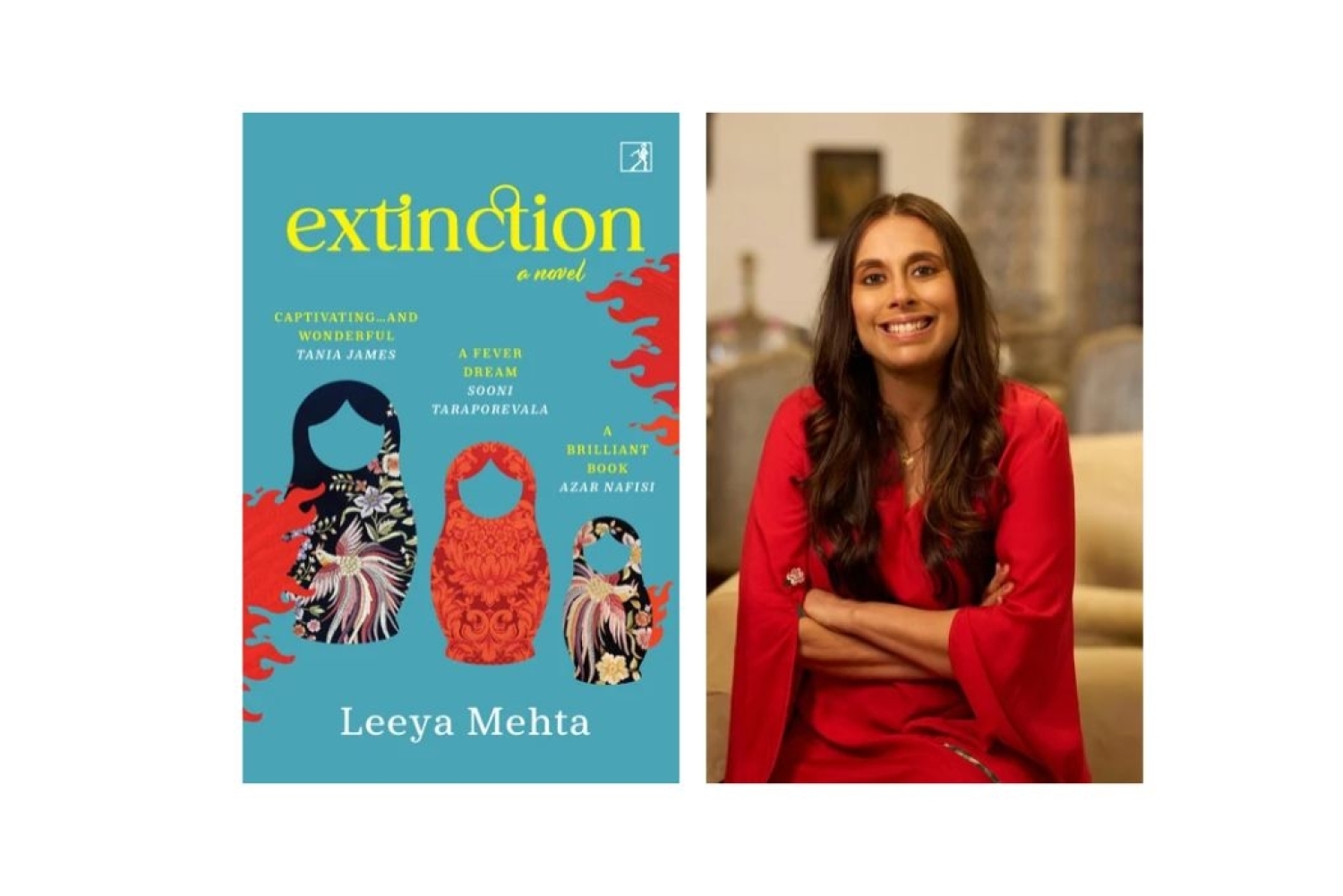
In Extinction, Leeya Mehta traces the intimate and inherited lives of three generations of women, moving between love and domestic violence, fantasy and reality, silence and speech. For a long time, she was circling, wanting to write about violence within the family but also about how important love is between generations. The novel grew from the character of Ava, a grandmother figure, based on her own, who held together both the fantasy life and this complex superstitious life and from a lifelong fascination with tigers as creatures that capture human imagination in many ways.
The book, which explores different aspects of consciousness and the generational weight of memory, was written under extraordinary circumstances. While living in Washington, Leeya was working late one night in her kitchen, drafting a scene in which a character experiences a hallucination of fire. She closed her laptop around one in the morning. At two o’clock, she opened her eyes to an inferno in the house. The fire spread rapidly along the ceiling. She and her husband grabbed one child each and ran downstairs. ‘We lost everything. The laptop fused to the table. Everything burned.’ They had to start from scratch in many different ways.
That moment was a pivot for her from a literary perspective. In this conversation, Leeya speaks about fiction as a form of permission, about memory as something we inherit and recreate and about how silence can become its own kind of extinction.
Finding The Story
For a long time, I was sort of circling the subject matter of this particular book. It has many different layers, as you know, having read it. And so initially, I wanted to talk about violence in the family, and also about love and how important love is between generations and try to capture the essence of growing up in a Bombay Parsi family and feeling very loved. And yet there was a lot of domestic violence in different ways. I spent some time building the characters of the three generations and the character of Ava, who is the grandmother in the story. She's based, I think, essentially on my grandmother, who had this fascination with tigers and with cats. There were some apocryphal stories about her. I always found her really rational, never talking in terms of superstition.
And yet there was this story about how because of her relationship with these big and small cats, she somehow could hold a separate consciousness, almost like both the fantasy life and this complex superstitious life together. My mother, when she was born, had blue eyes. And people said it's because you spend too much time with these tigers who have blue eyes. That sort of set me off. I was reading Borges and the labyrinth. I went from there to writing about this relationship between a woman and the tiger. I had read so much about tigers growing up and felt they capture the human imagination a certain way. I wanted to explore how they are reflective of our society and the changes in our society over the twentieth and early twenty-first century.
The Function of the Tiger
The book explores different aspects of consciousness, reality as it is and this active fantasy life that many of us have but do not articulate. There is the unconscious, the subconscious and the conscious. We can hold many ideas at the same time. I wanted to bring that across through the writing without telling people what it was about.
Especially as Indians, we have a sense of faith and are exposed to different traditions of karma. From there, I began to see the tiger as a connection between what we aspire to in the natural world and how the natural world and India, more broadly, are experienced in the family and in the nation.
The tiger carries the generational story through the women. It shares that story between families. No matter where we go as globalised creatures, we carry stories, imagination, monsters and fantasies from each generation. For many of us, the tiger was not something we experienced in real life except in a zoo. India has had the ups and downs of the conservation movement. The tiger as it is today is partly a figment of our imagination. We glorify it and yet we are not really able to live beside it. We internalise it into our imagination.
Memory and Storytelling
I went back and forth about where I wanted to end up. Early readers liked that element. It gave an animacy to the way we move through the world with memories. They feel like baggage but we also have free will in what we do with them. Memory is not only what is passed down but also what you recreate. You tell a story about a generation where previous generations did not even know what happened. You make a decision to tell what happened in a fictional scenario. As children, there is no language to describe what we are experiencing. With any trauma, how do you find a language and articulate it? How do you demand acknowledgement from society or the people around you?
For me, writing the book and telling my own story over time showed me how to come to language to explain what your experience is. My grandmother was a posthumous child. Her father died taking care of the dead. Imagining what it would have been like for her shaped the story and the absence or presence of people and memory impacts you. If you do not know someone, the grief is fundamental. That emptiness never fills.
This is an article from the May 2026 Bookazine. For more such stories, read the Bookazine here.
Words Neeraja Srinivasan
Date 14.11.2026