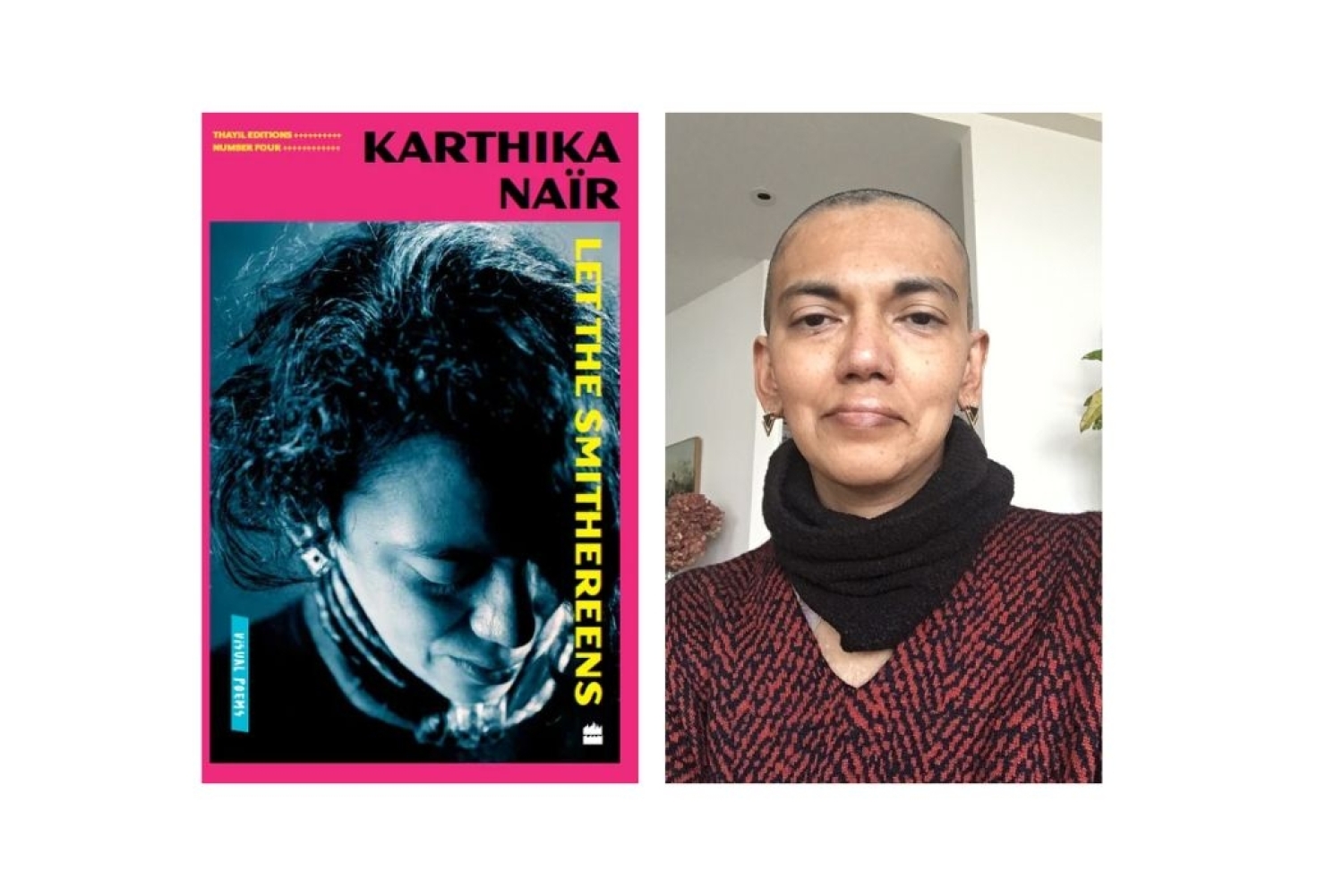
Karthika Nair’s Let the Smithereens turns language into an act of resistance. In this genre-defying piece of work, words fly and jolt, sentences are incomplete, and poems take on many different shapes. To them, language became a response to a dysfunctional body, one that lives with a chronic and degenerative disorder of the skin and mucous membranes. It became a haven, an oasis of transcendence and an arm. Yet, they are equally conscious of the limitations of language and its potential to become a weapon for misinformation, manipulation, fear and hate. Having worked extensively with dance, they also reflect on the relationship between the body and language, and how the former can wield an expression and heft that words can only aspire to.
The Category of A ‘Visual Poem’
Terms and categories serve primarily to frame a piece of work. In this case, a book, for the reader/viewer; they provide a useful point of reference. In the same way that fiction gets sub-divided into fantasy and thriller and autofiction and so on.
Within the praxis itself, that of writing, visual poems, also called concrete or shaped poems, are ones where the visual/graphic shape or design of the poem reflects its content, or highlights it. It’s a form of poetry where the typography of the words, their position and size on the page, the shape they form together are just as important in ‘telling a story’, or in conveying the theme/direction of the poem. In other words, form is content.
It is a genre that has appeared and disappeared through time; for instance, among the first concrete poems I read in English were those by George Herbert in the 17th century. In France, it regained prominence in the early 20th century with poems in Appollinaire’s Calligrammes, which were a strong influence: I saw how form could sometimes transform content into a sucker-punch.
Shapes and Poems
I should foreground all discussion about Let the Smithereens with an explanation: many of the poems in the collection are primarily ekphrastic, first written as librettos or scripts for dance. So, the shape can also be indicative of their dramaturgical function, or a potential rhythm structure in movement/kinetic terms, when I work with choreographers particularly attuned to the sonic potential of words. In other poems, where the dance/performance is the source material and the poem chronicles an existing work, that shape tries to replicate or refract the aforementioned rhythm or the direction(s) of the movement, the kinetic impetus.
For instance, Women of Uttarakhand, I did not know your names is written in the shape of a tree hugged by two women Similarly, the Cour Khorsabad diptych poems are roughly in the shape of the giant carved alabaster slabs from King Sargon II’s palace courtyard, the oldest section of the Louvre museum, again, playing with colour to convey a sense of the bas relief.
The Process
I’d begin with a caveat that the absence of an identifiable, label-friendly form is not the same thing as formless, if I may take the liberty of doing so. I think of myself as primarily a storyteller, whichever the medium and what I love about poetry in particular, is that it comes with no allegiance to the beginning/middle/end format, that it can create and disrupt a world with a fragment.
As for process: as I mentioned, many of the poems in this collection are connected to performance, largely dance, which is the mainstay of my life. They were either written as a script for performance or commissioned as an ekphrastic response to an existing artwork. So, they emerged and evolved entirely with one function: of creating a world for movement and/or movement-led narrative to unfold. Individual sub-sections, like Genesis: The Beginning and End of Time or PETTEE, would not ordinarily have been seen outside the world of dance. The wonderful poet Arvind Krishna Mehrotra had been urging me for long to compile them into a collection. And when Jeet Thayil launched the amazing Thayil Editions initiative in collaboration with HarperCollins India, Arvind spoke about this work to Jeet, who encouraged me to send him the poems. That’s really when I began to look at the connections between the sections. And doing so, figured out that these are poems that emerge from, and chronicle, the body.
Kinetic Poems
If I were to coin a name for these poems, it would be kinetic poems: the sensation of physicality is at the heart of the writing. While writing the script, the raw material for performance, for a dance piece, one of my jobs is to provide the verbal storyboard for the narrative of the body. So, just as it should serve as impetus for the dancers, it should ideally reach out to the body of the viewers of the show while they watch it, whether the words remain or not [often, they are transformed into choreography, or soundscapes, or visuals]. In other words, everything feeds into that objective: not only the meaning of the words, but the shape, the size, the rhythms, the sonic aftermath…
The Title
It comes from the first line of the title poem, and as the reader will see, the line is completed by the verb ‘speak’. ‘Let the smithereens/speak’. But, in the title, I wanted to leave the fragment open, so readers can place the verb of their choice: breathe, move, sing, be… They can end the story as they choose.
What’s Next?
Right now, an allegory on the ghastly ‘Great Replacement Theory’: the Far Right’s favourite bogeyman in Europe, and a scourge on our everyday lives. Early stages in two further and separate theatre adaptations of Until the Lions: Echoes from the Mahabharata by some brilliant minds; one spearheaded by actress Corinne Jaber who played Amba/Shikhandi in the Peter Brook/Jean-Claude Carrière Mahabharata, the other by French-Indian actress-danseuse Nirupama Nityanandan and theatre director-dramaturge Maëlle Puéchoultres. A restaging of the play Beneath the Music I had written during the pandemic for the Australian company Encounter Theatre and their director Jaye Emmanuel. And I am scripting a ballet version of Othello titled Othello & Desdemona for Stina Quagebeur, Associate Choreographer for English National Ballet.
Words Neeraja Srinivasan
Date 23.11.2026