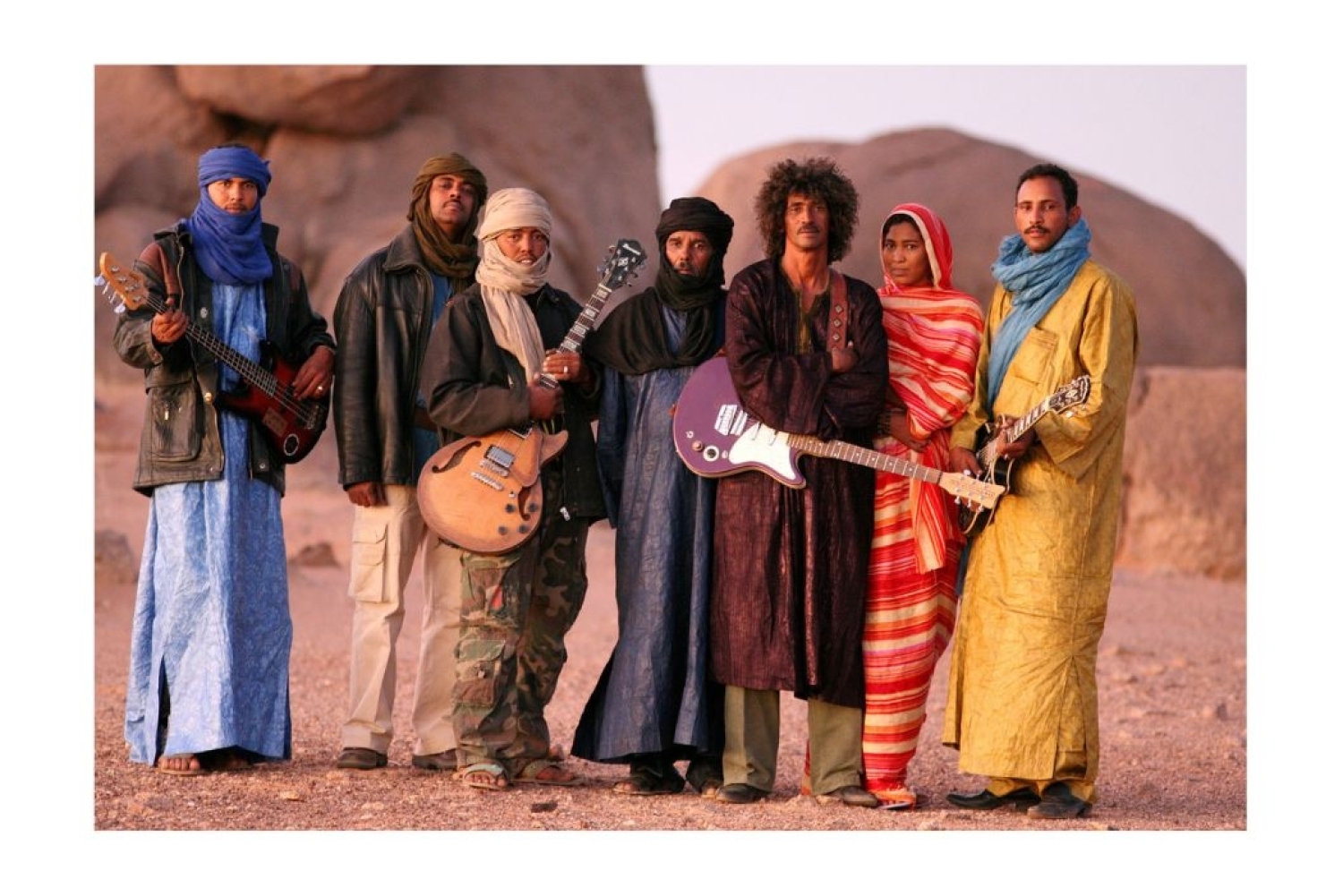
Tinariwen’s 2026 India Jazz Project dates mark a homecoming to audiences who’ve long embraced your sound. What kind of exchange do you imagine with Indian audiences and festival spaces?
We think of every place as a gathering rather than just an exchange. Indian audiences bring a strong collective energy and a deep appreciation for music, which changes how the music moves on stage. Our music comes from community gatherings where people listen, respond, and share time. The shows in India have always been great memories, like our last one in Bangalore, where the audience stayed in the rain throughout the entire performance.
Your music carries both resistance and rhythm. How do you approach this balance when composing?
For us, there is no balance to think about, because rhythm and resistance come from the same place. They come from life. In the desert, music has never been separate from what people are living through. It has helped us stay together during difficult times, not by forgetting reality, but by moving through it as a community.
Tinariwen’s songs have travelled across borders for decades. What does 'assouf' mean today, in a world still shaped by displacement?
'Assouf' is always present, the sound of the desert people, the sound of nostalgia. In Tamasheq, 'Assouf' is the word for this weight of distance: from the land, from those who are far… It’s a feeling many carry, shaped by their own lives. For us, it started with our experiences, but now it has become a music style in its own right.
Your collective has shifted and expanded across geographies. How has travel shaped your sound? Movement has always been part of our music.
Even before we travelled internationally, journeys were a natural part of our lives. Being in different places brings new experiences, new sounds, and new ways of listening, and all of that quietly stays with us. Travelling beyond the Sahara has added many layers to our understanding of music, but it has not changed where we come from. Each place gives us something, sometimes a rhythm, sometimes a mood, but mostly, new people and meetings. All of this becomes part of the journey, while the music continues to return to its roots.
As part of the India Jazz Project, how do you see Tinariwen’s music existing alongside jazz and improvisational traditions?
Jazz is built on listening and collective conversation. In the same way, our music is a space for exchange between musicians. From the beginning, our approach has grown out of repeating motifs and, above all, improvisation. This structure becomes the core of the music, allowing emotion to surface and move through hypnotic rhythms. As with the Indian Jazz Project, we are always glad to meet and play with other musicians who share these values and this understanding of rhythm and music
Words Hansika Lohani
Date 6.2.2026