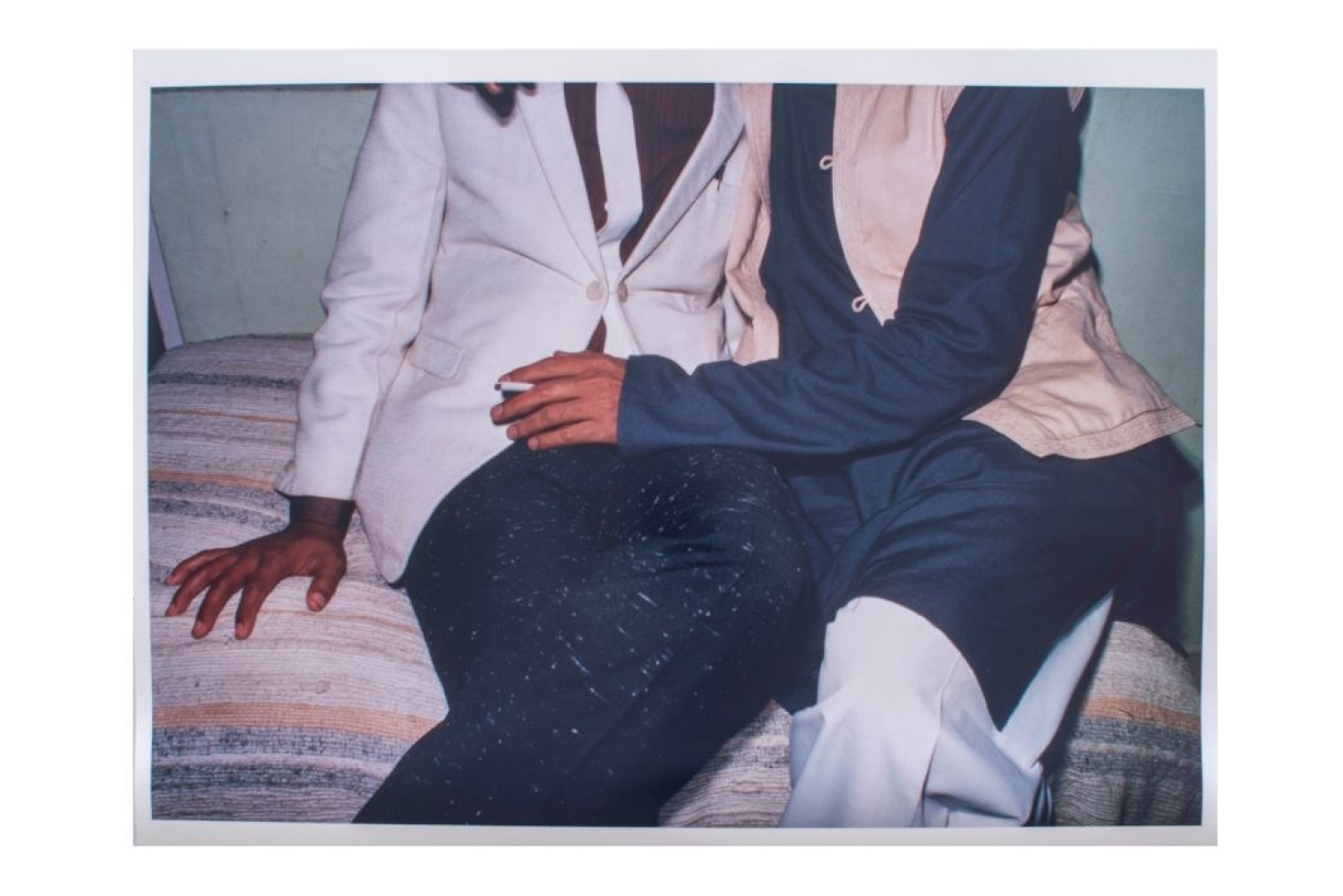
Exiles - The Party by Sunil Gupta
Exiles - The Party by Sunil Gupta
Gender is a verb: something done, undone and done again, in bodies, histories and the spaces law and language leave unaccounted for. In a moment when conversations around gender are being shaped as much by political uncertainty as by growing visibility, the art exhibition Beyond The Binary, curated by queer activist and critic-curator Georgina Maddox, brings together artists whose work approaches gender as improvisation lived in the body, rehearsed in performance and never arriving at a final form.
On view at APRE Art House, Colaba, Mumbai, until September 5, 2026, the show spans painting, photography, performance, installation and fashion, exploring drag, cross-dressing, Hijra subjectivities and the many experiences that exist beyond unmarked norms. Artists including Tejal Shah, Sunil Gupta and Inder Salim bring decades of artistic and political engagement to the exhibition; Prerit Jain's interactive installation transports audiences to a queer utopic space of play and possibility and fashion designer Bobo Calcutta, brings clothing into conversation with contemporary art. Every artist and its curator, comes from the community it speaks of.
Below, Georgina Maddox reflects on questions that shaped Beyond The Binary and why the exhibition arrives at a particularly urgent moment in India.
What first drew you to the idea of curating an exhibition around gender beyond the binary?
I am a queer activist alongside my work as a curator and critic and I have been engaged with studying the construction of the gender binary since 2013, when a queer feminist group LABIA published our study titled Breaking the Binary. So when Prerna Jain of APRE invited me to curate an exhibition on genders, we decided to do an exhibition that examines gender as a binary and issues around it. We discussed the exhibition when she was located in Pasta Lane Colaba and it came to fruition a year later in her new space at Wodehouse Road. It has been quite an intensive and collaborative discourse.
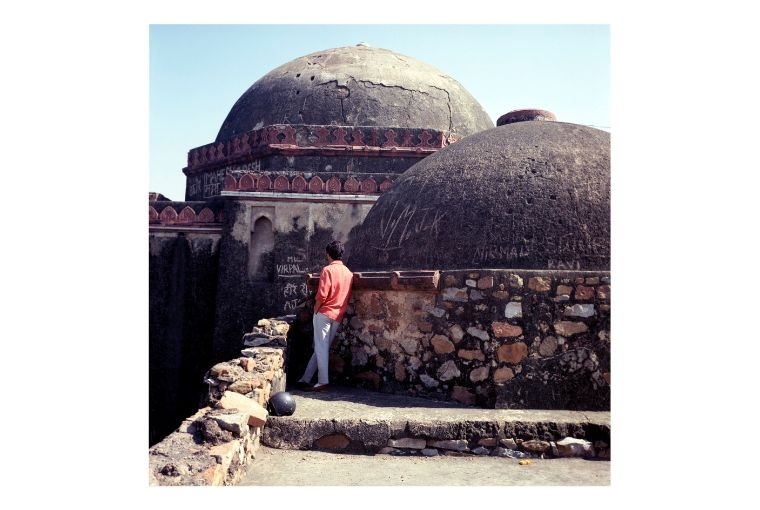
Exiles-Hauz Khas by Sunil Gupta
What were some of the questions about gender, identity, or representation that you found yourself returning to while putting the exhibition together?
I began to examine the most fundamental of questions: What is gender? From birth, gender is assigned by the doctor and then the state and often it is very restrictive of how people manifest and experience lived gender realities. The freedom to express and to self identify one’s gender is a complete and meaningful necessity for all beings. It is this reality that me and Prerna hoped to reflect in this exhibition.
How did you begin thinking about which artists and practices could come together in this exhibition?
I had some artists who I already knew and worked with in the past like Tejal Shah, Sunip Gupta, Inder Salim, Jehangir Jani and Satadru Sovan, who have been working on Gender and Sexualities for many years now. We brought in newer voices like Veer, Arun Roy, Naman Kumar, Mira, Bobo Calcutta and Maria Lopez through discussions over email and Social-Media, even doing a few zoom calls! The world has indeed gotten better connected.
How can art help us understand gender as something lived and experienced, rather than simply as a category?
Art offers a particularly fertile space through which the complexities of gender identity may be imagined, negotiated, and made visible. Through imagery, symbolism, fantasy, performance, and acts of creative transformation, artists can articulate experiences of gender that frequently resist the fixity of language and the limitations of conventional categories. The visual realm allows the body and the self to be reconstructed beyond the familiar binaries of masculine and feminine, opening instead onto more fluid, ambiguous, and multiple possibilities of being.
There are, after all, experiences that cannot always be adequately spoken. Where language may falter—or where social conventions determine what can and cannot be said—art becomes an alternative vocabulary. A gesture, an altered body, a fragmented portrait, an imagined creature, or a fantastical landscape can communicate states of desire, dysphoria, transformation, concealment, and self-recognition without requiring them to be neatly named. Fantasy, in particular, becomes more than an escape from reality: it functions as a speculative space in which identities can be invented, rehearsed, dismantled, and reassembled.
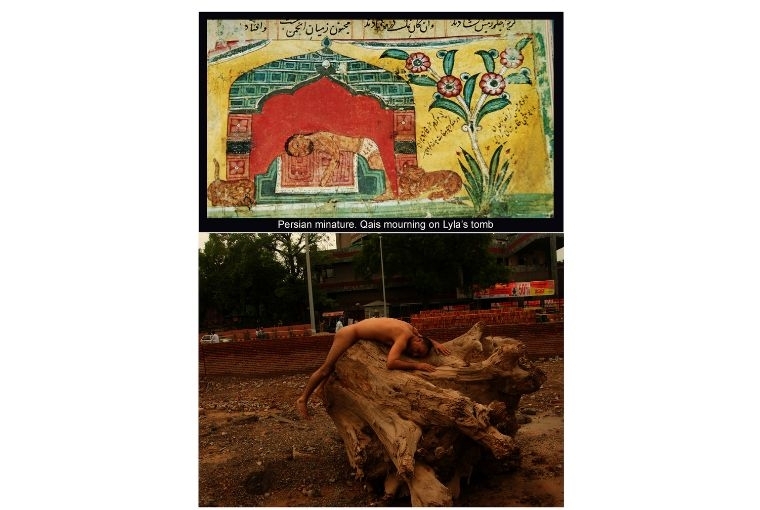
A Ghazal - Numa by Inder Salim
In this sense, visual art does not simply represent gender; it participates in its continual making and unmaking. It provides a space where the boundaries between the real and the imagined, the bodily and the psychological, the socially prescribed and the intimately experienced can become porous. Through such acts of visual imagination, gender emerges not as a fixed condition, but as a shifting field of possibility—one that can be inhabited, questioned, performed, and endlessly reimagined.
What does each generation of artists in the exhibition bring to the conversation around gender?
I found that the artists who are older look at gender from a larger lens space, looking at environment, politics and social issues (especially Inder) while the younger artists are much more focused on personal narratives that are very bold. Together they form a timely and complex narrative that presents gender expression and its variety with distinctive imagery.
The exhibition comes at a moment when questions around gender recognition and self determination are being intensely debated. Can you talk about what political discourse shaped the exhibition?
The political scenario is quite bleak for those who believe that gender expression requires self identification. In a move that many have described as turning the clock back by nearly two decades, the hard-won trajectory towards gender self-determination encountered a profound rupture. In March 2026, the Transgender Persons (Protection of Rights) Amendment Bill was introduced and swiftly enacted, despite sustained objections from transgender communities, legal experts, civil society organisations, and human rights advocates. The speed of its passage stood in stark contrast to the years of struggle that had secured recognition for the right to self-identify one's gender.
Perhaps most telling was the absence of meaningful dialogue with the very communities whose lives would be most deeply affected. Even statutory bodies such as the National Council for Transgender Persons found themselves sidelined in the process. In the aftermath of the Bill's passage, Council members Rituparna Neog and Kalki Subramaniam resigned in protest, describing the legislation as a retreat from the fundamental principles of self-identification, dignity, and constitutional equality. Their resignations became symbolic of a broader anxiety—that rights once painstakingly affirmed could, with unsettling ease, be rendered fragile once again.
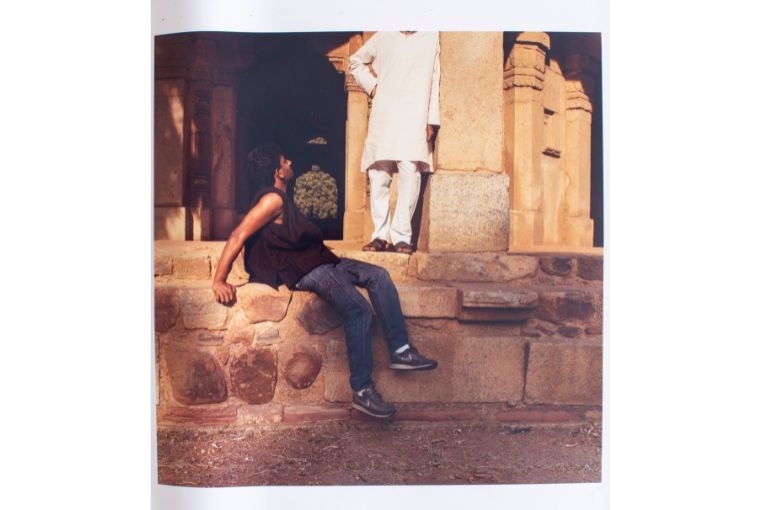
Lodhi Garden by Sunil Gupta
If you could have audiences leave the exhibition with one question rather than one answer, what would you want that question to be?
Ideally, the question they should leave with is, Who decides what personalized gender expression is?
Words Nidhi Soni
Date 26.8.2026
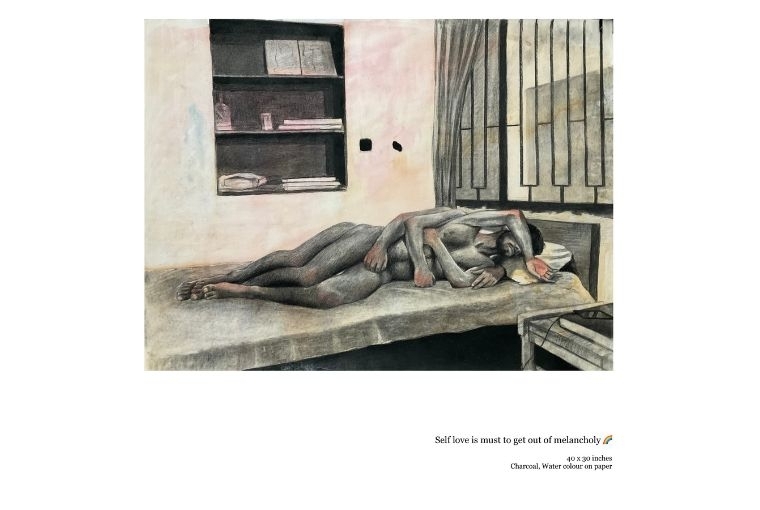
Self love is must to get out of melancholy by Arun Rao