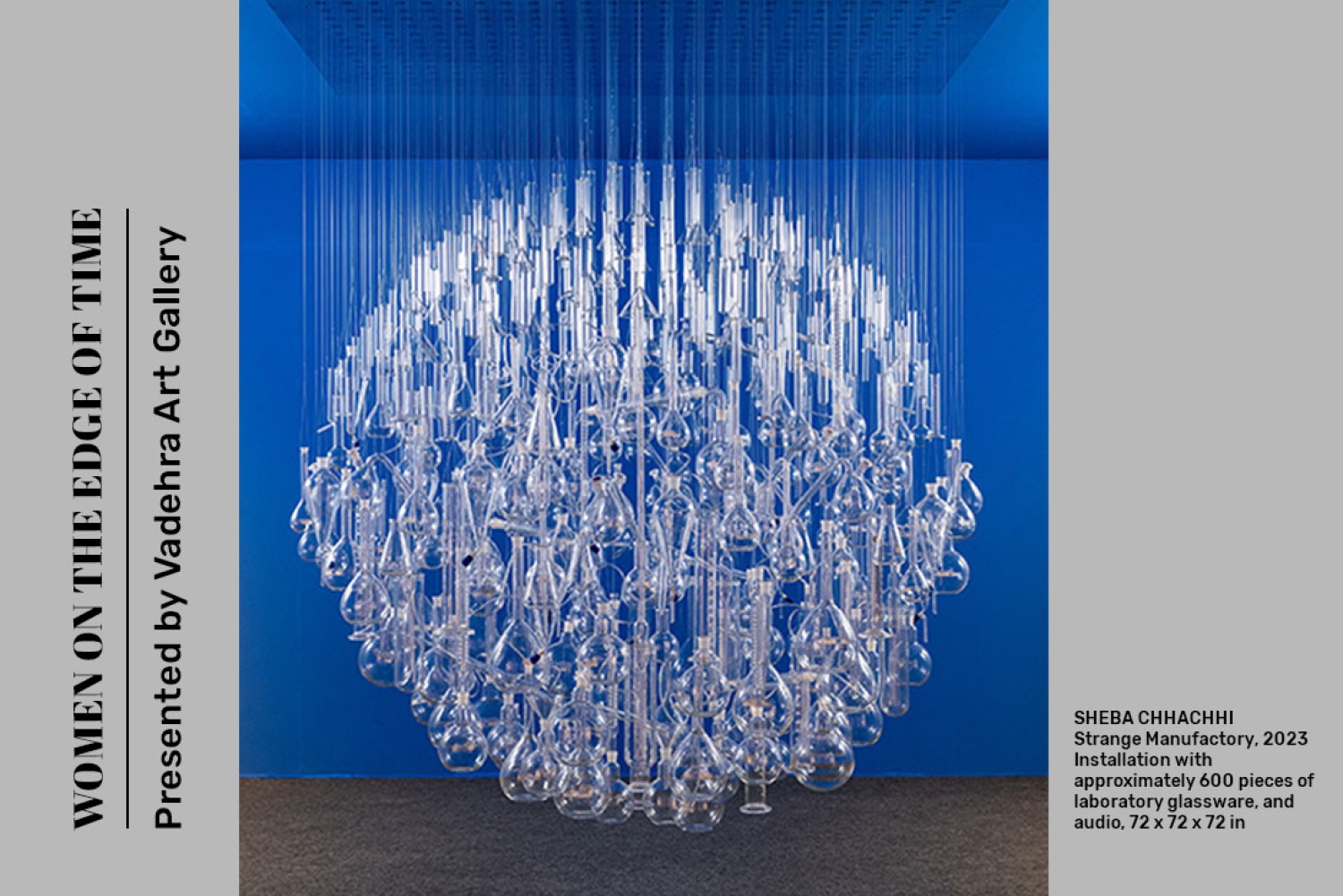
'Vadehra Art Gallery announces their exhibition Women on the Edge of Time, curated by Linsey Young, featuring the work of eight acclaimed South Asian artists, including Anju Dodiya, Arpita Singh, Ashfika Rahman, Gurminder Sikand, Jai Chuhan , Jasleen Kaur, Leela Mukherjee, Mumtaz Karimjee, and Sheba Chhachhi.
Women on the Edge of Time draws its conceptual frame from Marge Piercy’s 1976 novel, taking up Piercy’s questions about bodily autonomy, ecology, inheritance, and the possibility of a more equitable future. Spanning installation, painting, drawing, and photography, the show traces a path from institutional and clinical confinement towards collective political testimony, and from there towards land, myth, and inheritance. Across geographies and generations, th e exhibition asks what contemporary artists and viewers owe to the women who came before them, and what future can still be built from that inheritance, echoing Piercy’s own vision of feminist continuity reaching backwards and forwards through time.
In the exhibition, Sheba Chhachhi’s Strange Manufactory confronts pharmaceutical exploitation, while Jai Chuhan’s paintings reclaim the Western nude tradition through a female gaze. Ashfika Rahman addresses geographic uncertainties due to climate change, and Anju Dodiya’s and Gurminder Sikand’s works turn to wo men’s historical and spiritual ties to the natural world, referencing both women’s relationship to the natural world and the ecofeminist Chipko movement. Elsewhere, Chhachhi’s protest photography, Jasleen Kaur’s reworked colonial archive and domestic ceram ics, and Mumtaz Karimjee’s portraits of Indian women activists foreground overlooked histories of feminist and anti - colonial resistance – with Chhachhi and Karimjee’s real - life collaboration since the 1980s embodying the exhibition’s broader theme of women extending visibility and platforms to one another across generations. Leela Mukherjee – one of the first women sculptors of modern India – whose carved wood forms fused Indian, Western, and African traditions into an independent visual language , features a longside sculpture with her drawings, developed with the same quiet, unhurried independence , extend ing this same fusion of traditions onto paper, made largely outside institutional recognition or market attention during her lifetime. The exhibition closes with a new work by Arpita Singh, whose practice centres women not as symbols but as subjects observed with empathy, often in densely populated compositions that layer everyday objects, text, maps, and mythological references into scenes that feel both intimate and unstable, with dreamlike logic governing ordinary life.
Young writes: 'It has been an honour to work with such a remarkable group of artists, many of whom have long shaped my own curatorial thinking. Though they come from diverse backgrounds and perspectives, the artists in this exhibition are united by a shared interest in the lived experiences of women. By bringing together work from different times and geographies, I hope to draw out new dialogues and connections that might inspire us to think more deeply about what we can learn from the women around us.'
Curatorial Note & Images Courtesy of the Gallery
Date 25.8.2026