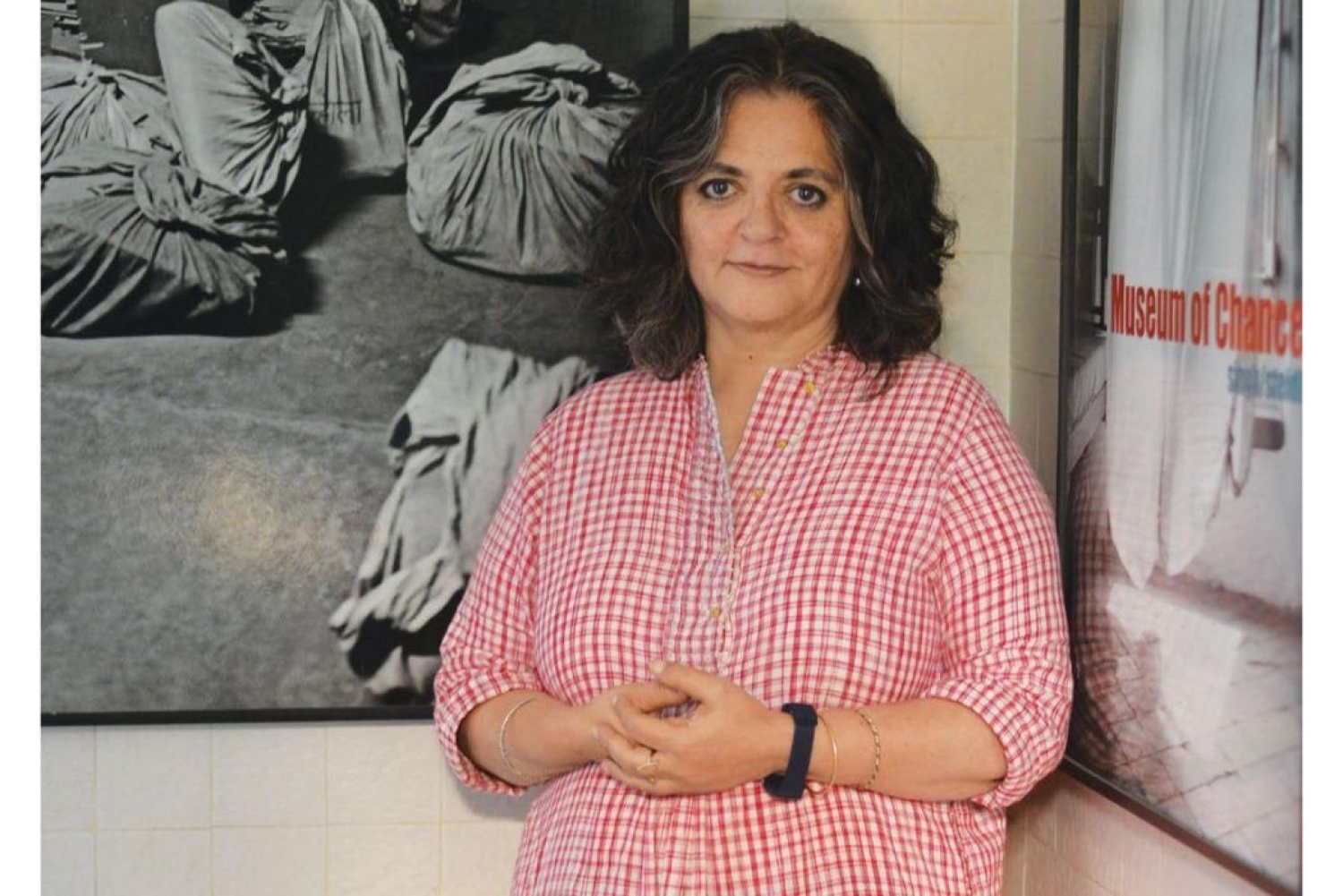
Reading Dayanita Singh’s interview gave me a sense of elation as it was only then that I felt that the arts issue was finally complete. One of India’s finest photographers, Dayanita and her camera are one and the same. She has written visual novels, and in her unique way recorded detail with such an extraordinary and special charm that every image evokes a sense of nostalgia, intrigue and fascination. She has captured thought and given it her own expression. Each chapter of her life has flown into the other and unconsciously altered life by holding it still. After umpteen years of adopting the black and white medium this is the first time the world sees Dayanita in colour.
Your father photographed extensively before he got married and your mother was the official family photographer documenting every occasion with you as key subject. What kind of role did that play in your relationship with photography?
Actually, it made photography the main irritant in childhood, with every departure delayed by my mother’s very slow photography. Of course, much later, I realised how much their photography and archiving habits shaped my own aesthetic.
What did your very first assignment photographing Zakir Hussain teach you about life and art?
I think I became a photographer because of Zakir. I am very grateful to the organiser at IIM who stopped me from taking pictures at the concert, for a class assignment. I fell on my back in a hall full of people. Then I waited for Zakir to come out from the concert and said, ‘Mr. Hussain I am a young student today, but someday I will be an important photographer and then we will see’. He got me some water and suggested I could travel and photograph him as much as I liked, which is what I did for six winters, and my diploma project was a published book, Zakir (Himalaya Books 1986).
The most obvious thing I learned from Zakir was his single-minded focus. But just listening to so many musicians, both on stage and during travels shaped to some extent how I edit my work even now. That restraint which our greatest musicians have — of knowing just when to stop. The power of the silent note. The building up of a raga.
Who were the people that helped you evolve and create your own photographic idiom in your formative years?
I am still in my formative years. My mother, who at age eighteen told me that I should never feel compelled to marry or have children, that I should concentrate on my photography and not bother about society’s reaction. Zakir Hussain, my mentor in how to cope with life; Sudarshan Shetty, the great artist who exposed me most closely to the working of an artist’s mind; Walter Keller, the legendary publisher who saw in my work things I was unaware of; Frank, who gave me a grant to photograph families at a time when no one was interested in that work; Sunil Khilnani, the brilliant mind, who very gently led me to the written word and the power of empty spaces; Gerhard Steidl, who is always open to the craziest of my publishing ideas. We have just made a book of postcards from industrial photos. Adam Fuss, the artist and fellow seeker. I am extremely blessed to have had the influence of such brilliant minds in my work.
Dream Villa sees Dayanita in color for the very first time. What prompted you to add colour to your frame and what is the story behind this series?
Dream Villa is actually preceded by the blue series, which will be shown at Nature Morte in February 2009. From black and white I went to blue imagery to the night of Dream Villa. I wanted to see if I could find a way with colour, for colour as it exists in photography did not interest me very much, making me wonder what else there was to do. Gradually I saw how the night transforms not just colours but the same world that seems ordinary by day, and this continues to intrigue me. Dream Villa is still emerging from the night.
“For me, the idea of becoming a photographer did not emerge from the love of photography per se, but the different worlds I could become a part of through it.”
How have you managed to work on your own terms and not get swayed into the commercialisation of your art?
By remembering why I do what I do. And having the emotional support of some very special friends and mentors. Earlier this year, I had a show in Kolkata, titled Ladies of Calcutta at Bose Pacia, where I showed all the 108 portraits I had made over the years. At the end of the exhibition, the people photographed their photos from the walls and took them home. The show now hangs in 62 homes in Calcutta. This is the work that sustains me.
Then I make little books of small photographs for friends I travel with. I have been making two copies from each journey since 2000. One remains with me, the other is sent to the friend it was written to. Along the way, Steidl received one of these and suggested that we publish them as Sent a Letter. So you can now buy a box of seven little books that turns into seven little exhibitions. My archive travels to your home. The books are mass-produced. I guess I am creating my own systems of dissemination of the images, systems that are not connected to the market.
I am fortunate that my medium has so many different levels of presenting the same work and I have given myself the freedom to present my work in varied ways. I am not limited by the boundaries of the art world. The pleasure of seeing my work displayed in the homes in Calcutta is more satisfying than any traditional exhibition. I just showed my work as wallpaper at the Serpentine Gallery in London.
How do you respond to photography coming into the Indian auction market?
As for auctions, I try my best to keep away from them. I find it absurd that people pay so much money for an image where the edition is still open. Where the same image could be had for half the money. It creates a false market then. One that is difficult to sustain. Yes once an edition is over, and the image has developed strong presence then perhaps a higher price would make sense. And, that will happen in India too. But let editions close first so the Saffron auction is too early.
Give us an insight into what the key subjects are that have become a part of your photographic canvas and how they have developed over your career-graph so far?
The most significant development has been the books: Zakir Hussain, Myself Mona Ahmed (Scala, 2001), Privacy (Steidl 2003), Chairs (Steidl 2005), Go Away Closer (Steidl 2000), Sent a Letter (Steidl 2008), Blue Book (Steidl 2008) and the upcoming Dream Villa (Steidl 2009).
What fascinates you about the black and white medium?
That it abstracts the chaos around me and allows me to make my own mood out of it. It allows me to interpret the world around me and not illustrate it.
In your opinion, what purpose does your art serve, what is it you want to communicate through it?
I am not trying to serve any purpose, nor am I trying to communicate any specific thing. If you get something from my work, based on your experience, then that is wonderful. If not, I still do what I do. It is an ‘inner necessity’ as Richard Bartholomew calls the creative process.
What are the most important influences that have moved you as an artist?
Life and conversations around it. The moon and the clouds, and as I mentioned before classical music in Italy and then literature. Reading Sebald (Austerlitz is my favorite photography book), Calvino (Difficult Loves and Six Memos for the New Millennium) to me are the most significant writings for photography. Ondaatje and his editing in Running in the Family, his poems in Handwriting and Coming Through Slaughter are books that have shaped my aesthetic, in as much as one can be specific about these things. Old Hindi films and Satyajit Ray. I am sure somewhere spending many weekends in Anandamaya Ma’s ashram as a child have had a profound influence, as well I am almost certain that I am blessed by her.
“Black and white abstracts the chaos around me and allows me to make my own mood out of it. It allows me to interpret the world around me and not illustrate it.”
Through photography you developed a very important friendship with Mona Ahmed. What intrigued you about her life and how did you evolve in the thirteen years of photographing her?
As has been stated long enough, this too was a routine assignment on eunuchs. Owing to some misunderstanding Mona took my shot film from me and embraced me. That embrace has lasted eighteen years now. I knew from the start that she was a truly unique human being, that she lived life on her own terms, that she was a born outsider from any world, even that of the eunuchs.
Since I was a photographer, I would photograph her world as I photographed various friends’ families. At a certain time, she decided she wanted the world to know her story. She wrote the text for the book in the form of emails to the publisher Walter Keller, and he published them unedited. She also wrote the caption and requested a small enough book that could be read in a train or plane. Myself Mona Ahmed was published in 2001 and released by the German ambassador in the graveyard where Mona lies.
Has there been a shift in your own head in the way you photograph?
I certainly hope there have been regular shifts. From the Mona work, family portraits, to the empty spaces, to the books such as Go Away Closer and Sent a Letter, to the blue series and now to Dream Villa. All the experiences one has, all the books one reads, all the music one hears, the loves and the losses — all shift how one sees and one hopes it will always be so.
How does it feel being the recipient of the prestigious Robert Gardner Fellowship in photography from the Harvard Museum Art Museums, and the Prince Claus Award, that will be given to you on January 21st 2009?
It is a great honour but also a certain responsibility.
What projects do you have lined up for the future?
One does not line up projects for the future. Life brings them to you, one chapter flows into the next and the next and one never quite knows where they will lead. Well, that is how it works for me. The day I can line up projects to do is the day I should retire.
This month, in the spirit of Women’s Day, we revisit conversations with the countless extremely inspiring women who have graced our pages. This interview was first published in our June 2009 Issue.
Words Shruti Kapur Malhotra
Date 18.03.2026