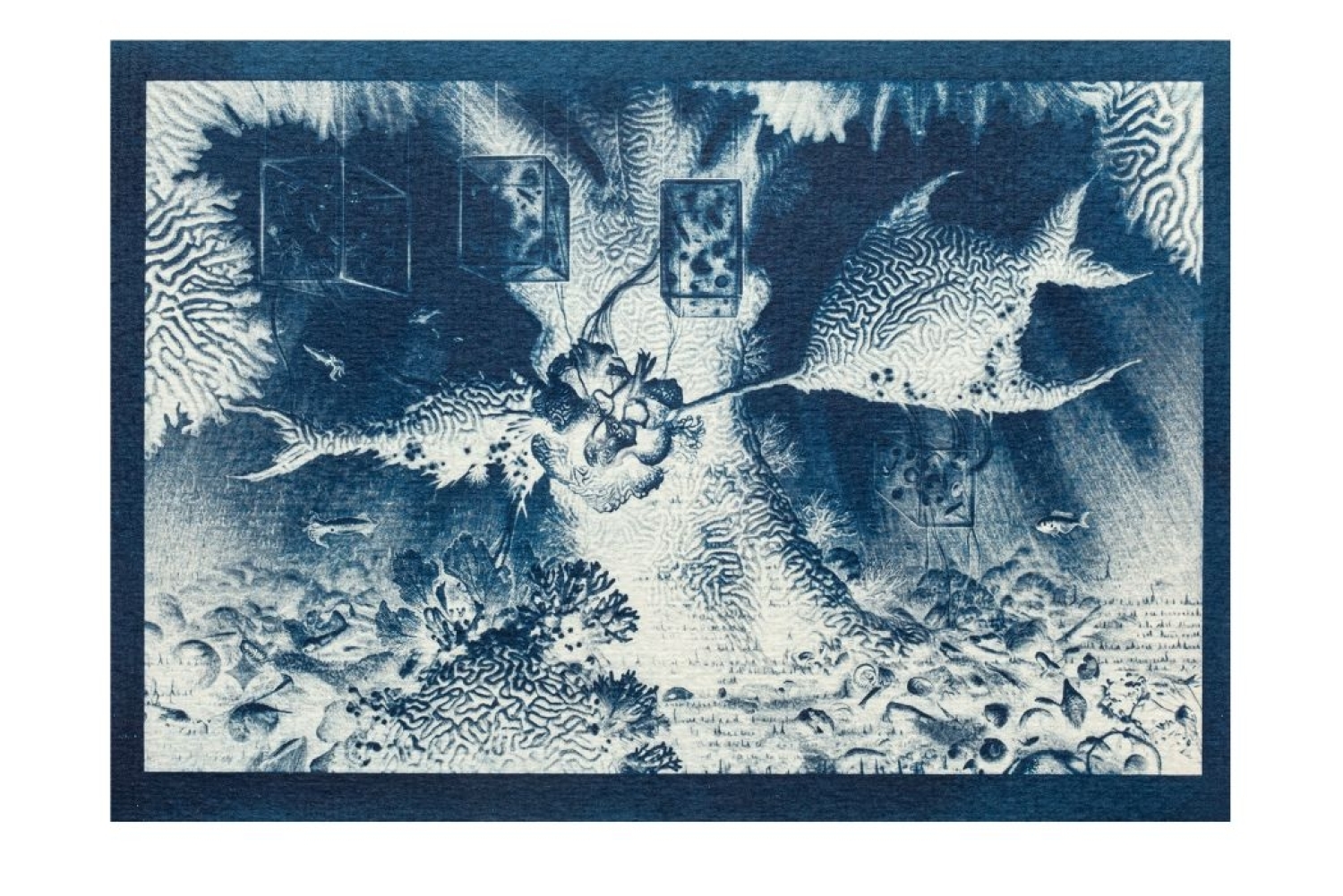
Parag Tandel Vitamin Sea Archives: Sediments of Intelligence - 5, 2026 Cyanotype on Archival watercolor paper, washed in local seawater and freshwater 5.9 x 8.3 inches
Parag Tandel Vitamin Sea Archives: Sediments of Intelligence - 5, 2026 Cyanotype on Archival watercolor paper, washed in local seawater and freshwater 5.9 x 8.3 inches
'TARQ presents Salted Caviar, a solo exhibition by artist Parag Tandel, accompanied by a text by Natasha Ginwala. Spanning sculpture, cyanotype, textile, and archival research, the exhibition brings together four new bodies of work that move between geological deep time, living knowledge systems, and the ecological and political struggles of Mumbai's Koli fishing communities. In the Salt Shrines series (2026), vibrantly hued yarn and found elements are wound onto metal armatures to create multi-layered sculptural figures that crystallise Koli votive traditions, nature worship, and multispecies cosmologies — evoking the Bharali Puja ceremonies held at full moon each October.
Alongside these, Tandel works with Habur stone, a fossiliferous material from Jaisalmer that was once an ancient seabed, to cast oil pipes and marine life-forms in cooling, mottled rock — drawing a sharp poetics between petrocapitalist extraction and the Koli community's embattled relationship with the coastline. The stone becomes a monument to an erased ocean, connecting the geological history of the Rajasthani desert with the ecological memory of Mumbai's shores.
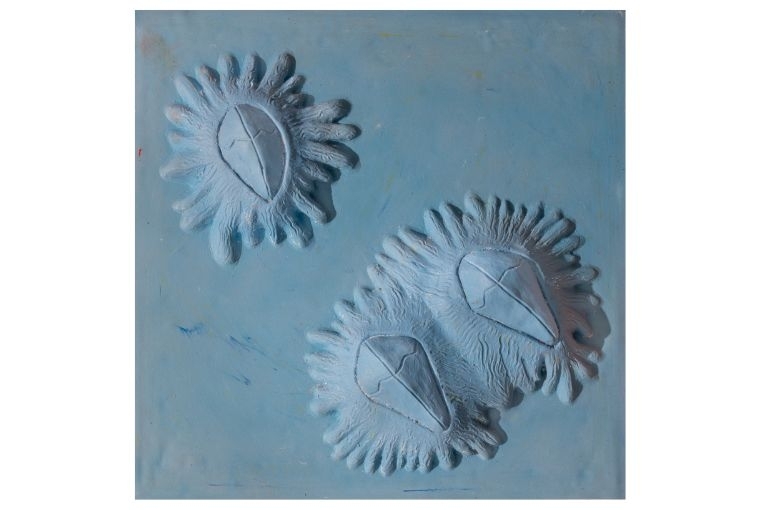
Parag Tandel Sea of Relation - 3, 2026 Silicone rubber reinforced on marine plywood, cotton fabric11.9 x 11.9 inches x 2.4 inches
In the Vitamin-Sea Archives: Sediments of Intelligence (2026), the stone becomes an archival potli, gathering geologic memory alongside technocratic encroachments on the hydrosphere. Speculative cyanotypes address the desalination of seawater for data centres and artificial intelligence infrastructure, weaving together coral reefs, marine organisms, undersea cables, and shipwrecks into a kind of reverse-engineered cartography of the ocean floor. The Worli Koliwada series (2026) assembles oral histories, archaeological records, and meticulously illustrated recipes — drawing on the Koli diet and his mother Kamal Tandel's kitchen — to position food as an archaeological site and endangered epistemology. In Estuaries of Waning Sounds: Koli Dictionary Project (2025–26), woven fish-net sculptures animated by shells, knots, and found elements give form to a growing Koli language lexicon, where indigenous words are recovered not only in script but in cadence and vibration. A soft floor piece, Sea of Relation (2026), affirms the Koli worldview as one that is horizontal and seamless — founded on movement, interdependence, and lateral kinship with the sea.
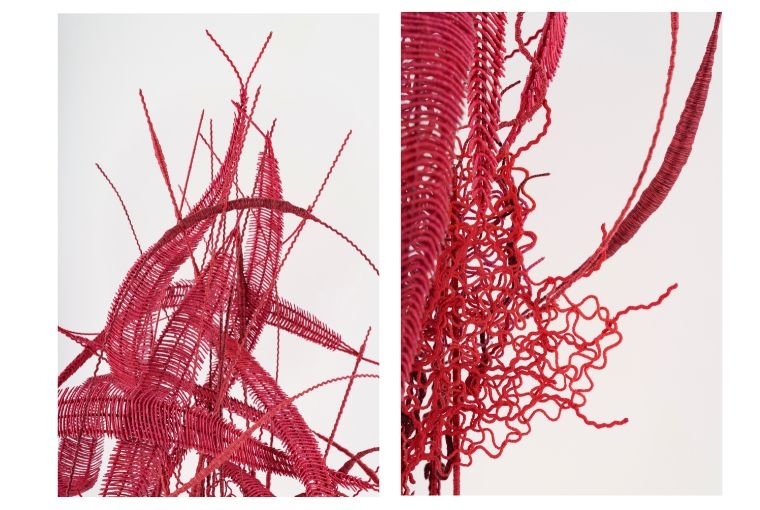
Parag Tandel SALT SHRINES: Colour Blind/ ???????? series (6), 2026 Stainless steel wire and polyester and cotton thread 45 x 26 inches Base Diameter: 8 inches
“[Parag] brings forth an ensemble of aural autoethnography of neighbourhood tales, coastal livelihoods, indigenous rhythms, and underwater chronicles as communal pursuits of knowledge gathering. . . It is via the embodied lens of brine that I view this praxis emerge; its conceptual and material character resonant with a more-than-human hydrocommons, livelihood struggles of Koli fisherfolk, spatial justice and reimaginations of ocean-centered sovereignty.”, says Natasha Ginwala. Together, these works constitute an act of maritime reclamation — archiving what is disappearing, and insisting, through material and language alike, on the depth and continuity of Koli presence along this coastline.
Salted Caviar is on view at TARQ, Mumbai until 17th October, 2026.
Curatorial Text Natasha Ginwala
Date 18.9.2026