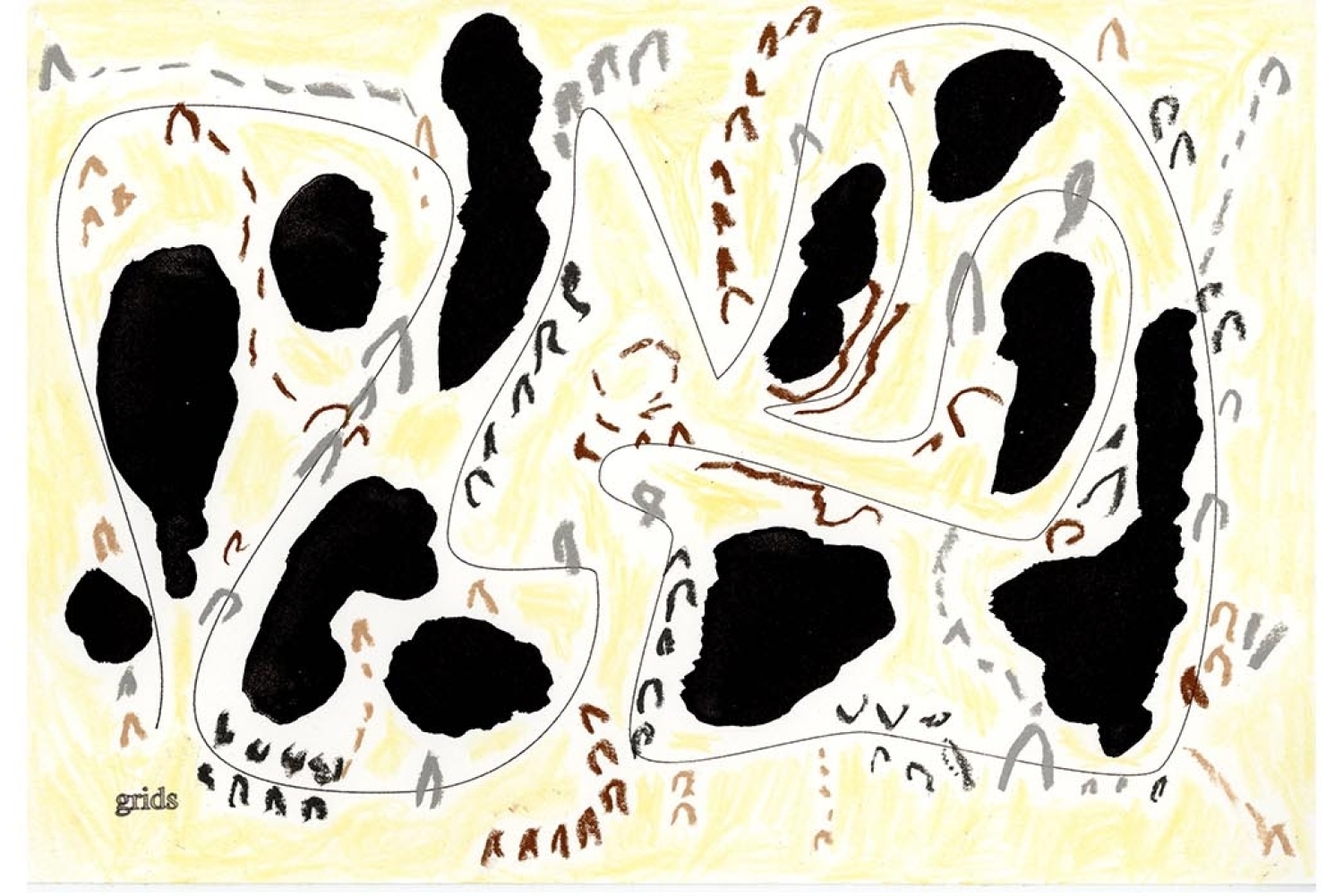
An abiding source of inspiration throughout Lala Rukh’s career, Indian classical music was a cornerstone in Rukh’s practice whose father was also the founder of the All Pakistan Music Conference. In severa l of her drawings and works, references to music and musical notations can be discerned, but her final work Rupak , a stop motion animation, on view in the exhibition, is the culmination of this influence. Lala Rukh collaborated with Sunny Justin who she me t at APMC to compose the twelve - second rupak taal tabla solo that forms the basis for her animation. Once the score was completed, Rukh devised her own method of transcribing beats to paper. This took place over a two - month period, during which she would d raw and redraw the sounds of the rupak taal in a dot - based system on a grid. The drawings all coalesce into an animation, where a single white dot that moves rhythmically along the screen to each tap of the tabla is heard on the accompanying soundtrack.
Spillage is intentional in the exhibition, and as the beats of Lala Rukh’s Rupak echo in this gallery where Parul Thacker’s work is located, the viewer finds themselves confronted by a series of delicate and elaborately constructed embroidered sculptures. At first sight they resemble abstracted lines of black thread on airy silk, but upon closer examination reveal th emselves to be drawings that are based on alchemical and metaphysical representations of ancient philosophies, energy fields that use mathematical definitions and constructions of pure intuition. Adjacently a series of lenticular prints capture transience through smoky renditions of shifting forms that are also reflective in a sculptural installation of gold - leafed crystals. Equally referring to celestial studies of movements of planets and to meditative practices that form the core of Thacker’s world, the works highlight the inner workings of the artist’s mind. Thacker is deeply influenced by the rudra veena musician, Bahauddin Dagar, and loops of staccato sonorous vibrations emitted by his veena often become the starting point of her transcendental aesthet ic in space and time. Thacker’s work seeks to acknowledge the existence of ancient philosophies and classical Indian music alongside a technical vocabulary of algorithms, mathematical topology, and material molecularity — straddling registers of both ancie nt materials and contemporary practice, in ways that represent their rhizomatic circularity instead of a linear progression in time.
The immersive installation of Superhero Sighting Society 1 transports one into a soundscape of multiple languages testifyi ng to the sighting of super heroes from around the world. A cacophony of voices resonates across the icy peaks of unclimbed mountains belonging to faraway places, where truth and projections overlap . The installation is made by Super Taus, the alter ego of artist Taus Makhacheva who hails from Dagestan. Super Taus is emblematic of Makhacheva’s reflections on daily life in Dagestan and the Caucasus region of Russia. The Superhero Sighting Society was conceived by Sabih Ahmed and Taus Makhacheva, the Society’ s Founding Secretary Members, in collaboration with the Society’s Records Clerk, Jessica Saxby. Maintaining anonymity of its members, the Society gathers witness accounts of superhero sightings to raise awareness and promote conversations around new figura tions of power that have emerged in the 21st century. The installation invites the viewer to conjure images and apparitions , and re - render environments through a congestion of narratives, a reminder of the constant jostle of facts and fictions, desires and fears that shape contemporary life.
In the large space that is adjacent to Superhero Sighting Society are Biraaj Dodiya’s works rooted in personal metaphors, exploring aspects of sound as coded language and as noise. Dodiya’s work often refers to ruina tion and form through ideas of support, structure, material and surface. A new suite of paintings on metal, represent Dodiya’s ongoing thoughts on support, anchored in the haunting sounds that the memories of medical stretchers evoke . The central form in these works, alludes to the fragile or the absent body. The structure of the works mimic the stretcher of a painting — the physical armature on which paintings are built, nurtured, invented, repaired and rescued. A series of works on paper accompany the met al ‘ stretchers ’. Dodiya’s works in the exhibition are analogous with the unstoppable buzzing and humming sounds of our inner and outer worlds. One, the siren, a loud alarming sound from our metropolitan world which signals danger, imminent emergencies and alerts ‘all listeners’ . Our mortality remains an inevitable reality, pulsing through the ink of newspaper images of warzones and freak accidents. The other sound , characterises the private voice , the constant ringing — a visceral mimesis of the nature of thought.