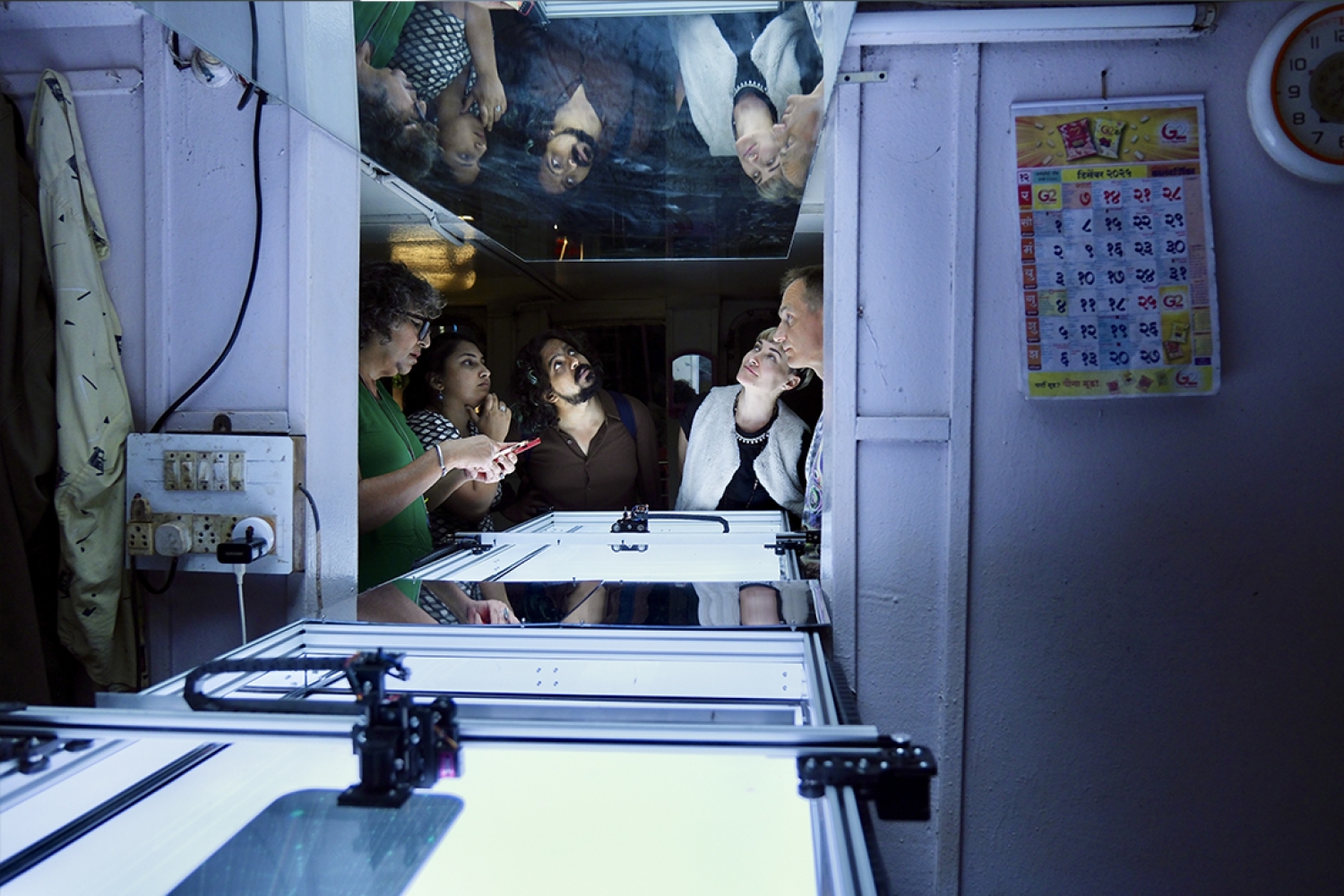
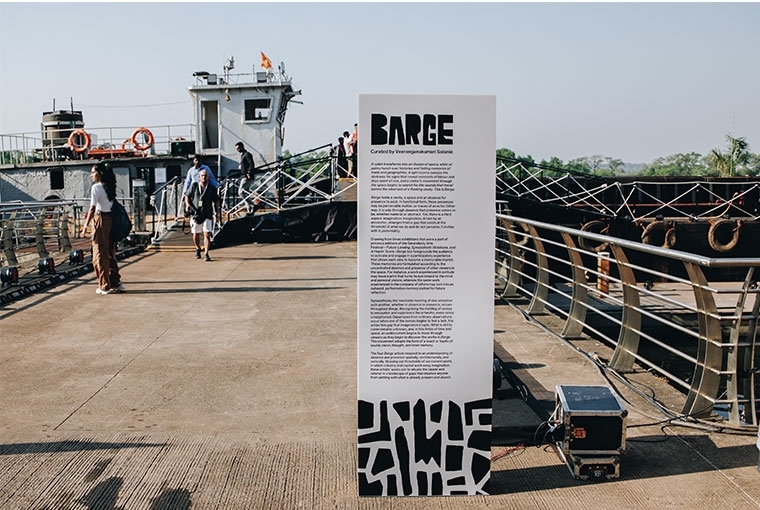
Visiting Serendipity for the fourth time this year brought with it a familiar expectation: the promise of encountering something new, or something presented intriguingly. Barge, a site-specific immersive exhibition, delivered exactly that. Onboard a ship at the Captain of Ports Jetty in Old Goa, the exhibition became an invitation to experience art from a fresh perspective - one that extended beyond the visual to include physical space, sound and something compelling – imagination.
The exhibition invited spectators to truly engage: to lie down in hammocks, gaze up at the clear sky (a novel experience for us Delhites), and watch the stars while listening to soundscapes created specifically for Barge. The gentle rocking of the ship with the waves, ‘oil palms hunched over histories and fading memories of trade and geographies’, the faint sounds that pulled one in different directions in search of their source, a cabin that transcended space collectively transformed a seemingly mundane setting into an immersive interplay of sight, sound, and physical space—unfolding as a captivating narrative.

Leaving Barge, one conjures stories of what the past might have been: the trade routes once taken, the labour once enslaved to work on ships. It leaves much to the imagination—an activity often dismissed in mundane life.
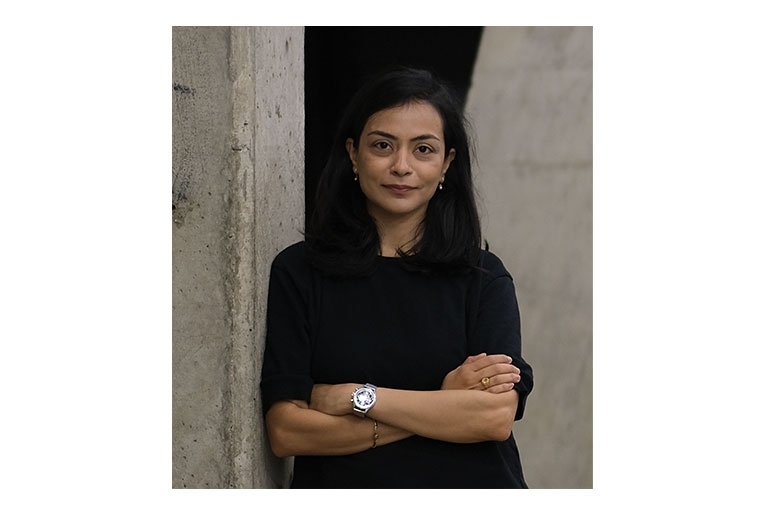
We talk with Veeranganakumari Solanki, the curator of Barge about the exhibition, her curatorial process and curating for public spaces.
What has been occupying your thoughts lately?
It’s been a few months since we started discussing the barge and really thinking about what it means to curate publicly, but also in a space that is so prominent. It’s made me think a lot about what curating means, what space means, and how to work with artists through this and with them.
What insights or discoveries have you made through your engagement with public art? what challenges or considerations arise when working with site-specific exhibitions and public alternative spaces?
I think something to think about a lot is audience engagement, outside of the fact that, while working through thinking outdoors and thinking through the public, it’s of course, like I said, primarily the audience, but also how elements such as the sun, the rain, and night dew come into play. All of these things often get taken for granted when curating in a white cube or an enclosed space. Also, with the materials we’ve been working with, rodents. All of these factors become challenging and fun, and also extremely satisfying, when one arrives at this confluence where the artist, the art, and the audience all come together in engaging with public art.
Of course, when it comes to challenges or considerations, specifically again, outside of just outdoor elements and thinking about audiences, what really comes to mind is taking the overall location, situation, and place into account. With the works that are out there, it involves discussing with the artists the fact that these works are exposed to various elements beyond just a public audience, but also outdoor conditions that are sometimes beyond our control, and what it might mean to put art out there in a space that is alternative and public.
It's a challenge that, I think, the artists and I have all enjoyed considering. One thing that becomes quite important to remember, at least in my experience working in these spaces with the artists, is that these spaces cannot be transformed into white cube spaces. So it's also keeping in mind how one embraces the space and the environment in which the art is located.
Given your exposure to a wide range of artistic practises, how does the constantly evolving art landscape shape your curatorial approach?
I think something that has specifically evolved in my curatorial approach with the past few years of working on exhibitions at the Serendipity Arts Festival started with Future Landing in 2020, which was online in 2021, before moving into the physicality of exhibitions from 22 to now, the fourth show at the festival in 2025, is just letting go.
And by letting go, it's not only letting go of the control over audiences, but also arriving at a point of knowing when to stop controlling how things might be. That has led, I think, to a different kind of a conversation.
What is the most ambitious or unconventional exhibition idea you've ever considered?
I think they’ve been crazy ideas. I keep saying this every year at Serendipity: every time the festival team and Smriti and I come up with an idea, it’s a crazy one.
We say it, and there’s never a no. That’s what makes it really exciting. A challenge begins with thinking, “Okay, why don’t we try this?” and then realizing, “We don’t know where this will go.” But there’s never a no, so you take it on. I think that’s something Serendipity has really offered me as a platform.
One of the most unconventional, or what I call crazy, ideas came during the pandemic in 2020, when we conceptualized Future Landing. It was truly a team effort. One of the goals was to create something that didn’t already exist on the internet, knowing that the moment something exists, it’s only a matter of days before something else replaces it. Working with the Serendipity team, the coders, and the artists, who trusted in this process, we asked: how does one create an exhibition in an online space that cannot be saved or returned to, because every time you return to it, it changes? And that has been, I think, something that really pushed curatorial ideas for me.
From Future Landing to Sinner Segmentations, to Haptic Score, and finally Barge this year, from one to the next - it's all fed into ideas. It’s been challenging.
And I think those challenges are what make the work extremely satisfying, because they don’t pause or create an end. Instead, they actually become starting points for thinking more and beyond. That is what I feel exhibition-making needs to be.
In the case of Barge, what guided your selection process and how did the experience of previous editions influence the final exhibition?
I was quite certain that I wanted to work with artists who had been part of my previous curations at the festival. While thinking through this, we were, of course, also considering budgets. One artist I wanted to bring in as a new part of the exhibition was Prajakta Putnis. When we saw the Barge as a space, the way Prajakta Potnis integrates her work into space, it felt important that all the artists working with the Barge understand it as a vessel while also knowing that we cannot make it disappear or transform it into something it is not.
This raised the question of how one works within the presence of the Barge, but in the absence of the space, its cavity or cavities. I also wanted to work with artists who are based in Goa. So many of the performances and sound interventions are by artists I’ve worked with over the past few years.
Dennis Peter, who is non-linear, is based in Goa and he works with tech. This brought up challenges related not only to medium, but also to space. How one works within it and with it. Julian and Hemant have, Hemant has worked with the Barge in the past, through this threshold of sound, which became an important way to think about imagination, where it comes in, in the presence, in the field of absence and presence.
Julian Segard and Prajakta Potnis have addressed issues that come back to the idea of the Barge as a vessel—whether in relation to migration, capitalism, or how comfort pushes into discomfort, and how familiarity moves into spaces of memory. These processes often lead one back to their own thoughts, questioning them, and reflecting on what the Barge represents as a vessel, what capitalism does, the kinds of issues that emerge when thinking through of Barge as a vessel. It has also been challenging for them to think of new work for a new space and to integrate into the space rather than away from it, and that was important.
The artists who are part of the programming were equally important, Tenzing, who made the film on the Barge, the sound artists who has interventions such as Hemant Sreekumar, Alan Rego, pause.dxa, Lionel (who performs as DA SAZ), Farah Mulla, and Abhinay Koparzi, both of whom were part of Future Landing; as well as Akash and Sara and Sara Bhar x soundcodes, who were also part of Synesthetic Notations and A Haptic Score.
All of them have responded to not only to how they see the Barge, but also to the same core concept, and the four artists with permanent works on the Barge, have responded to: thinking through imagination at this threshold of absence and presence.
Words Samiksha Sharma
Photographs Courtesy Serendipity Arts Festival
21.12. 2025