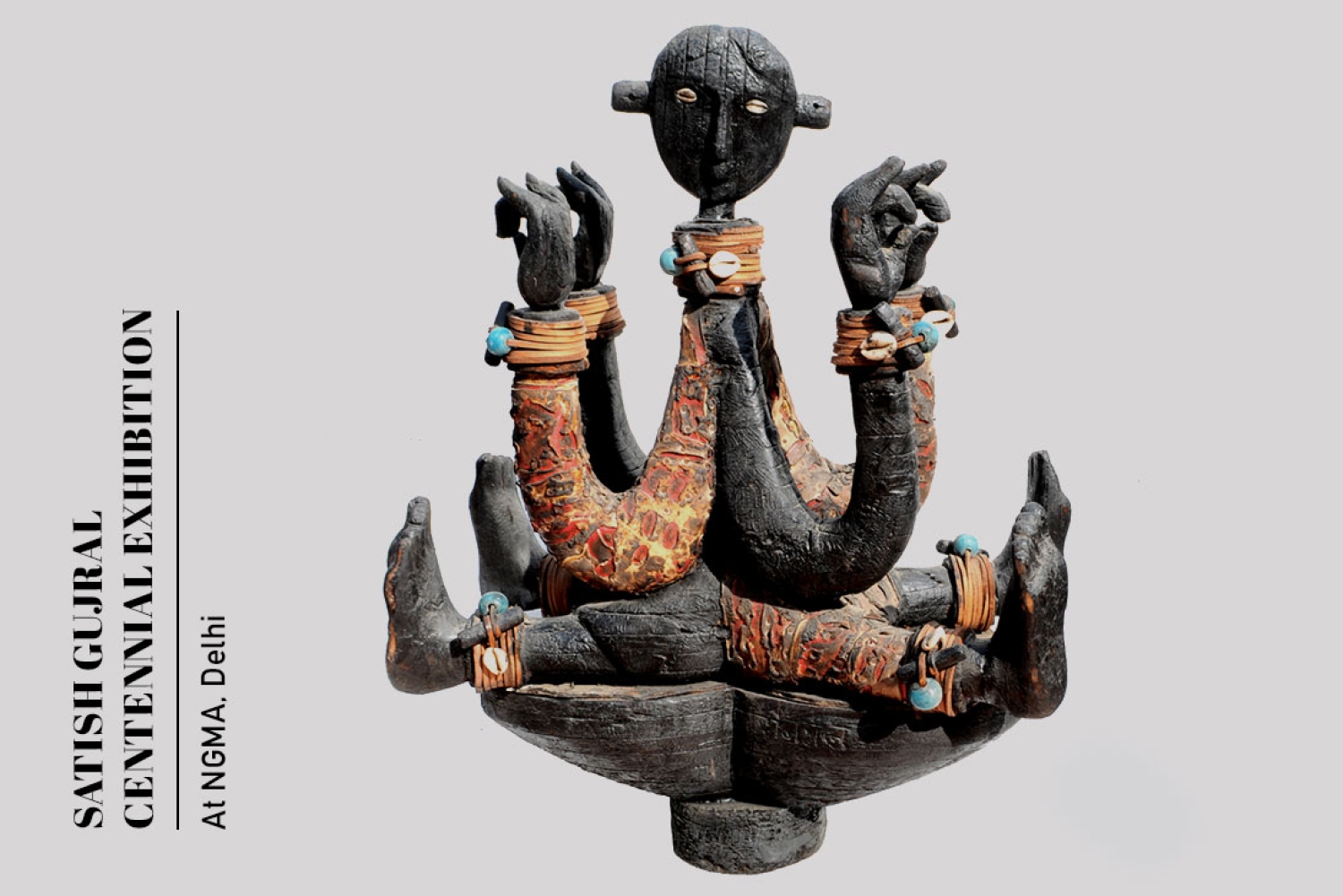
“The word renaissance can be applied to only one Indian modernist—the remarkable Satish Gujral (1925-2020), whom the art critic Charles Fabri described as a ‘genius’ as early as 1952. In a career spanning seven decades, Gujral was critically acclaimed as an extraordinary painter, sculptor, muralist, and architect whose practice touched the lives of viewers in India and around the world. The first Indian artist to train in Mexico, he overcame a lifelong hearing impairment to carve a career all the more significant for tapping into a range of emotive experiences—from the horrors of Partition and his denouement of mitigating political actions, mob violence and riots to the cadences and rhythms of his own life recollected as a series of memories, making his engagement with art is deeply personal.
The centennial exhibition probes into the catalytic moments that shaped Gujral’s practice in ways resonant with his use and choice of materials that introduced a reflective, tactile element to Indian modernism. Gujral’s studio was a place of reflection that allowed him to respond to the silence that engulfed him, affording him the opportunity to convert a disability into ‘the bliss of solitude’, thereby accentuating his skills of observation and deduction. As a result, his art ranged from the empathetic to the playful, from the poignant to the joyful.
Rooted within his own experiences, it became a requiem for a nation’s history—both national as well as individual, and therefore intimate. This exhibition takes a sweeping view of Gujral’s career as an artist who shaped his own destiny within that of a newly birthed nation and its challenges, moving from occasionally faltering steps to those that confidently scaled the heights of ambition. Seen from his unique perspective, the exhibition is an acknowledgement of how the understanding and selective assimilation of global movements and moods played an important part in his creation of art that was rooted in the individual and the indigenous. Satish Gujral was firmly Indian in his outlook.
His art came from his heart and was humanistic in its approach, rising beyond the narrow confines of geographies and histories, to find a place in the global annals of art making. His relevance is no longer of the past but belongs to our collective present and future.”
Satish Gujral: A Century in Form, Fire, and Vision — a centenary celebration, opening on 16th January 2026, on view until 31st March, at NGMA, New Delhi.
Text Kishore Singh
Date 12.1.2026