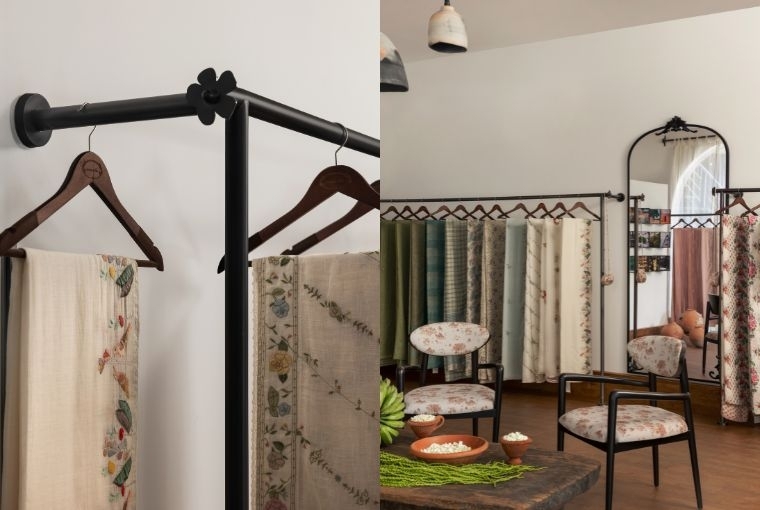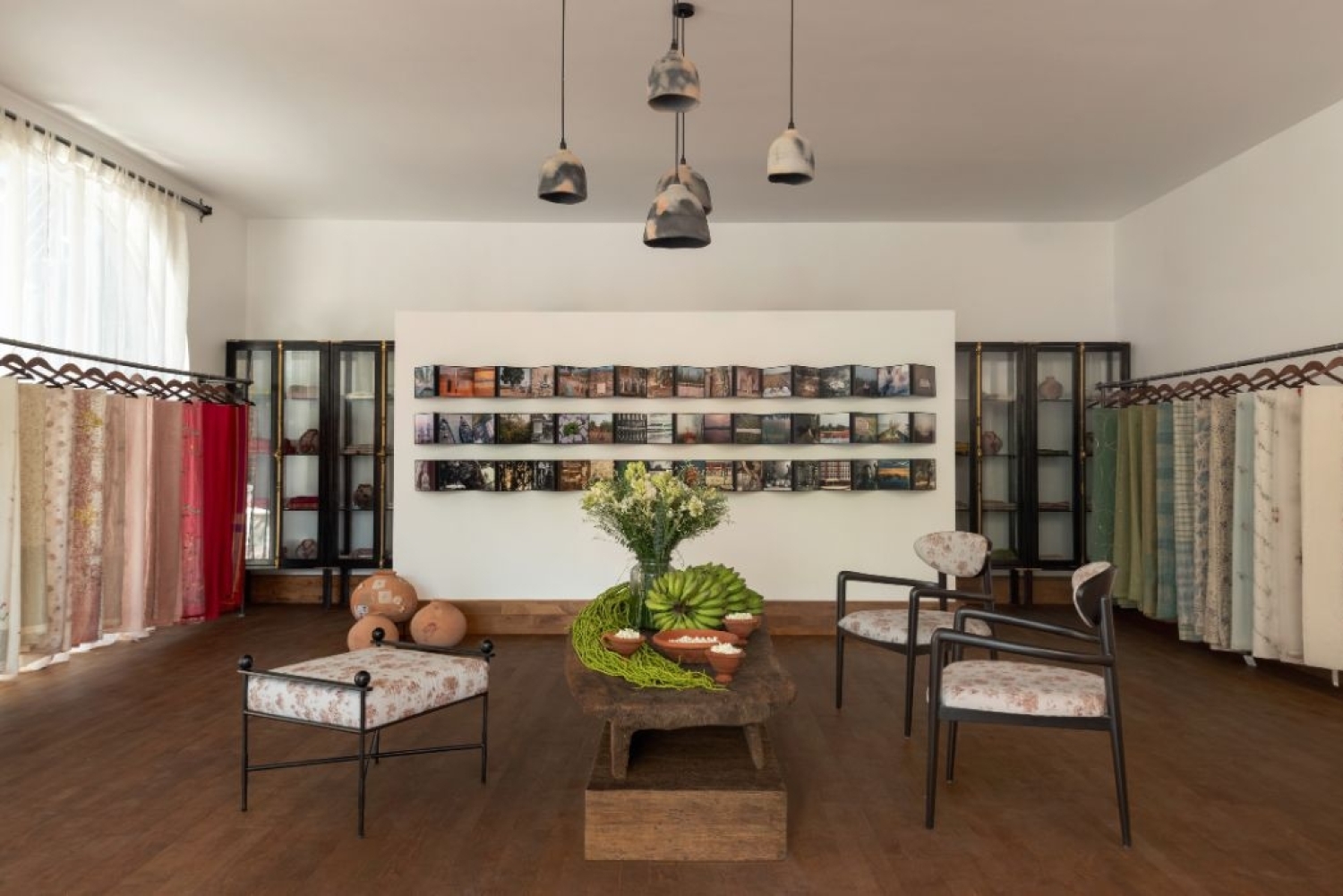
Built around a ber tree, sun-bleached bougainvillaea, terracotta, and the fleeting scent of mogra at dusk, Anavila Misra's new Delhi store is less a retail space than a considered world. Inside, linen, the material that has defined her brand since its earliest saris, moves beyond clothing into upholstery, surfaces, and hand-fashioned flowers on metal rods. A photographic installation traces her journey from Hashupur to Shantipur to Delhi, with her father's village, as she puts it, remaining closest to her heart. We sat down with the designer to talk about the elements that shaped the space, the legacy she feels responsible for, and what Indian fashion must slow down enough to ask itself.
You have a new store in Delhi which is built around a ber tree, bougainvillaea, terracotta pottery, and the scent of mogra at dusk. How did you decide on these specific elements, and what were the early conversations around?
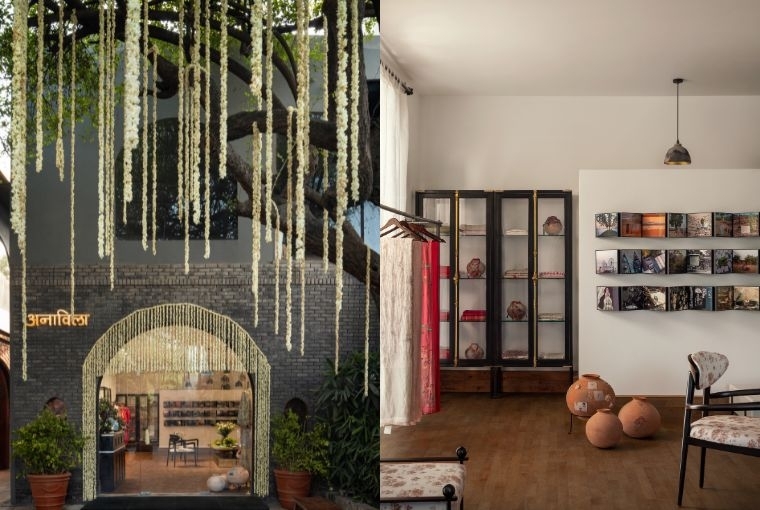
The ber tree and the bougainvillea were a beautiful serendipity. The bougainvillea is what our artisans fondly call kagaaz baha. It has been part of the brand’s visual vocabulary for a long time. So to find it already in bloom, felt almost as if the space was already speaking a language I understood. The ber tree was also already at the heart of this space, and I don’t find that accidental. Throughout my life, I’ve always related to places through trees. Whether it is the Neem tree in Hashupur, my village, which became the shade under which I spent my childhood, or the Jamun tree that carries so many memories for me, trees have always been an anchoring point in my experience of spaces. They feel like the centre of a universe, holding everything around them together.
Terracotta, for me, comes from a place of instinct. I have always been drawn to clay and pottery in the same way I am drawn to fabric. Both are of the earth and water. The way clay is kneaded and shaped by the kumhar, and the way fabric breathes on a pit loom because of the moisture in the air, feels almost connected in some way. There is a shared language between textile and terracotta and that fascinates me. And the reason I decided to place mogra right at the entrance is because it is ephemeral. It is sensual, fleeting, and almost impossible to hold. That elusive quality is what beauty is, to me. Whether beauty whispers or is loud is not the point, it has to feel true. And that, in many ways, is what the scent of mogra at dusk is for me. I think all of these elements, very subtly, give away what beauty is to us. It is of nature…of the earth and water. And it is honest, simple, abundant and alive.
Linen has always been central to your identity as a designer, but in this store, it moves beyond clothing into the architecture itself, through upholstery, surfaces, and metal rods with linen flowers. What does it mean to you to extend the material into the space this way?
I still remember the process of developing my first linen sari, the constant back and forth, the experimentation, and finally that moment when the fabric and the idea began to speak the same language, both for the weaver and for me. So there is a deep personal connection I have with linen. It is much more than a material we work with; it has really shaped the brand in fundamental ways. Extending it beyond clothing, into the upholstery, the surfaces, even into details like metal rods with linen flowers in the store is really a gesture of devotion and of love. It is a way of honouring and staying close to something that continues to define our language even today.
The photographic installation by Pranoy Sarkar traces Hashupur, Shantipur, and Delhi as three chapters of your life and creative journey. Which of those three places feels the most personally charged for you, and why?
I think Hashupur, my father’s village, feels the most personally charged for me. My father’s journey and the life he built have deeply shaped who I am. The village still stands with traces of his presence and work everywhere, and I feel a strong emotional responsibility towards it now, almost as if it is time for me to give back something to that soil. The place is invested with an immense amount of memory and emotion for me. For me a lot of things start and end there, and that it is connected to my dharma; to understanding what I must carry forward from the generations before me.
Both my parents and my grandparents before them lived with immense integrity, simplicity, and strength. I grew up witnessing their struggles, their values, and the way each generation evolved while still remaining rooted.
My grandmother, for instance, was the only woman in the panchayat and was respected as much as any man there. These personal histories feel like a large legacy to inherit. Sometimes I wonder if I will ever be able to fill my father’s shoes, not in terms of achievement, but in the simplicity and clarity with which he lived. I think there is something incredibly powerful about a simple life because it is also fruitful. It allows you to step back and rightfully move forward. Hashupur takes me to that space within myself. It makes me think about the person I want to become and the journey I want to have beyond the brand, beyond work. In that sense, it is the place that remains closest to my heart.
Can you tell us about the collection you have chosen to present at the store? What guided those choices, and how does the work on the floor speak to the spirit of the space it now lives in?
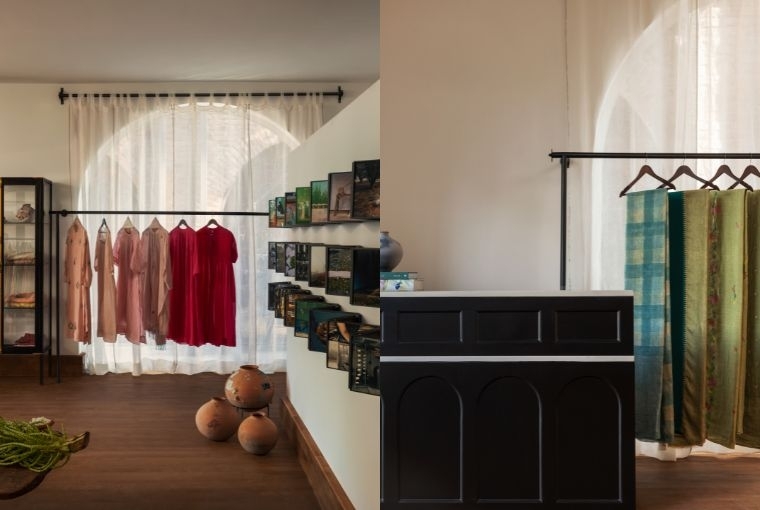
The work presented across the floor is layered in time and, in many ways, traces the journey of the brand. Through it, you can see the origins of the brand, the language we’ve built over the years, and also where we are moving towards next. You can see some of our earliest linen saris and the crafts we’ve worked with, which continue to define us and which people keep returning to even today. The gota kinari and zari work, through which we reinterpret festive dressing, are also very much a part of the space. So are our latest Spring and Summer collections and the floral prints we work with, through which we continue to speak the language of flowers, landscapes, and botanicals. Also on preview are pieces from an upcoming collection where we are working quite intensively with artisans around the idea of their natural habitats, the flora and fauna around them that shape their memories and become part of their visual language.
You were among the first designers to champion linen saris at a time when that was not an obvious commercial choice. Looking at where Indian fashion is today, what do you think the industry still needs to reckon with?
I think we need to return, in some way, to a slower and more thoughtful rhythm of working, and I do feel that shift is somewhere around the corner. Right now, there is this overwhelming emphasis on what comes next, on constantly keeping up with a very social media-driven cycle.
I think growth and commercial success are important, but we are also living through a time of immense content saturation and creative exhaustion. So perhaps the question now is not only what is sustainable commercially, but whether our business and production models can evolve in ways that are also sustainable emotionally and creatively, for our minds and hearts. Can we find a pace of working that allows for reflection, depth, and genuine thought? Because meaningful work cannot exist in a constant state of urgency.
Words Hansika Lohani
Date 22.5.2026