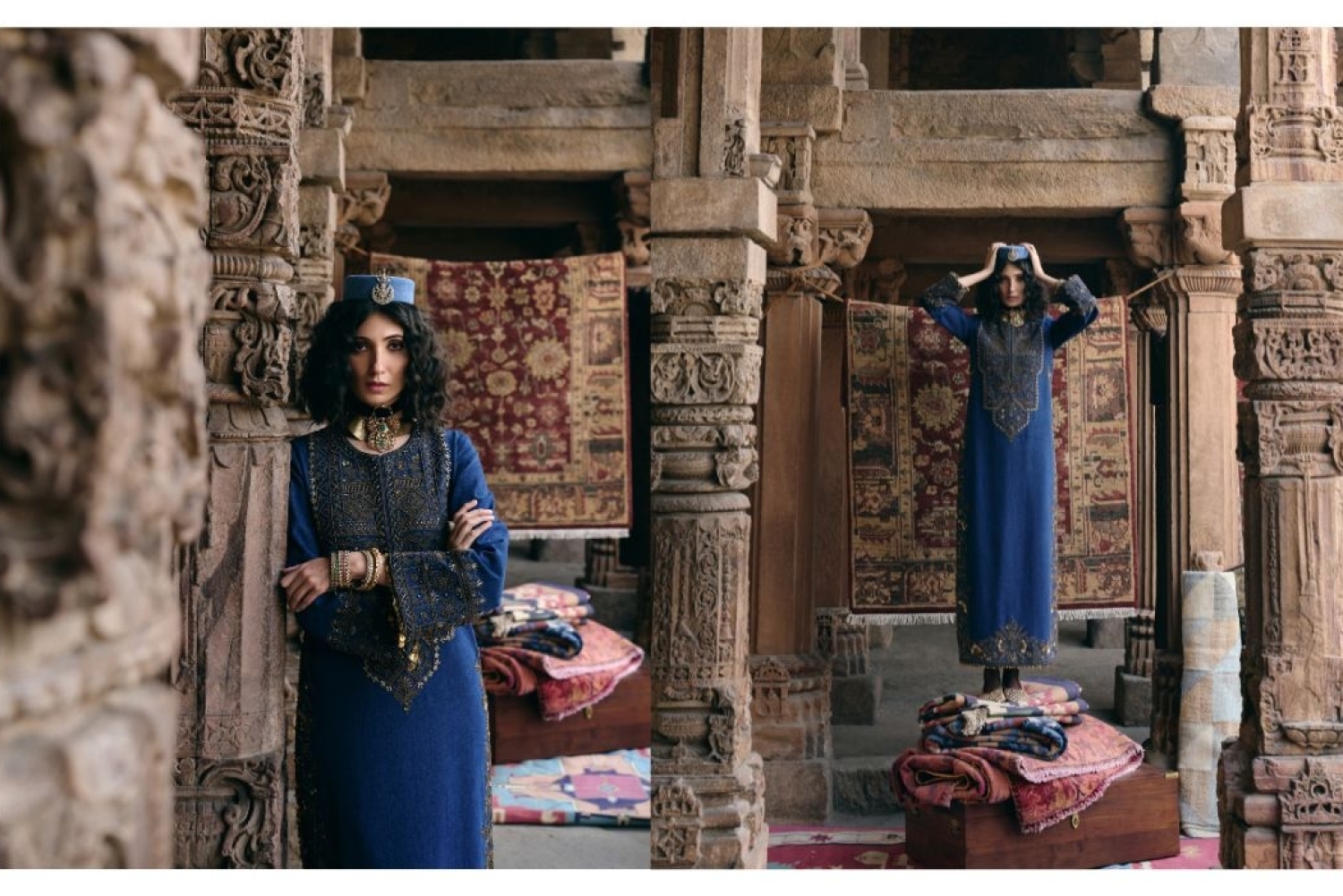
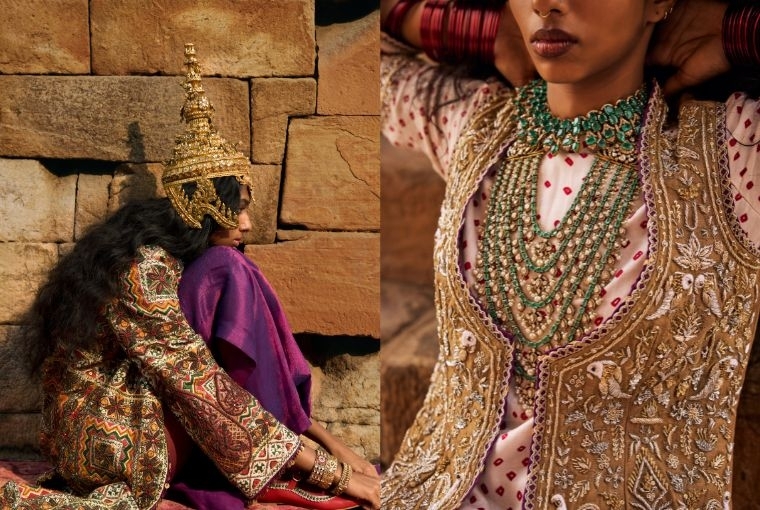
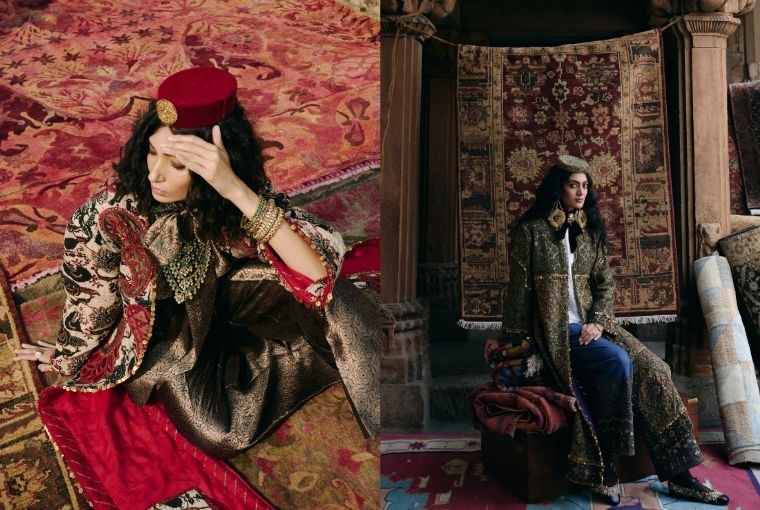
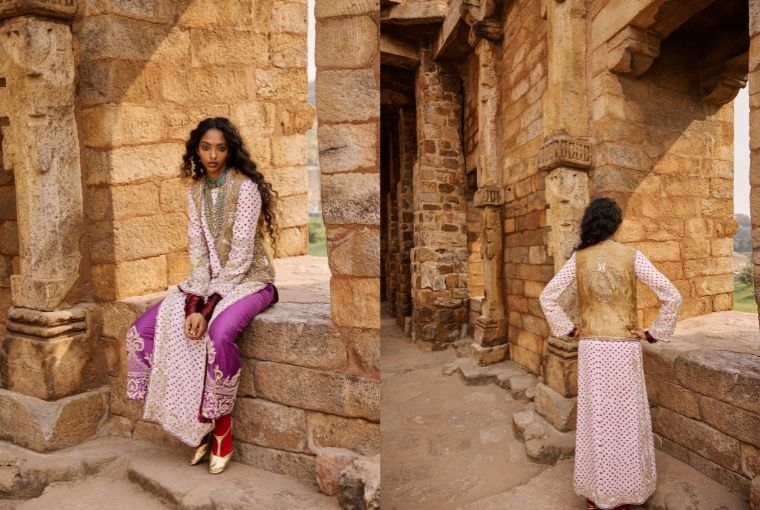
Mayyur Girotra has known from the start that the future of Indian couture is woven, not printed. Drawing from a childhood spent watching the finest saris, shawls and heirloom fabrics glide through his family wardrobe, the designer’s latest chapter, The Collectables, turns that memory into a manifesto. Here, rare Kanjivaram borders, whisper–soft cottons, indigo-rich tie-and-dye and hand-loomed silks are cut into sharply modern silhouettes that feel intimate and glamorous. The intimacy lies in the memories these textiles carry, and the glamour comes from the precision of their modern tailoring.
What looks like effortless luxury on the rack is, in fact, the work of many invisible hands; artisans Mayyur insists on naming, paying fairly and re-centring in the story of Indian fashion today. These are pieces designed to move far beyond a single season: a jacket that begins life as a vintage weave, a lehenga that carries the history of a family loom, a sari recast as a fierce evening look. In Mayyur’s world, every thread carries weight, and every garment leaving his atelier is already halfway to becoming tomorrow’s heirloom.
As a creative, a designer and a lover of the arts, what inspires you? What do you feed yourself with to keep creating?
Mostly, the love for craft only sustains me. As much as I can remember since I was a child, I have had an eye and love for craft.
I think thanks to my family as well. Just creating something gives me so much love and excitement and happiness that you're bringing your vision and what you dream of to life. And that's a very beautiful thing if you think about it; You envision something, you work towards it and bring it to life and it stays forever. That feeling itself for an artist is so satisfying.
The Collectables began as a very personal search for rare and historic textiles. Can you walk us through a specific moment or discovery in that journey that fundamentally changed how you think about Indian handloom and its place in luxury fashion?
I have always been a fan of Indian handloom and textiles. My grandmothers, my mother, my aunts, I have only seen them wearing the finest of textiles and textiles and handloom in our household was taken very seriously. Whether it is saris, or whether it was shawls, or whether it was fabrics. The whole, I have been brought up in a family which has had a lot of love for craft art and textiles.
I think this was embodied in me since I was a kid. And I always knew, and I still know that it's luxury. But I also know that a lot of people, especially Indians, take it for granted, because it's very easily accessible and available to us. But for me, I never take it for granted, especially with collectables. When I went so deep into studying about artisans, meeting them, and knowing more about each craft, my respect for all really deepened. For me, I would never say cotton is not luxury for me. Cotton, tye and dye and indigo, they are all luxury, they are all couture, because I know, I have seen the process behind it. I have seen what goes into making that, how many hands burn into making it.
You’ve spoken about visiting textile hubs like Kanchipuram and feeling the disconnect between the weaver’s reality and the final ‘luxury’ product. How did those encounters concretely shape the financial and creative model behind The Collectables? What did you change in terms of how artisans are paid, credited, or involved?
Individually, in my journey, I am making sure I give them the right wages. I want to educate them that they are artists and they are making beautiful craft and they should not give up on this, and their families and the kids should also learn it. But only giving them that gyaan is not what is required. They want to change their lives. And that can happen only through the right remuneration and wage structure. I think slowly and gradually it will build up in our country and I'm playing my part as much as I can.
What was your process for sourcing the textiles and deciding which pieces were ‘worthy’ of becoming heirlooms?
So yeah, I use every textile as and when I mix them, match them. The label is only that since inception. I have always been playing with colours, mixing, and matching so much. I don't really have a definition for my design language. It's very fluid. I definitely don't work with a lot. Ethically, nothing is sustainable in our country to be honest with you. Every process somewhere is leaking or has a lot of wastage.
So if I say that everything end-to-end is sustainable in my process? No, none of us can do it. When you work with handloom, handcraft and hand-dyed fabrics, you don't call them sustainable, but eventually there is a lot of consumption of water and other materials that are used. So sadly, in a world of fashion, where if on one side, we want to make something which is hand-woven, hand textiles, hand dyed, the processes involved are not very sustainable. But obviously, keep staying as conscious as I can, I would never work on things like real fur or hardcore pure leather. I stay away from such things because I am a vegetarian. I practice vegetarianism. That's my lifestyle. And so obviously, I stay away from animal skin, animal fur. But having said that, when we are weaving pure silk, it's a lot to do with the fact that there are a lot of things that are done to it. But we try to stay as much as we can to do what we believe in.
The Collectables is framed as a limited, heirloom-focused line. How do you balance preserving the integrity of these rare textiles with the need to innovate in cut, silhouette and surface, so they feel contemporary rather than purely archival or nostalgic? Are the garments not open to customisation?
Basically, most of them are off-the-rack pieces. Okay. But there is a parallel line in Collectables that is Zardozi on denim, which we can produce.
But when I'm working with textiles or when I'm buying textiles on my travels, they are limited; they are not mass-produced. So I basically make sure that my silhouettes are very practical. And they are something that they are timeless classics, which have a repeat value. Collectables is not just all about old textiles; it's also about new textiles. The whole definition and the process behind Collectables is that whatever we are creating today is an heirloom for tomorrow.
You’ve acknowledged that these are “very small steps”, even if they transform the lives of ten weaving families. What would a truly sustainable ecosystem for Indian textile artisans look like to you, and how do you see The Collectables as a prototype or starting point for that future?
Where they are living the life they should be living: their needs are met comfortably, they have fair and stable remuneration, and they are not afraid of their children following the same path, because that fear has disappeared. When we say that the craft is dying, it is primarily because they see no long-term future in it. Artisans feel they cannot sustain their lifestyles and see no improvement in their living conditions. As a result, they stop producing, and the consumption of the craft declines. It becomes a full circle.
From start to finish, how does Mayyur Girotra create? Is there a method to the madness?
I do not follow a strict method. I simply create what I love, and my approach is very fluid. Ideas often come to me late at night, around 2 a.m. I write them down and begin developing them. I keep creating and experimenting, and I may start with one idea and end up transforming it into something completely different. What I value most in designing is the sense of freedom. It is difficult to define, and that is exactly what I love about my work.
In the future, you will see me continuing to create, with a stronger focus on reaching the right audience. I have always believed that word of mouth is the best form of publicity, as one client recommends you to another. For a designer, that is the true measure of success. Above all, I want to keep going back to the artisans and provide them with more and more work. That is the impact I hope to achieve.
Have you ever had moments of doubt on this journey? How did you pick yourself up then?
Yes, absolutely. Self-doubt is a very natural part of the process. The key is to keep talking to yourself kindly and remind yourself how far you’ve come. You have to believe in yourself. That belief grows through positive self-talk. Your main comparison should be with who you were yesterday, not with anyone else. Still, it isn’t easy in the fashion world, where everything moves so fast. It can be hard to keep up and still stay true to yourself and trust that what you’re doing is right. You really have to keep talking to yourself, stay grounded in gratitude, and move forward with that mindset. That’s what I do.
Words Hansika Lohani
Date 20.3.2026