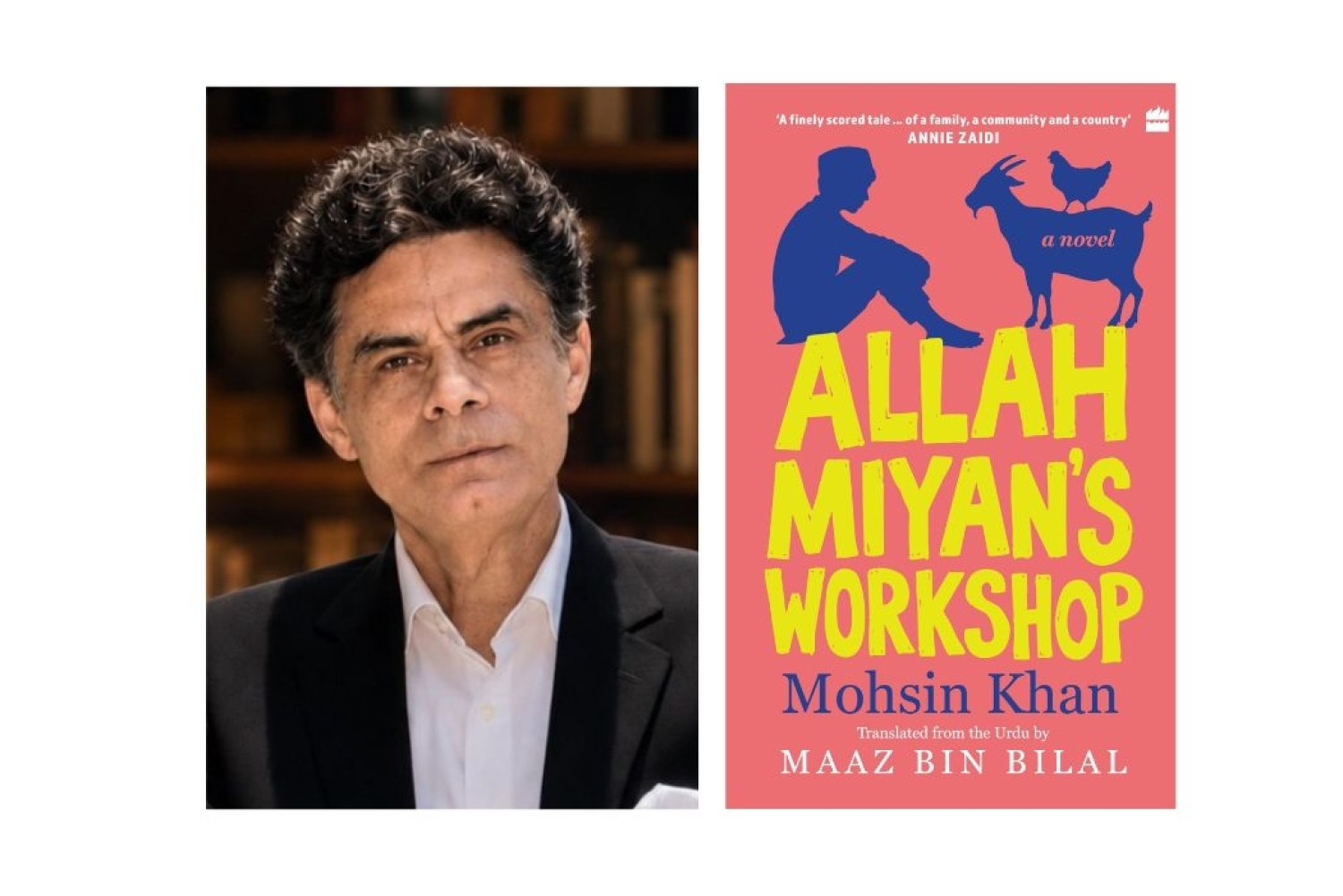
Author, Mohsin Khan
Author, Mohsin Khan
Books with children at the centre have always been excellent at offering layers and profound input into the human condition; what drives us, what destroys us, what keeps us going. Mohsin Khan's award-winning story, Allah Miyan's Workshop, uses a child's perspective to explore extensive themes. At first glance, its narrator, Gibran, appears preoccupied with kites, animals, mischief, running away from studies like any other student. Read in between the lines and it becomes clear that his lens is a reflection of chilhood and its travails.
Gibran lives with his parents and younger sister, Nusrat, in a small village in Awadh. His deeply religious father frequently leaves home, and both siblings attend the local madrasa rather than a conventional school. He fills his days flying kites, caring for the family's chickens, and entertaining himself with small adventures. At the heart of the novel is his affectionate relationship with Nusrat, whose warmth and innocence make her one of the most endearing characters. By filtering life's biggest questions through a child's unguarded gaze, the novel examines how dogma, excessive religiosity, and ritualism can stifle curiosity and childhood itself. We're in conversation with Mohsin Khan, the author.
The novel captures both the joys and difficulties of childhood. Why did you want to tell this story through a child's perspective?
Unlike adults, children look at the world with honesty and innocence, and express what is in their hearts fearlessly, without any foresight or expediency. They reflect on small things, ask difficult questions, and do not worry about the consequences. If this story had been narrated by adults, its innocence and delicacy would not have remained intact. The novel contains several harsh and forbidden subjects which do not seem objectionable because they are being narrated by a child. While reading the novel, the reader forms an image of a child in their mind and feels that the child is recounting the true story of his life. Many readers ask me whether Gibran is a real character, or whether I myself am Gibran. The fact is that, through the eyes of a child, I have tried to present issues such as poverty, faith, family, friendship, and human contradictions with simplicity, and with love and gentleness rather than bitterness.
How did the story for this novel find you? What is your writing process?
This novel is based on my observations, memories, and the lives of ordinary people around me. Some experiences and incidents from the past were preserved in my mind, which I arranged and shaped into a novel. I do not begin writing with a predetermined plot. A character emerges from the subconscious, and the story naturally finds its own path. I write slowly and revise repeatedly. I reflect on the language and dialogues and try to improve them. My effort is to ensure that the story does not feel artificial, but rather possesses a flow and a natural quality.
When it came to balancing tenderness and serious subjects while writing, did you face any challenges along the way?
I wrote many stories and dramas with great effort and discipline, but neither did I like them nor were they able to gain the attention of readers. On the other hand, there are some stories and dramas that I wrote with great ease in a single sitting, and not only did readers appreciate them, but they were translated into other languages and received awards. There is a creative state that cannot be forced out, but appears naturally like rain or the wind. I completed this novel with great ease and within a short period of time. My desire was neither that the reader should remain crushed under the weight of sorrow, nor that the bitter realities of life should be ignored. Humour, curiosity, love, and small joys give human beings the courage to live even in difficult circumstances. I tried to ensure that all these emotions remained present together, just as they do in real life.
What do you hope readers take away from Gibran's journey and the world of Allah Miyan's Workshop?
Urdu and Hindi readers not only loved this novel immensely, but dozens of articles were written about it. Videos were made, and it was adapted for the stage. Now that it is reaching a wider circle of English readers through HarperCollins India, I feel even happier and am confident that English readers will also appreciate it. My wish is that, after reading this novel, readers feel a sense of closeness to Gibran and emerge more compassionate and more curious. Characters like Gibran are not confined to any particular society or region, but exist everywhere in the world. Gibran's journey reminds us that childhood is not merely a stage of life, but also a way of looking at the world with an open heart, innocence, and wonder. If, after reading this novel, the reader feels greater empathy for the lives of ordinary people, values human resilience, and carries away the belief that hope can remain alive even in the most modest circumstances, then I will feel that my purpose has been fulfilled.
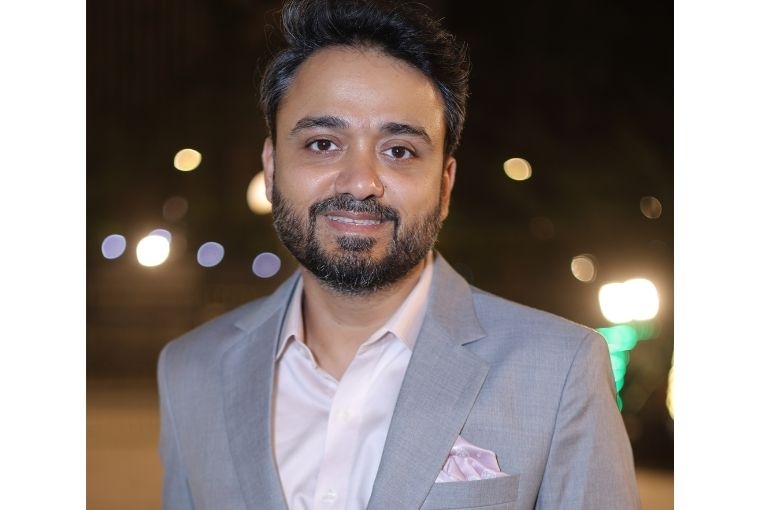
Translator, Maaz Bin Bilal
We also spoke to the translator, Maaz Bin Balal, about his process, relationship with language and the function of translation.
What is your relationship with Urdu and English?
Urdu is my mother tongue, English is my professional language. But that division is not watertight. I dream in both languages; I emote different feelings to different people in both or either language as needed. I write primarily in English but have also published in Hindi-Urdu. I have barely any formal training in Urdu, I have four university degrees in ‘English’. I feel more confident in English, but I have a greater yearning for Urdu. Translation is my attempt to further hybridize my world, learn and express both languages better and to play with them.
Tell us about your translation process. Take us step by step.
I translate a work or author that resonates strongly with me. This could be for different reasons, including sheer pleasure, socio-political relevance, personal identification, and admiration for the strength and qualities of the work. With poetry, I seek to recreate form as well as meaning. With the creative prose in this novel, I focussed on maintaining the voice and tone of the young protagonist, Gibran, tried to avoid a more adult diction, and to recreate the world of these characters, without flattening or anglicizing the narrative completely. At the level of the prose, I tried to emulate original syntax to the extent possible without making the English prose clunky, and retained cultural concepts and objects as they were, while making space elsewhere for their explanations. Yet, I find it abhorrent to exoticize English prose with native words for the heck of it.
Were there specific words or cultural references that resisted translation? How did you navigate those moments?
A superstition such as ‘kawwa baithna’ or ‘a crow sitting on someone’s forehead’ is one example of a cultural reference that was tough to navigate. It is a local belief that was new to me too, and is rubbished within the narrative as well. So, first, to bring it in, explain it, only to reject it, while not making all of it verbose, since the original never bothered to explain it, was tough. I have tried a trick of sorts to introduce another native word/concept here to comment on this superstition, which had its own logic and worked well here. I have commented more on this, among other translational problems, in my note in the book Confessions of a Reluctant Translator, and I will leave the readers to find out more as they pick up the book.
According to you, what is the function of translation? How does your translation give this story a new voice?
The function of translation is to bring a cultural, linguistic, thematic, and regional, [in this case even religious] newness into a literature. It also allows greater prominence for the source literature, work, and author. It is a responsibility for the translator, but also their domain of play. My translation seeks to bring Mohsin Sahab’s world of Gibran to English with verve, yet simplicity. There are also some collaborative new bits, a few upon my suggestions, a few straight from the author, that I am not sure have even made it to the Urdu editions yet. I earnestly hope that Gibran’s vital tale of our times travels far and wide through my English words.
Words Neeraja Srinivasan
Date 24.7.2026