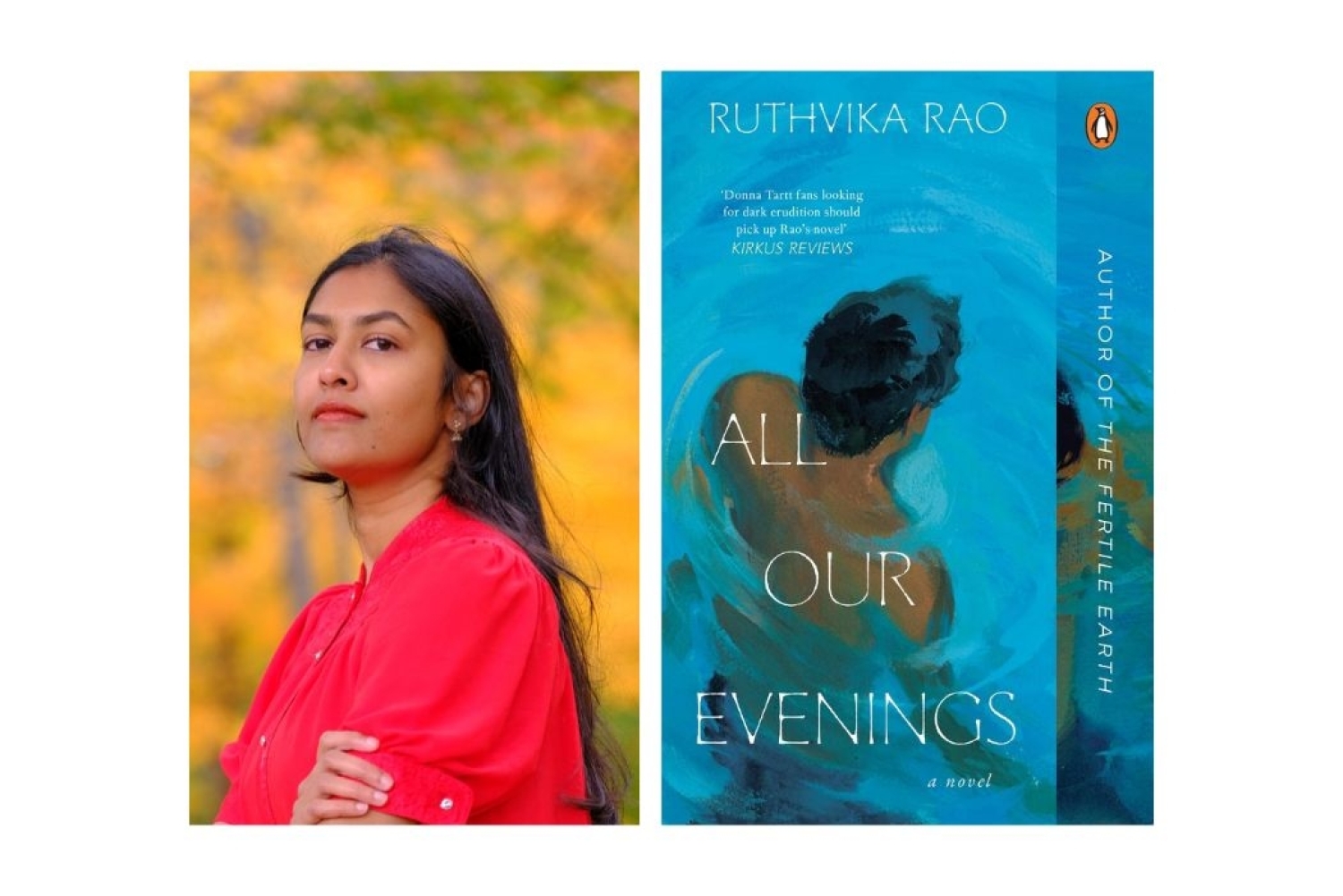
Summer may have passed but a good summer novel never ceases to exist. All Our Evenings by Ruthvika Rao is one such story set across a sun-drenched summer where Arjun, Ruhee and Ganesh, the trio at the centre of the story, form a strong bond. They confide in each other, even fall in love, and their lives are intertwined in a way that childhood friendships often are. But an incident brings their friendship to a sudden rupture, leaving behind questions and silences that linger long after that summer has passed. Moving between the past and the present, this compact, slow-burning novel explores the complexities of human relationships, the things left unsaid, and the memories that continue to shape us.
Tell us a little bit about the roots of All Our Evenings. How did you find this story/the story find you?
Years ago, I wrote a few pages about a small neighborhood in Hyderabad. I wrote what were essentially character sketches, landmarks, lines of prose that drew me into the atmosphere of the neighborhood. But it wasn’t a story exactly, though I called it that and put it aside. Every year I would take it out and fiddle with it, there was something so tense and intriguing in the pages that I couldn’t help returning to them. After my debut novel was published, I decided to train my attention on these pages, and find out what happened. I think the book still carries the same energy of intrigue and suspense that existed at its conception.
So many things go unsaid between the love triangle at the centre of this novel. The relationship between all three of them, Arjun, Ruhee and Ganesh, requires a lot of reading between the lines. What inspired these characters?
I wanted to creatively push myself. My first novel has a big cast of characters, and the technique to handle a large cast in a time of revolutionary change, where the stakes and the drama is so intense; it’s very, very different from handling a small cast, told solely from a the perspective of one character, when the novel thrives on the emotional drama between them, in the lucid, slow-burning atmosphere of a small town in the 90’s. So much going unsaid: this, in my opinion, is true to life. Very rarely are we capable of expressing our feelings clearly, and what is expressed isn’t necessarily true. And that is assuming that we are even fully aware of our feelings. The most intense moments in our lives happen in the spaces between conversations, where things are unsaid and yet are true.
The structure of the novel is very delicate and succinct. It moves between Arjun’s present and a summer that shaped his life. Why did you choose this structure to tell the story?
I do find, in my own reading, a real whiplash when characters are yanked between one timeline to the next, and each time it leaks a lot of narrative energy from the story while we re-orient. I was always clear on my goal of writing a compact novel, and a compact novel is unforgiving and demanding in its expectation of pace and energy. In a story that lives in two timelines, I found the best way to do this is by subtle slips back and forth, which very often you don’t even register in the reading experience. I also thought this is how we remember things. Very rarely do we revisit memories in our mind by anchoring events on a particular date and year. We slip in and out of our memory, and the novel reflects that psychological movement.
Your novel has echoes of dark academic fiction and slow-burn thrillers. Are there any writers or works that influenced your approach to suspense?
A Pale View of Hills by Kazuo Ishiguro is masterful. At one point I had to put the book down because I was too scared to continue! And in the end, for a reader there is so much ponder over, so much subtlety. It is so layered and mysterious, but the source of mystery is the human mind itself.
What is your writing routine? How was the experience of writing this book different from your debut, The Fertile Earth?
The Fertile Earth is an expansive novel, that style of book is meant to be read slowly and really savored. All Our Evenings is a compact novel, and in this style there is no room for mistakes. It is almost like a short story in how unforgiving and demanding it is. It is a switch in the way of thinking, and it requires an extreme amount of discipline on the work. I write all the time.
There’s no routine in a sense of writing only at particular times or with particular implements. I’m waiting in line in a queue somewhere and I’m noting down a sentence that sailed through my head while looking at a bar of chocolate at checkout.
What are you working on currently and what’s next?
I’m catching up on all the reading I missed out on while working on All Our Evenings. Recently I read Paradise, by Adbulrazzak Gurnah, which was an incredible experience. I’m currently reading Independent People, by Halldor Laxness, for a book club I have with a couple of close friends.
Words Neeraja Srinivasan
Date 27.10.2026