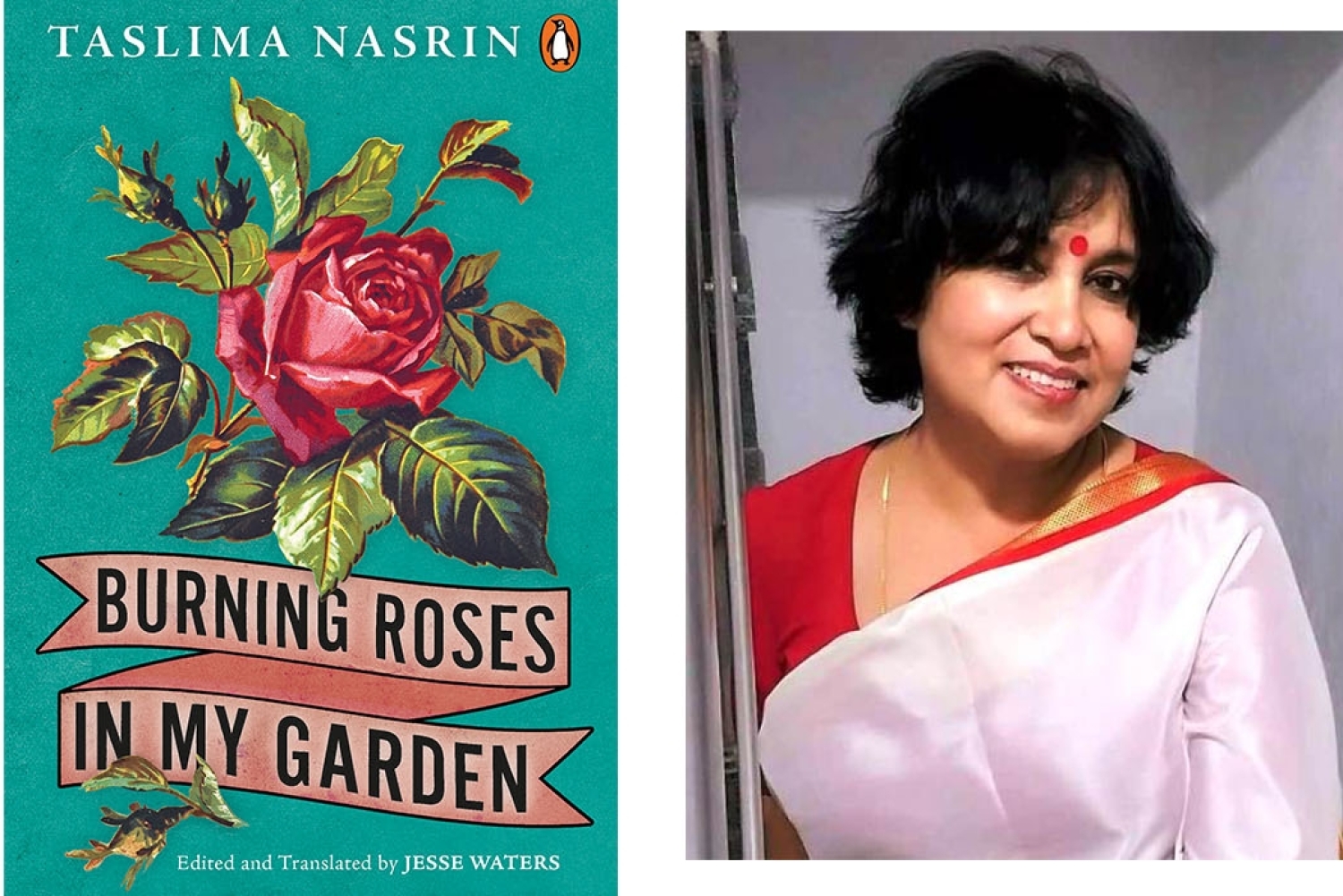
Widely celebrated and acclaimed author Taslima Nasrin, famously known for some of her previously revolutionary work Lajja, Split: A Life, My Girlhood, Exile and French Lover, is back with her first ever collection of poetry in English, Burning Roses in my Garden. Edited and translated by Jesse Waters, the collection is intimate, and exists elegantly in the intersection between the personal and the political. We’re in conversation with Taslima Nasrin on all things related to writing and poetry.
Since this is your first ever comprehensive collection of poetry, tell us a little bit about the process of compiling it.
This is my first ever collection of poetry in English that’s been published in India. Collections of my poetry have been published in Bengali and Hindi both in Bangladesh and India as well as English in the USA. I’ve also had poetry collections published in French in Europe. For these processes, I select the poems for the collection I think best fit a given theme – or set of themes – I’m working with. As I write in Bengali, and not in English, I ask some of my Bengali or Indian acquaintances to translate my poems into a generalized and basic English. Some of them did. But what’s interesting is that some people sent me translated poems even though I did not ask them to do so… they did this simply out of love for my poems. I collected these early translations I received from so many different people, but many of them were just literal translations. While these are fantastic people who support who I am and what I do, they’re unfortunately not poets, they just understand and know both Bengali and English. I then sent all the translated poems to Jesse Waters, an American poet, good friend, and a professor of creative and critical writing at Elizabethtown College in the US. I’ve known him for almost 15 years, and I trust him with my work as he himself is a fine poet. He and I worked together to pick the best poems from the group of work I’d sent him.
Actually, long after reading some of Bengali poet Rabindranath Tagore's poems, W.B. Yeats was instrumental in getting Tagore’s collection published, and spreading the word about him and his work in so many literary circles. Yeats was an eminent, celebrated poet who understood another poet’s feelings, and even wrote the introduction to Tagore’s Gitanjali. In this introduction, Yeats wrote, “I know no German, yet if a translation of a German poet had moved me, I would go to the British Museum and find books in English that would tell me something of his life, and of the history of his thought.” I wonder, how many poets in today’s world would do this! Simply knowing the language is not enough – one really needs to be a writer or a poet to translate another writer or poet. In the past, writers translated the works of other writers with some regularity, but nowadays, we hardly see this phenomenon. French poet Charles Baudelaire translated American writer Edgar Allen Poe, and this even led some bilinguals to prefer Baudelaire translations over the originals! Ezra Pound edited T. S. Eliot’s “The Waste Land,” the work that earned for that American poet the 1948 Nobel Prize in literature. Edward FitzGerald, the English writer, translated The Rubaiyat of Omar Khayyam (1859), which achieved its Oriental flavor. Long before that, in the 14th century, the first fine translation of Italian into English was made by England's great poet, Geoffrey Chaucer, who adapted from the Italian work of Giovanni Boccaccio in his own works. Chaucer even began a translation of the French-language Roman de la Rose, and completed a translation of Boethius’ work from the Latin. Going this far back, some might even say Chaucer founded the English poetic tradition of adaptations and translations from those earlier-established literary languages. So adaptation, which formerly was common, has certainly changed over the centuries, Probably since the 19th century, instead of adaptation, literal translation or word-forword translation became a norm.
Describe your relationship with poetry.
I grew up reciting poetry of the great Bengali poets. My eldest brother published a literary magazine, and I remember seeing how excited my brother was both writing and publishing his own poems and those of other people. Reading his poems as I began my own journey into reading in general was an amazing experience! I remember when he fell in love with a girl in the neighbourhood and expressed the way he felt for her in his poems. It was a kind of magic, I guess… I was just so inspired by my eldest brother that I started writing my own poetry when I was about 12 years old. Slowly, I started to notice that the subject of my poetry was often the desire for freedom. We girls and women are shackled in patriarchal society, and I found myself writing about those struggles and frustrations. After finishing secondary school, I edited and published a poetry magazine, and while In medical college I edited 'wall magazines' and created a literary group. After graduating, and becoming a doctor, I created a group for reciting poetry. We used to recite poetry in different literary programs and during that formative time in both my public and literary life I published my first poetry book. My other collections were later published over the years; my second book of poems was in the best seller list, and when this happened editors of different newspapers and magazines asked me to write columns for them. So my poetry was the reason I became involved with being a more public writer of different modalities, not just poetry. The columns and opinion pieces began to appear in national and international newspapers, most of them about the rights of women. My message was that of raising consciousness in a male-dominated society where women are treated as sexual objects and slaves and childbearing machines. Over the years, I’ve now published 50 books -- poetry, essays, novels, short stories and a memoir. I write columns, novels, etc. for income; since poetry doesn’t really sell well, it gives me happiness and peace. After all, one has to eat but also be content with being a creator. Irrespective of whatever form I’m writing, I recognize the power of my voice, and my place in the world: In my columns and essays, I am a fierce, furious woman constantly fighting against injustices and inequalities to make the world a better place. In most of my poems, I am a loving and caring person, a lover. I want women everywhere to share in that voice, and create a chorus of power and awareness that all of us both share and create.
The struggle for self-identity is a theme that runs through several of the poems in this collection; what are other experiences that inspired this anthology?
My poems are about the struggle of women to be considered human beings. With so much oppression and violence in the world that’s directed solely at women, I try to capture and reflect these struggles. But my poems are also about love and pure passion. I write poems when I cannot fit what’s in head and heart into another form. It’s the ultimate vehicle for expressing my thoughts when I feel beaten up, exhausted, frustrated, powerless, and angry, or homeless; poetry gives me solace. Poetry is my one, true home.
What are some challenges you encountered while putting this collection together?
I am grateful to Penguin India for publishing this Burning Roses in My Garden. Even though Youtube is flooded by my poems recited by thousands of Bengali people, those poems are in Bengali. While I hope they do, I really do not know whether readers like to read poems that are translated. Nowadays, fewer and fewer people read books as there’s so much media to choose from. And If they do read, they tend to read novels. It is a well-known fact that poetry books do not sell well, so the first challenge is, of course, getting this book into people’s hands. But poetry is perhaps the most powerful of all literary voices, and if a person gives poetry a chance, it will open their lives in ways they might never have expected. It was certainly a challenge working over the years with Jesse to bring this book to its best state.
The anthology is rather retrospective and necessary in its intention and scope. What do you hope the readers take away from this book?
Dreams to live in a beautiful world, and the chance to see a side of humanity they may never have known existed.
Lastly, what are you working on next?
A collection of essays and another book of poetry.
Date 09.10.2023