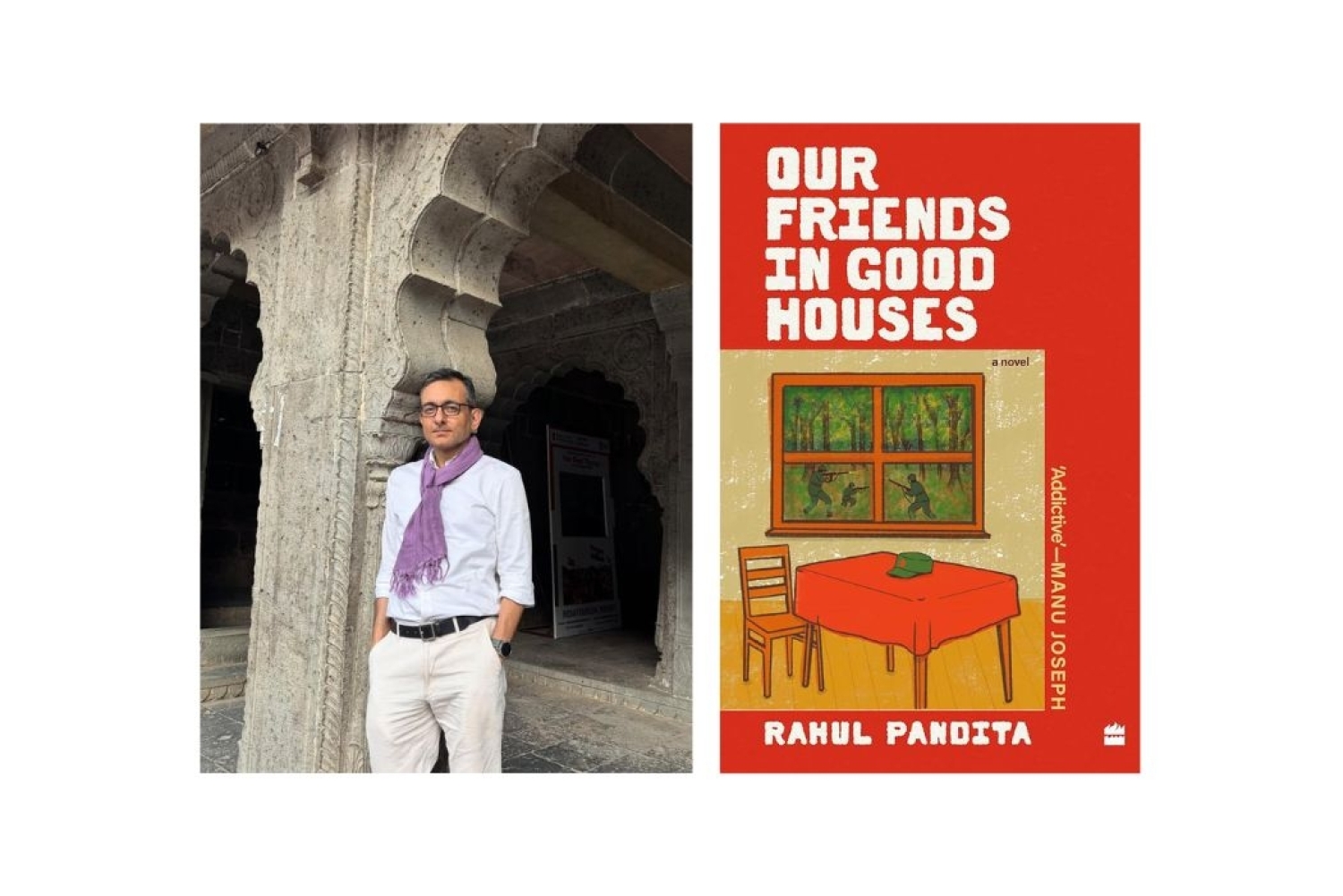
Rahul Pandita’s debut novel Our Friends in Good Houses follows Neel, a journalist drawn to war zones. It’s in these spaces riven by conflict that his sense of dislocation, of not belonging anywhere, drops off him. At all other times, he’s in quest, seeking solid ground: a home. It is a pursuit that takes him halfway across the world to America and back to the urban dystopia of Delhi, headlong into fleeting relationships that glimmer with the promise of shelter. Rahul speaks of the story beginning as several streams that were eventually held together by the concept of ‘Ungrund’, a word to explain the lack of a solid ground. He also draws from his own experiences as a journalist, where he felt a certain gap between what he was witnessing, and what he could articulate. ‘The idea of home works as an antidote to impermanence all around us.’ he says, while delving into the quest for home that the novel is centred around.
Rahul gave us insight into the creation of his debut novel, what the quest for home means to him, and influences that guided him.
What drew you to this story for your debut novel? Take us right back to the beginning.
The story began in my head as several streams. But it came together with the seed of ‘Ungrund’ - that is the word the German mystic Jakob Bohme uses for explaining a lack of ground. At the heart of it is also a love story, which at one point I wanted to write separately. But then it all came together organically as one unbroken love story, as I call it.
How did your own experiences as a journalist shape this story?
Immensely. During my journalism, I often felt a gorge between what I was experiencing and what I was able to express through my journalistic dispatches. My experiences are all over this novel, and those who have read my journalistic world will spot those easily.
What does home mean to you, given Neel’s quest is what shapes the narrative?
I wish I knew. But my protagonist Neel has a very definitive idea about it. The idea of home works as an antidote to impermanence all around us. That way, Neel and I are quite similar -- both of us have this dread for change that is constantly happening around us. But in the end, Neel is wiser and accepts these. I am still not able to.
What are some influences, literary or otherwise, that kept you company through the writing process of this novel?
There are many. For me, VS Naipaul, foremost. But other influences are many, and I have created small tributaries around them. I was recently at this beautiful bookshop in Mumbai called Trilogy, and Ahalya, the founder, said she had made notes of many writers and philosophers mentioned in the novel. I have found similar tributaries in the writings of other people, and now I have done my bit.
The title is quite intriguing—what’s the story behind it?
It has meant several things to me at several points during the process of writing. I prefer it that way; the readers should also be able to derive their own meanings from it.
What was the most challenging aspect of turning themes of exile and longing into fiction?
I have very consciously stayed away from my own story of exile in this book. There are so many other things that have moved me. You will find some of them in this novel.
What’s next, what’s the future holding?
I am constantly thinking of new things to do. At present, I am deciding between two or three ideas. But that apart, the future is love. It has always been that for me.
Words Neeraja Srinivasan
Date 9-12-2025