Photography Kenzi Crash
Photography Kenzi Crash
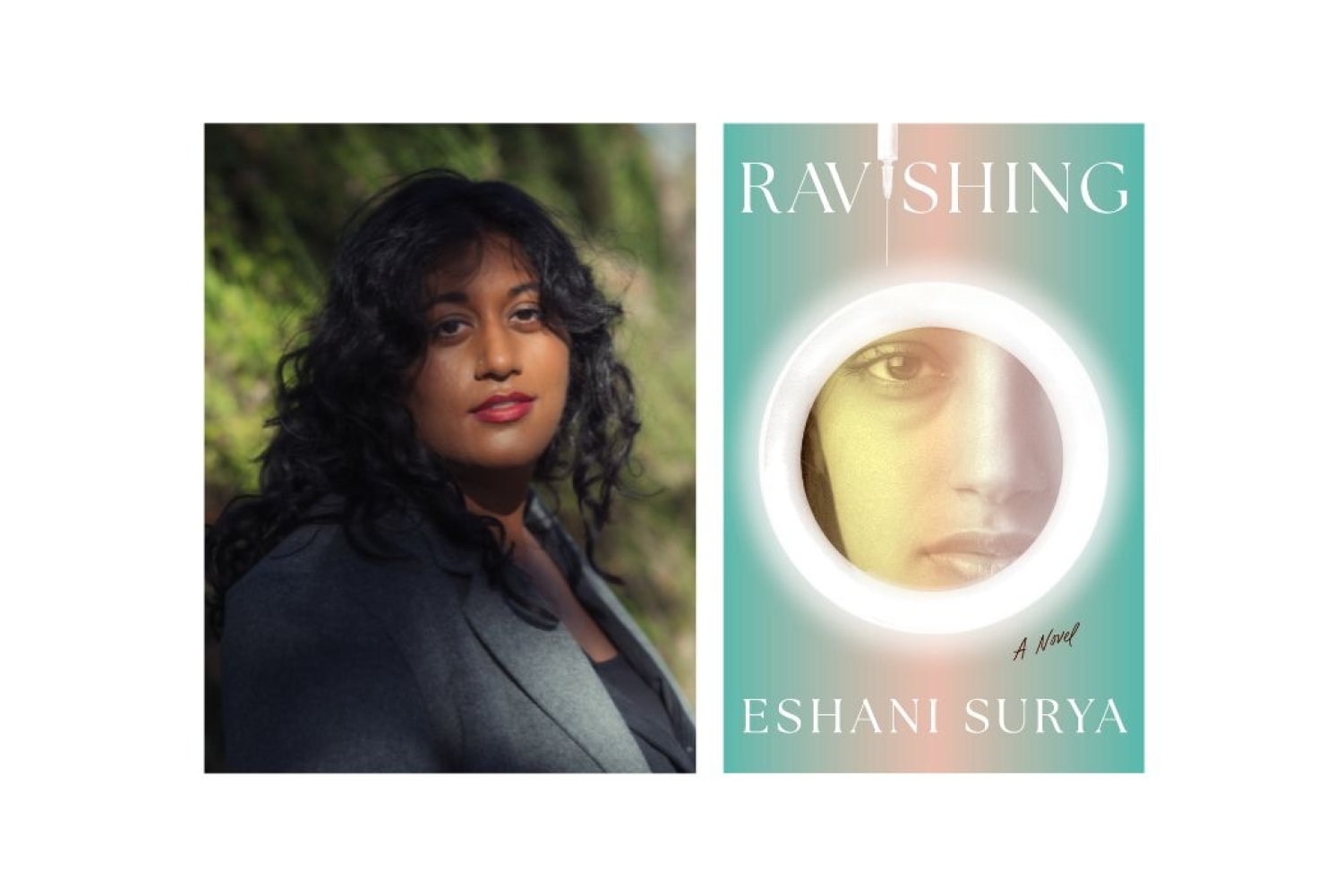
Growing up South Asian in the 90s in a predominately white suburb in the United States, Eshani Surya has always been interested in how we perceive our bodies, beauty, and who we are. As someone who constantly strived towards mainstream beauty ideals, the diagnosis of ulcerative colitis, a digestive disease, meant she had to contend with being sick—a state many would call ugly—on the inside, while looking healthy on the outside. This upended her understanding of her own body, and who she was to herself. In that vein, she says, ‘Perhaps it was natural that my first novel ended up being about this monumental shift in thinking, as it had such a large impact on my life.’
This led to the creation of her debut novel, Ravishing, a narrative that follows the complexities of growing up brown in the West, chronic illness, communal care, and our relationship to both what’s beautiful and what’s ugly—themes she spoke to us about in this conversation.
Relationship with Writing
I’ve gravitated to writing since I was young. I suspect that the reason for this is that writing allows me to take all my anxious disaster thinking and turn it into imaginative and expansive thinking instead. Fundamentally, it’s really a joy to write, and because of that, I’ve been working toward writing a long-form project—a novel that could take up a lot of space in my life—for a long time.
I didn’t realize, though, that such a project would be Ravishing, which actually started as a flash fiction. I thought I would be done with the idea in less than one thousand words, but the story stayed with me until I let myself write more. It took me about a year and a half to draft the book, and I let myself be very open-ended when constructing this book, and that allowed the book to take form as a mixed genre novel with multiple points of view. Much of my history with chronic illness, the South Asian identity, and the tech industry ended up in the book, albeit in highly fictionalized ways.
Research Process
The world we live in is already defined by technology that modifies our bodies. The book was partially inspired by the prevalence of visual filters through apps, and since the initial draft of the book, we’re seeing an increase in body modification through new medical technologies like GLP-1s. So, in a sense, all I had to do was look around to find inspiration for the world in my novel. However, the idea of changing one’s face to deal with familial trauma did come organically through exploration and revision, and I did do research on the beauty industry (Glossy by Marissa Meltzer, for one) and the tech industry (Weapons of Math Destruction by Cathy O’Neill) to help construct the world in the book more fully.
Questioning Unbalanced Power
Rather than revealing something in particular, I hope to pose questions to my readers: What does it mean for corporations to market beauty and wellness to us? What kinds of intentions do companies have for us? And even if those are good intentions, is it possible for us to create a ‘healthy’ and ‘lovely’ life through capitalism? My hope is that readers will consider these questions not only while they read the book, but also as they move through our increasingly health-and-beauty obsessed world and decide how they want to engage with it.
Cultural Background
While writing this novel I pulled both from my own background as an Indian American, as well as from the experiences I saw others around me having. I drew much of the characters' experiences as feeling in-between cultures from my own history. But I also thought about others’ stories as I wrote characters who are much more ingrained in their Indian community or fully turning away from their Indianness. When writing this book, I was really interested in showing the large variety of ways that Indian Americans can and do exist. And overall, I wanted to ask the question: Is there such a thing as the healthiest, most perfect, most beautiful way to be brown in America? And does it even matter if there isn’t?
What’s Next
I am focused on enjoying debuting. It means a lot to get this book out into the world, and I’m eager to connect with readers and continue the conversations this book begins. However, some new ideas for my second book are emerging. I’ve started doing some research, and I’m finding that I’m interested in the complex intersections of parenthood, chronic illness, eugenics, conceptions of captivity, and American healthcare/health insurance systems.
This is an interview from our November EZ. Read the EZ here.
Words Neeraja Srinivasan
Date 1-12-2025