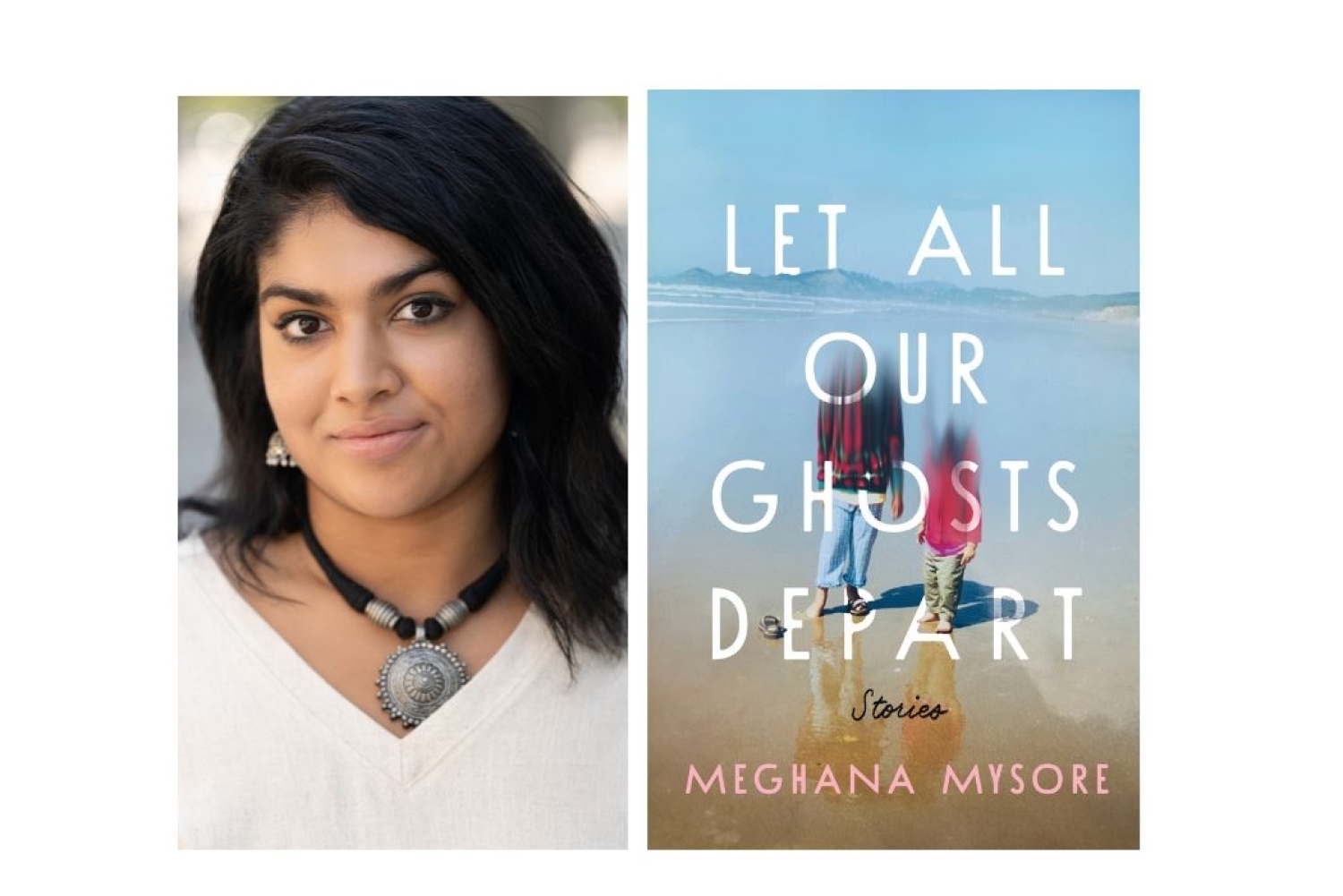
Meghana Mysore’s debut short story collection, Let All Our Ghosts Depart, studies the fragile spaces between people, where love, grief and silence can often coexist. Written over almost nine years, the debut short story collection brings together characters across generations as they try to understand one another, blending the rigid boundaries of language and culture. Drawing from Meghana’s experiences as the daughter of Indian immigrants and conversations with her family, the stories consider what we inherit from those who came before us. Surreal and speculative elements allow her to approach grief and loss with humour and emotional freedom. Placing women of different ages and circumstances at the centre of these intimate stories, Meghana creates an unexpected world of characters who metamorphose and transform; both literally and figuratively.
Finding Writing
Since grade school, writing has been a way for me to express the unsayable, and that which I most want to say. When I was younger, I struggled to belong, and I desperately wanted to find a way to do so. When I began writing poetry, I felt like I’d found somewhere I could belong and truly express myself. It’s this same impulse towards imagination and expression that drives me now, and led to the creation of my short story collection. It took eight or nine years to write these stories, to see the threads between them, and what they were trying to say. Thematically, I’ve always been interested in communication across generations. I’m interested in language itself; growing up in a bilingual home, speaking both Kannada and English, I became fascinated with the twists and turns of speech, with what we try and fail to say to each other, with the ways we express ourselves beyond words. At its heart my collection is about people across generations and experiences trying to speak to one another and failing and succeeding at that.
The Form of the Short Story
A Sweater for You is the oldest story in the collection; I wrote it during my M.F.A. It was part of a project that was a novel-in-stories focused on one family and a collage-like portrait of their lives. This story is told from the perspective of an older woman nearing the end of her life, and it wades into her memories, her regrets, and the parts of her past that shaped her. The story’s container, the event in the present, is the narrator’s experience of being bathed by her daughter-in-law, and the intimacy of this act of care. The themes of this story; bodies and womanhood, and silence and speaking recur throughout the collection. One of my aims in this book is to illuminate the lives of women across circumstances and ages. I feel that older women are not often the center of stories and it was important to me to challenge who and what can be at the center of a story.
Ghosts, Transformations and Surreal Elements
I’m relatively new to writing surreal, speculative fiction, and I find it to be so fun. Surreal elements allow me to play in ways that I can’t quite access through realism. Many of these stories contain absurd, otherworldly elements, and absurdism allows me to access a more complex portrait of grief and loss. Logic is disrupted when we experience trauma and grief, and the boundaries between reality and dreams can fracture. In times of loss and struggle, I’m also still laughing. I’m still marveling at the strangeness of daily experience–the ways we fly in the air with bags of pretzels and strangers who we’ll never see again, the peculiar intimacy of crying in public, in a McDonalds drive-thru. I’m unbounded by the rules of life, and to some extent, a performance of respectability, when I write surreal fiction, and in this way I can access something that feels more emotionally true.
The Immigrant Experience
In a way, this book is a love letter to immigrant parents and to their children. As I’ve grown up, I started to understand the ways that my parents and I were experiencing parallel challenges and parallel pain in the times that we couldn’t really speak to one another. Often, in times of disagreement, there was something happening under the surface, for instance, they were trying to assimilate to American society, and I was struggling to fit in at school. While the experiences of immigrants versus their American-born children are distinct, I think places of silence offer powerful opportunities to recognize that generation gaps happen not because we are different, but because we share the same deep pain.
This is an article from the September EZ. For more such stories, read the EZ here.
Words Neeraja Srinivasan
Date 8.10.2026