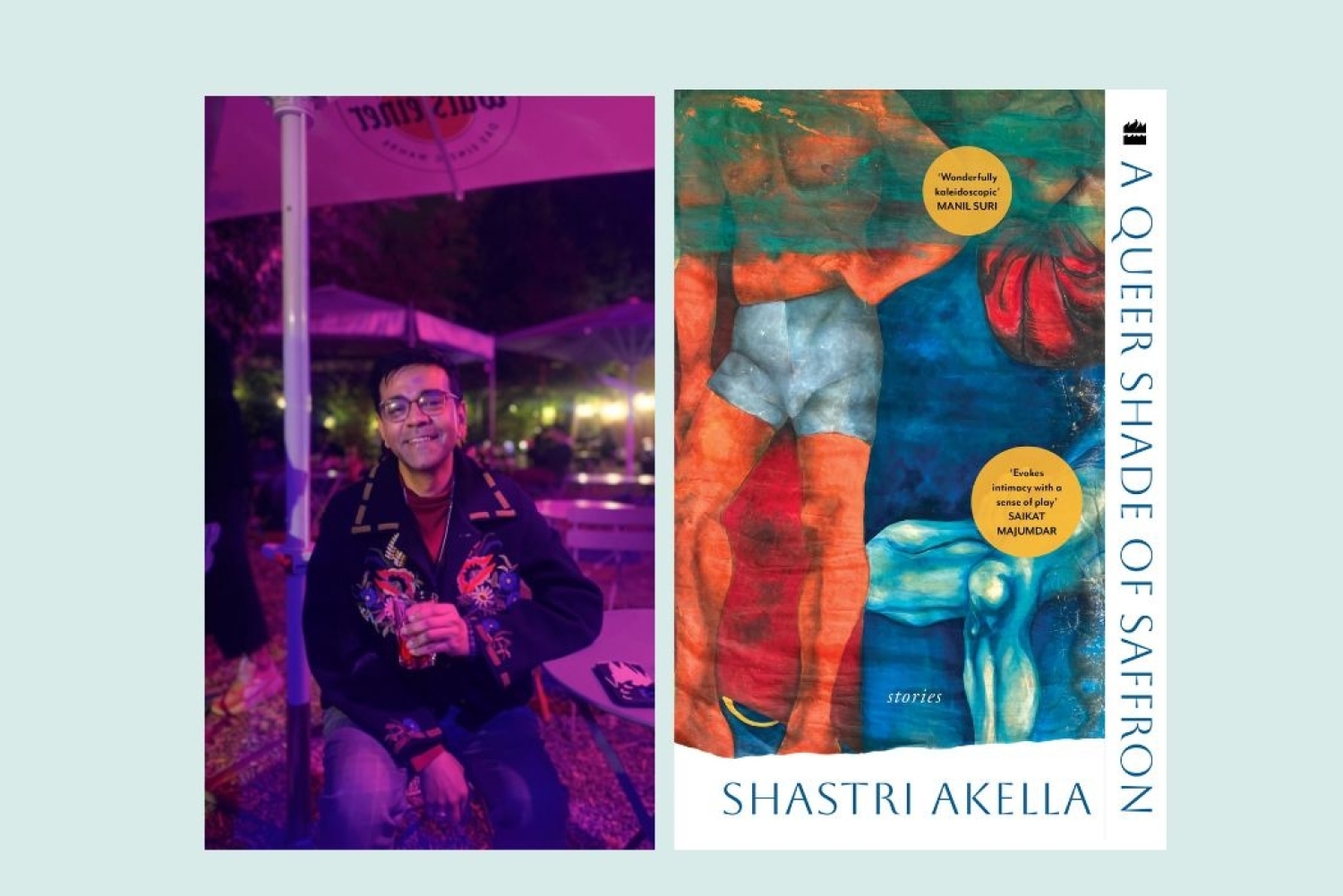
Known for his debut novel The Sea Elephants, Shastri Akella returns to the world of fiction with A Queer Shade of Saffron, a collection of short stories. The possibilities of gender, sex and longing across the breadth and width of India come to light here, where queer solace is found everywhere: a small village in Andhra Pradesh, in pre-Partition Punjab, the slopes of the Garhwal mountains. It challenges the narrative that sensuality and desire can only exist in urban spaces. In these stories, queerness is brought closer to home, examining how intimacy and self-discovery can look very different in vernacular contexts within the country.
In his acknowledgements, he aptly says ‘A Queer Shade of Saffron owes its existence to those without whom these stories would not exist and those who championed the stories and the people they contain.’ Below, Shastri Akella shares his notes on his interpretation of the term ‘queering’, the desi-ness of his stories and the ideas that shaped this collection.
I wanted to start off by asking about the division of chapters in the collection: Queering, Queer and Queering Queerness. Could you tell me a little about the idea behind these names? What is Queering?
‘Queering’ is to break open closed systems, making room for bodies who were previously excluded from it. Where ‘queer’is a noun/identity/being, ‘queering’ is a verb/action/doing. It was originally coined by the filmmaker Pratibha Parmar. The collection begins with a poem I’ve written inspired by this term.
Even the title brings together two seemingly unlikely words. One might not consider the colour saffron and queerness in the same context. What was the reasoning behind this?
It’s a queering of the color. To say that every voice deserves to be heard; that’s why I dedicated the book to my students. It’s also a reclaiming. Read the story of Hanuman taking Sita’s sindoor and smearing it all over himself to please Rama and tell me it isn’t queer.
Many of the stories take place in non-urban settings. Why was it important for you to take desire, longing and sensuality to a rural setting?
Whenever conservative uncles call ‘gay things’ a Western import, I disarm their prejudice with fact: 10% of our population is queer, including small towns, rural spaces, muhallas with their favorite chai ki dukaans. I root my stories in such settings to convey this truth. Something that the Marathi film Sabar Bonda does exceptionally well.
There’s also a certain desi-ness about these stories, they bring the idea of a queer identity much closer to home. Were there any challenges along the way?
There’s an immersive quality to every regional expression of Desi-ness. That’s why Rushdie dismissed the notion of ‘the great Indian novel’. My challenge was to bring vernacular contexts into my stories with the right degree of detail so they bring depth to the characters without overshadowing them, and pan-India readers appreciate their complex beauty.
Why are you drawn to the form of the short story?
The form gives us an intense, intimate experience of the life of another and therefore can expand our potential for empathy. Apparently people don’t read short stories these days; look around, see where that’s gotten us. If we all read more short stories and watched Derry Girls, we’d do hella lot better.
What are you working on currently? What’s next?
A climate crisis vampire novel rooted in Irish mythology and, predictably, a very gay love story at its core.
Words Neeraja Srinivasan
Date 15.10.2026