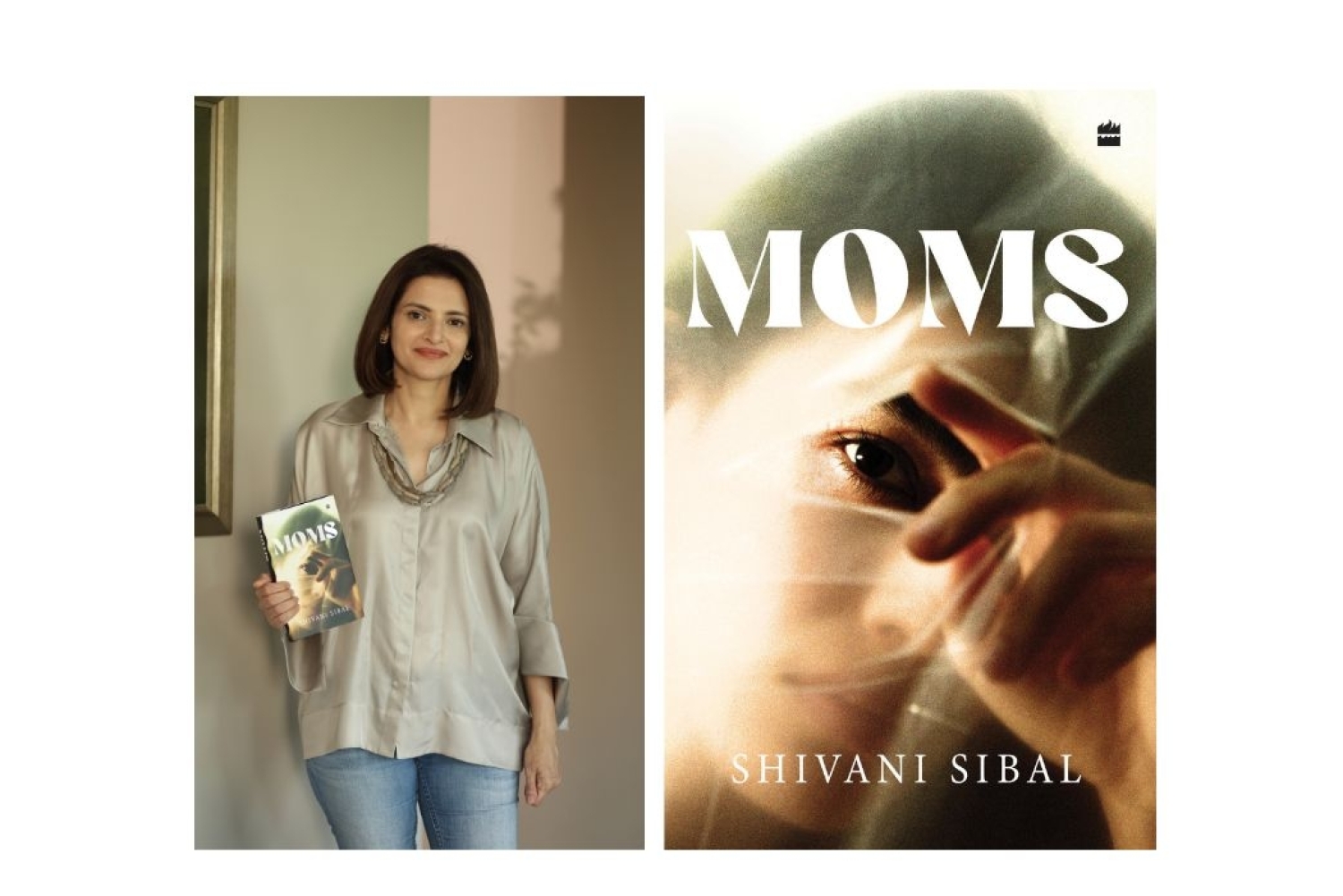
The world of modern motherhood often comes with its own social codes, small hierarchies, judgements, anxieties and performances. ‘There was an entire script around what kind of mother one ought to be. To be endlessly present, emotionally fluent, administratively efficient, and all of it made to look natural.’ says the author of Moms, Shivani Sibal, who finds the norms of this world both fascinating and unsettling. A school becomes a particularly important site of power and social surveillance where questions of ‘who is always at pickup, and whose child is collected late? Whose child made the team, won the medal, got the part, and whose did not? Which mother seems to be looking better, coping better, doing better?’ are constantly in the atmosphere, but nobody is explicitly acknowledging any of them. Moms follows Radhika, a mother who is constantly grappling with all these questions herself, but also doesn’t have a choice but to play along.
How did the story for Moms find you? Take us right back to the beginning.
If I wasn’t a mother, I couldn’t have written Moms, and I can’t pretend otherwise. I entered the mothering ecosystem as we know it fifteen years ago, when my older daughter was born. I was naïve, and I came to it with the same somewhat laissez-faire expectations that many of us in my generation had, based on what we had ourselves experienced at the receiving end of mothering.
Once I became a mother, though, I was exposed to a whole world of social codes, small hierarchies, judgments, anxieties and performances that modern mothering seemed to demand. There was an entire script around what kind of mother one ought to be. To be endlessly present, emotionally fluent, administratively efficient, and all of it made to look natural. I found that world both fascinating and unsettling. Long before I wrote a single line, I knew the book would be called Moms.
Why did you choose the school as the background where Radhika’s carefully constructed persona begins to rupture?
The school felt like the natural setting for this novel because it is where so much of the performance, one-upmanship and anxiety around motherhood plays out in plain sight. Who is always at pickup, and whose child is collected late? Whose child made the team, won the medal, got the part, and whose did not? Which mother seems to be looking better, coping better, doing better? This seemingly insignificant stuff comes loaded with judgement.
When mothers begin to live largely through their children, those children are expected to fall in line and play their part too. But children are their own people, and they do not always comply. This is why I felt a school would be such a natural place for Radhika’s curated self to crack.
Take us behind the scenes of building the central character, Radhika.
I wanted to construct Radhika as a complete, three-dimensional woman rather than as an emblem of suffering or victimhood. It mattered to me that she should feel layered and contradictory: sometimes likeable, sometimes petty, both good mother and failing mother, loving and exasperated, vain and vulnerable. That, to me, is how most real women are. We are rarely one thing consistently, and I wanted to allow her that full, messy humanity.
I write in a slightly trance-like state, to be honest, and even I don’t always know where a lot of what I write comes from. Perhaps it is an amorphous distillation of many life experiences, observations, memories and emotional truths gathered over time. But once Radhika’s voice began to come through, I felt I had to trust it and stay close to her, without simplifying her or making her more sympathetic than she naturally was.
The novel is deeply concerned with the body; weight, appearance, grooming, clothing and the scrutiny women experience. How did you approach writing about this universal female experience?
As you said, this is a universal female experience, and yet the elephant in the room. I wanted to address it without condescension and moral overtones. The hard truth is that appearance occupies a significant part of many women’s headspace and lives, and this has been amplified 100x in the social media era. It is simplistic to dismiss this as superficial, and is tied to deeper questions of self- worth, confidence, desirability and acceptance, and this is something I wanted to address consistently through the novel.
Were there any similarities or differences between writing Moms and Equations? In what ways?
Equations was my first novel, and it told the story of two men, partly set in 1980s India, a world I knew only as a child. In many ways, I was in strange new territory, and with the benefit of hindsight, there are things I would have done differently. I tried to apply those learnings when I began Moms, and took my time over countless drafts until I felt entirely right about sending it out into the world. Writing Moms from a woman’s and a mother’s point of view also made me feel sure-er of my ground.
What are you working on currently and what’s next?
At the moment, I’m not working on another novel, only on some columns and op-eds. I actually didn’t write a word for almost two years between Equations coming out and starting Moms, largely because of family commitments.
While it was frustrating at the time, looking back, I think that fallow period was curiously useful. Sometimes the mind needs to lie fallow, rather like a field before the next crop is planted. When I am ready with the next story, I am sure my fingers will automatically reach for the keyboard and start banging it out!
Words Neeraja Srinivasan
Date 5.10.2026