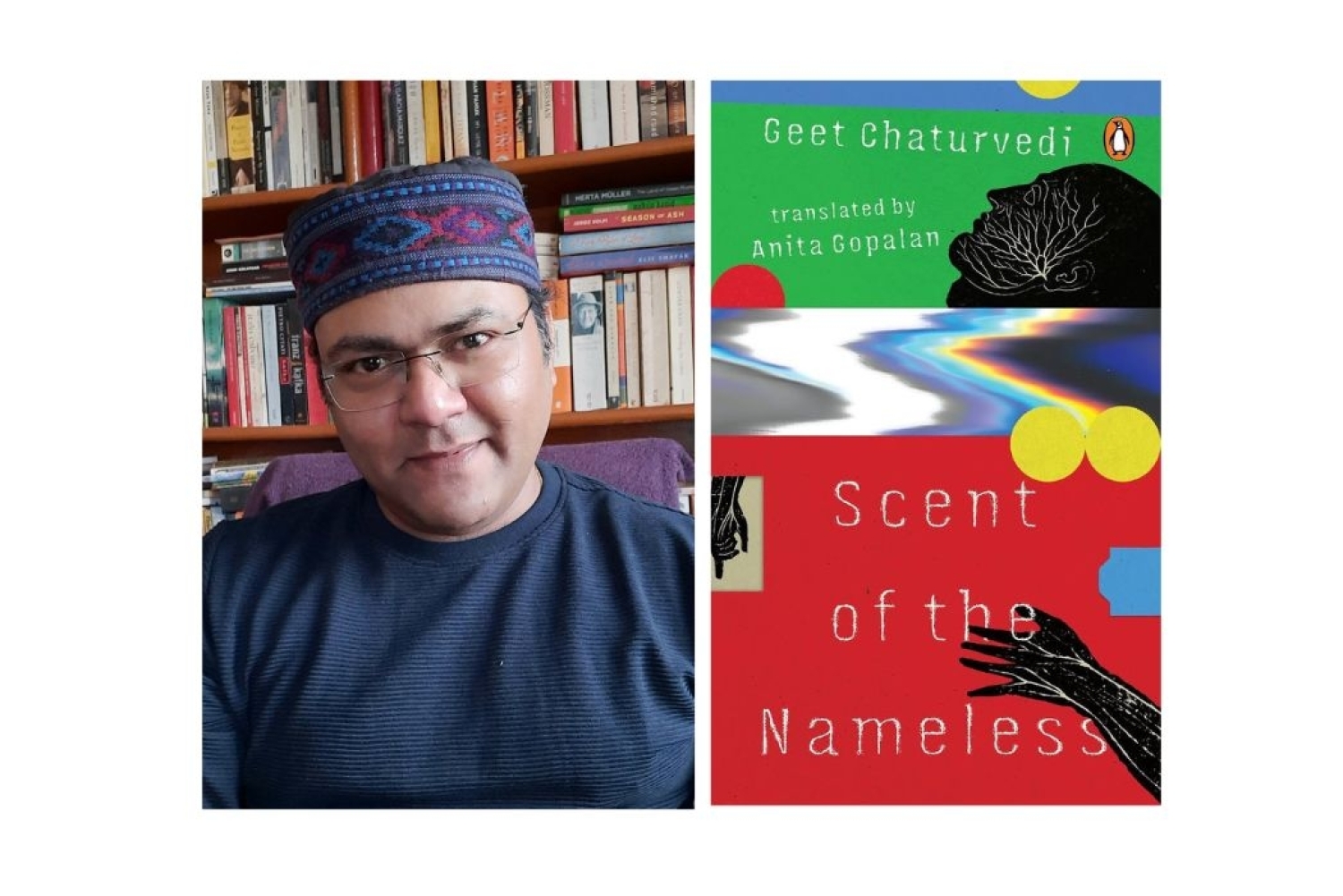
In Scent of the Nameless, Geet Chaturvedi turns the seemingly ordinary life of a middle-class individual into a portrait of financial humiliation, manufactured desire and the corrosive nature of debt. First written in 2008 and reworked in 2023, the novel emerged from a period of economic slowdown, debt-driven farmer suicides, aggressive bank recovery agents and what the author describes as the ‘financial humiliation’ endured by middle-class individuals. At its centre is a nameless protagonist who, in the eyes of the system, becomes little more than a number, a statistic, a demographic equation. He describes the novel as an exploration of dark humour that ‘translates the absurdity of our doom’ and reveals the fragility of middle-class stability and the invisible violence of inequality.
For Anita Gopalan, who translated the novel into English, the book was immediately striking for the way it moves between the ordinary and the surreal, and the real and the imagined. Drawing on her relationship with both Hindi and English, she approached the novel by listening closely to its shifting voices and registers. The result of about a year and at least ten drafts, her translation seeks to preserve the covert cleverness of Geet Chaturvedi’s language while trusting readers to navigate its cultural specificity.
What first sparked the idea for Scent of the Nameless and its seemingly ordinary protagonist?
I first wrote this novel in 2008. At that time, the world was going through an economic slowdown. The Indian economy was also in a kind of chaos. Almost daily, there were reports of farmers committing suicide due to debt. Bank recovery agents were acting like goons. It was a period when a middle class individual was forced to endure some form of ‘financial humiliation’ almost at every turn. I saw many such people in my immediate circle as well. Witnessing all these things planted the seed for Scent of the Nameless. The situation that existed in 2008 was much the same in 2023, when I reworked on this novel, and even in 2026, it remains largely unchanged, as the book reaches you in its current form, in Anita Gopalan’s beautiful translation.
I chose an ordinary protagonist for my book because our society is made of ordinary people. An ordinary protagonist possesses a state of pure anonymity and he is a favourite target of capitalism. The nameless protagonist of this book is so ordinary that he feels he is not regarded as a human being, instead, in the eyes of the system, he is just a number, a statistic, a demographic equation. From the heights of the tower of power, ordinary people look like insects. We ourselves belong to that very class of ordinary people. There is no magnificence in our ruin, but it certainly has a nameless scent.
Since the novel turns a credit card into the catalyst for a life coming apart, what interested you about themes of debt and financial distress?
The Bhagavad Gita says that you are a karma-yoddha (a warrior of action). Modern economics, however, suggests that you are a karja-yoddha (a warrior of debt). Almost everyone is paying some kind of EMI. We have become slaves of a plastic card. The protagonist of the book acquired a credit card but paid the price by selling his soul. He lost his sleep and peace of mind and dignity. This is the reality of everyone, be it a labourer, or a farmer, or a contemporary middle class individual. We are born as free individuals but are sold like commodities. Our labour, emotions, anger, dissent, skin and time, everything is up for sale. In this book, I have portrayed the various shades of this commodified man.
What is your process of writing satire?
I think it leans more towards dark humour than satire. Both mock societal flaws, but dark humour does that without pretending we can fix it. Dark humour abandons the naïve hopes of satire. It translates the absurdity of our doom. A capitalist nightmare can convert a human life into an ultimate cosmic joke. This is how I approach the alley of dark humour.
What did you hope to reveal about modern middle-class life through this story?
The book reveals many profound vulnerabilities and harsh realities but if I am asked to phrase a few, that would be: the trap of manufactured desires, the fragility of middle class stability, the corrosive nature of debt and the invisible violence of inequality.

Translator, Anita Gopalan
We also caught up with the translator, Anita Gopalan.
What is your relationship with Hindi and English?
In Arun Kolatkar's style, I would say, ‘My pencil is sharpened at both ends. I use one end to write in Hindi, the other in English. What I write with one end comes out as English; what I write with the other end comes out as Hindi.’ I have put Hindi in place of Kolatkar’s Marathi. I write in both. I read in both. I speak both. My own native language is neither Hindi nor English, yet these are the two languages in which I feel most at home.
Growing up in Pilani, I heard Hindi in many dialects and speech rhythms from Rajasthan, Haryana, Delhi, and Uttar Pradesh. English was the language of my education and has somehow become the main language spoken at home. I have also learned the many shades of both languages through books. Ever since childhood, it has been books, books, and more books, in Hindi and in English.
What was your first reaction to Scent of the Nameless, and what made you want to translate it?
I remember thinking, ‘What a book!’ I was immediately drawn to its language and the way it moves so effortlessly between the ordinary and the surreal, between the real and the imagined. It's one of those slim volumes that keeps expanding as you read. Beneath its simple, hallucinatory surface lies a deeply layered novel.
The reason I translated it, to be honest, was perhaps simply that it was the next book in line. We had just finished translating Geet's nonfiction book, The Master of Unfinished Things, and Scent of the Nameless was next. But I also wanted to take it on because I knew it would be difficult to translate, given its slippery content and visceral, paranoid language. Can I pull it off? That’s the dare I set myself, and I get a kick out of that. In fact, it has been the most exacting work of literary fiction I have translated.
Which aspects of Geet Chaturvedi's style were the most challenging to bring into English?
Rather than say I was challenged, I'd say I was absorbed; not so much by the mood or the atmosphere as by Geet's choice of words. He often says something in an unexpected way, hiding an extra layer of meaning inside a single word or phrase. I wanted the English not only to carry the same meaning, but also the same covert cleverness.
One example is ‘sajeevan samadhi.’ It carries the cultural idea of a saint entering a tomb while still alive. Geet draws on that inherited meaning to reveal another one: systemic violence disguised as voluntary renunciation. In English, I coined ‘living entombment.’ It cannot carry that cultural history into English; its strength lies elsewhere. The phrase is immediately unsettling. It preserves the original image while sustaining the same tension between liberation and violence.
Arriving at those choices takes patience. I am a slow translator that way. This book took me about a year and at least ten drafts. That’s simply how I work. I often think of Oscar Wilde's remark: ‘I was working on the proof of one of my poems all the morning, and took out a comma. In the afternoon I put it back again.’ I think every writer and translator knows that feeling.
Words Neeraja Srinivasan
Date 20.8.2026