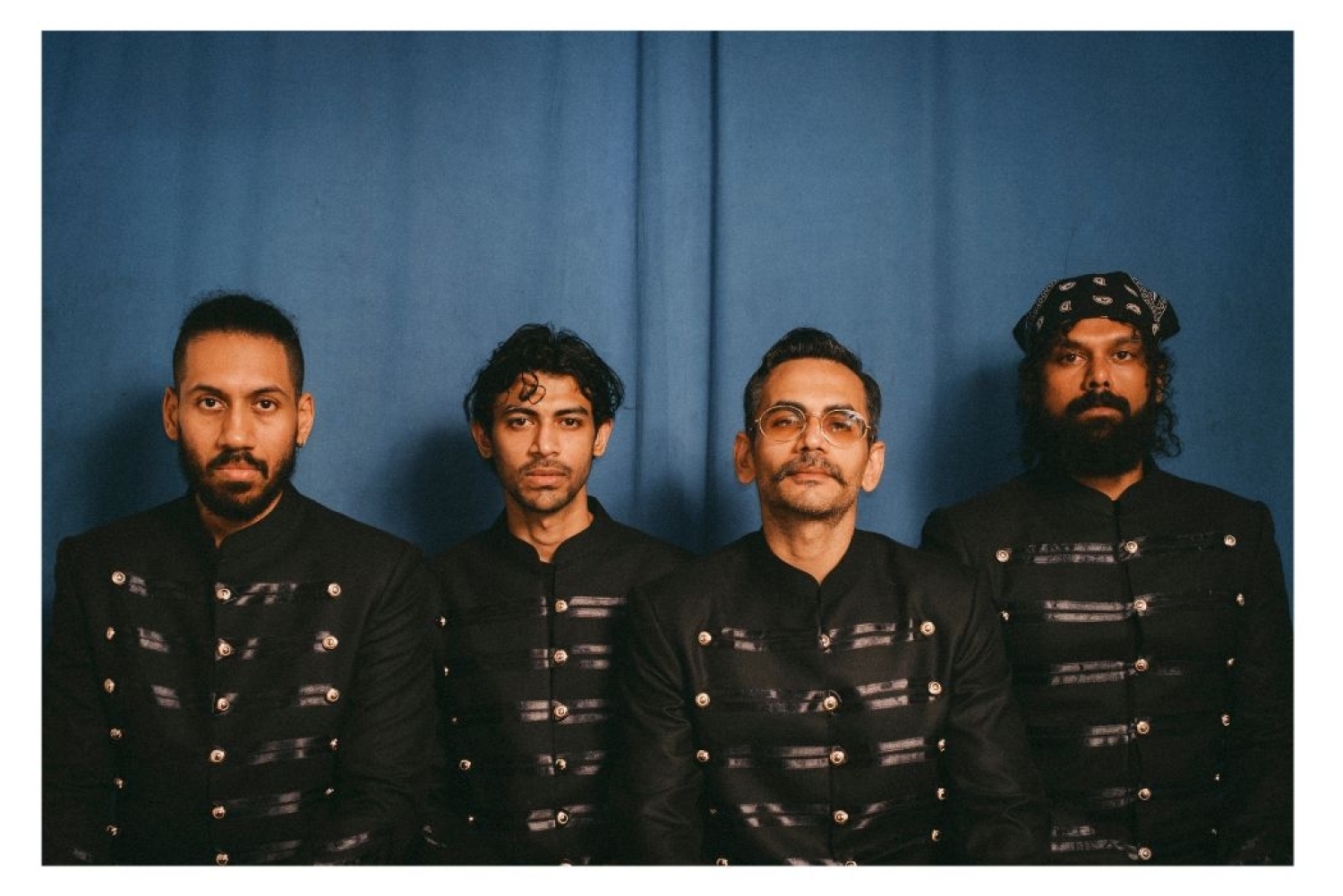
Photo by Isaac Nico
Photo by Isaac Nico
Ten years ago, The F16s were four guys in Chennai getting passed over for a DJ, wondering out loud if the music mattered less than being brand-friendly online. They said as much, plainly, in the run-up to Triggerpunkte. A decade, several EPs and one pandemic later, that calculus hasn't really changed. Harshan Radhakrishnan, Josh Fernandez, Sashank Manohar and Abhinav Krishnaswamy will tell you as much themselves. What has changed is not the situation, but how much weight they're willing to give it.
Mt. Whateverest, the lead single off their long-awaited sophomore album All Dogs Go to Heaven, is where that shift shows up first. It's a song about the summit that keeps relocating itself. Reach the peak and someone points you to a higher one, and another, and another, keep up or disappear. Ten years after Moonchild crossed 12 million streams and turned The F16s into one of the bigger names to come out of India's independent scene, Mt. Whateverest finds the band sounding like themselves, just less interested in the summit than they used to be.
That recalibration is the whole story of this record. It was born out of six weeks of voluntary isolation in the hills of Ooty, away from Chennai's heat and its rehearsal-room politics. There the band did something they'd never done before. They settled on a title, All Dogs Go to Heaven, before a single song existed. What followed was less filtering, more letting go, instinct over perfectionism, kinship over ego, a whiteboard's worth of ideas allowed to just be whatever they wanted to be. Somewhere in there, dogs became the album's moral compass: symbols of loyalty and unjudging presence, a rough answer to the endless goalpost-chasing of Mt. Whateverest itself.
For the October EZ issue's cover story, Platform sat down with the band to talk through the Ooty sessions, the songs that survived only because they stopped overthinking them, and what it means to keep climbing a mountain whose summit they've finally stopped chasing.
Ten years ago, Triggerpunkte took shape from songs you'd accumulated and road-tested over years before you sat down to record. Ten years on, and after multiple EPs in between, was the gap before the new album more about waiting for the right songs to arrive, or something else?
The main aim for this whole exercise was to just get back to how we wrote music earlier in our careers. Time was the problem; we found a month. Space was the problem; we found it in a cottage in Ooty. We did want it to be a full-length album, even if there was the odd convo to spread it over 4 EPs. Triggerpunkte was a little different in that after its release, we were quite spent, creatively speaking.
Does your process actually change when you know you're building an album versus an EP? Do you sequence and write differently when there's a beginning, middle, and end to hold, or is a full-length just more songs, more time?
More time = more songs. That’s the correlation we made, at least. It frees you up a little; we knew we had a month on us to write as much as we could. The first couple of weeks were us just workshopping and shedding as many ideas as we could come up with. We spent hours just jamming instrumentals, something we didn’t really have the liberty for in Chennai. We even switched around instruments just for fun because why not? Stuff like that gave us Trickortreat from this album, Shank played an old casio keyboard, Booby played bass.
Triggerpunkte was described as an accumulation, not a narrative. Does All Dogs Go to Heaven have an arc you'd want a listener to feel start to finish, or is it more a mood you're steeping in, track by track rather than chapter by chapter?
The latter, probably. There may be a few connected strains from song to song, if we’re talking about moods and themes, but it really depends on interpretation. We did assemble the tracklist for the listener to try and experience this in its entirety, but we wouldn’t say it’s a ‘concept’ album by any means. There are contradicting airs of optimism and defeatism throughout the album in equal measure because it’s all about balance.
You've talked in the past about the constraints of not having your own studio, being a slave to rehearsal room time. This time you chose voluntary isolation in Ooty instead of a booked slot. What did stepping away from Chennai actually change about how you wrote?
Our individual lives had begun taking differing trajectories as we entered our 30s and we found it harder and harder to settle in for a prolonged period of writing. Us taking time off and moving our setup to Ooty for almost six weeks could have had selfish undertones but we very quickly realised how much we’d needed this. We were even at liberty to call our friends to come hang out and play drums for a few days if they wanted to.
We love Chennai and it has been home for nearly forever, but it comes with its own creative bottlenecks, whether it's a lack of rehearsal space or recording space. It has also had a flagging creative landscape for too long now, in spite of the many times we and others have tried to inject something into it. And sometimes it's just the heat; it gets to you. On a simpler level, we were just looking for a change of scenery and were thankfully afforded that with Ooty.
Your process has always been described as filtering, refining, revising. Was there a song on the record that would've been cut or reworked to death under your old process, but survived because you let it?
Hmm, that’s a good one. A lot of the songs on this record came together fairly easily because the hard part was out of the way. We took the time out to do this together. Fee Fi Fo Fum and LMAO came about over two separate afternoons and we let the reins go immediately. Back in the City took an extra day but we were sold in the first playthrough. That’s not to say we abandoned that outlook completely. So Unique took over three drummers and several studios to get done because we were unable to find what we were looking for. For Secret Garden, we argued about it till we Frankenstein-ed it with another old demo called Money Don’t Grow on Trees and it finally made sense.
Years ago you were fairly blunt about the economics of this, being passed over for a DJ, the music mattering less than being brand-friendly online. A decade in, has that calculus changed at all, for better or worse? Does it feel different making a full-length now than it did when Triggerpunkte came out?
Don’t think a lot of those things have changed. Being a band is still a daunting task where the economics are constantly against you. Maybe we just like making music together; sometimes it’s that simple. That was part of what we were hoping to discover during this whole process. That being said, we probably couldn’t have picked a worse time to put out a full-length album, with attention spans at an all-time low. The machinations that exist around releasing an album also carry some undue weight, more so than before. But that just comes with the territory now. So we’ll keep doing it, because we like doing it.
You've framed dogs as symbols of purity, loyalty, instinct, and asked how humans might care for one another the same way. Is that a lens you arrived at before or after the songs were written? Does All Dogs Go To Heaven carry any tension with the endless summit anxiety in Mt. Whateverest, like the dog is the antidote to the goalpost chasing?
We had a whiteboard in Ooty, and for the first time in our careers, we had the title penned down before the songs even existed. The idea that we were finite and heaven-waiting made us want to write like dogs with absolute liberty, with well-trained instinct, zero judgment, and a sense of curiosity. If you want an antidote, we would say, ‘Be like a dog: in your quest to help your master [or others] reach its summit, you too can enjoy the view’. Mt. Whateverest is about chasing a summit that keeps moving: hype, ultimatums, whether it means anything at all. Is that a feeling that's gotten louder or quieter for you over ten years, now that you're not the new band anymore but also not exactly the establishment either?
We want the glory, not the fame, if that makes sense, as T.S. Eliot wrote, ‘Not with a bang but a whimper’. This absurd pursuit of a summit that keeps relocating itself has gotten a lot quieter. We say this because ten years later, we’re not chasing the feeling of being discovered anymore. We’re chasing the feeling of discovering something. There's an absolute rest in contentment and an absolute peace in gratefulness, and if there's glory in it, it’s in the work itself, not in being seen doing it.
This is an article from the October EZ. For more such stories, read the EZ here.
Words Hansika Lohani
Date 21.10.2026