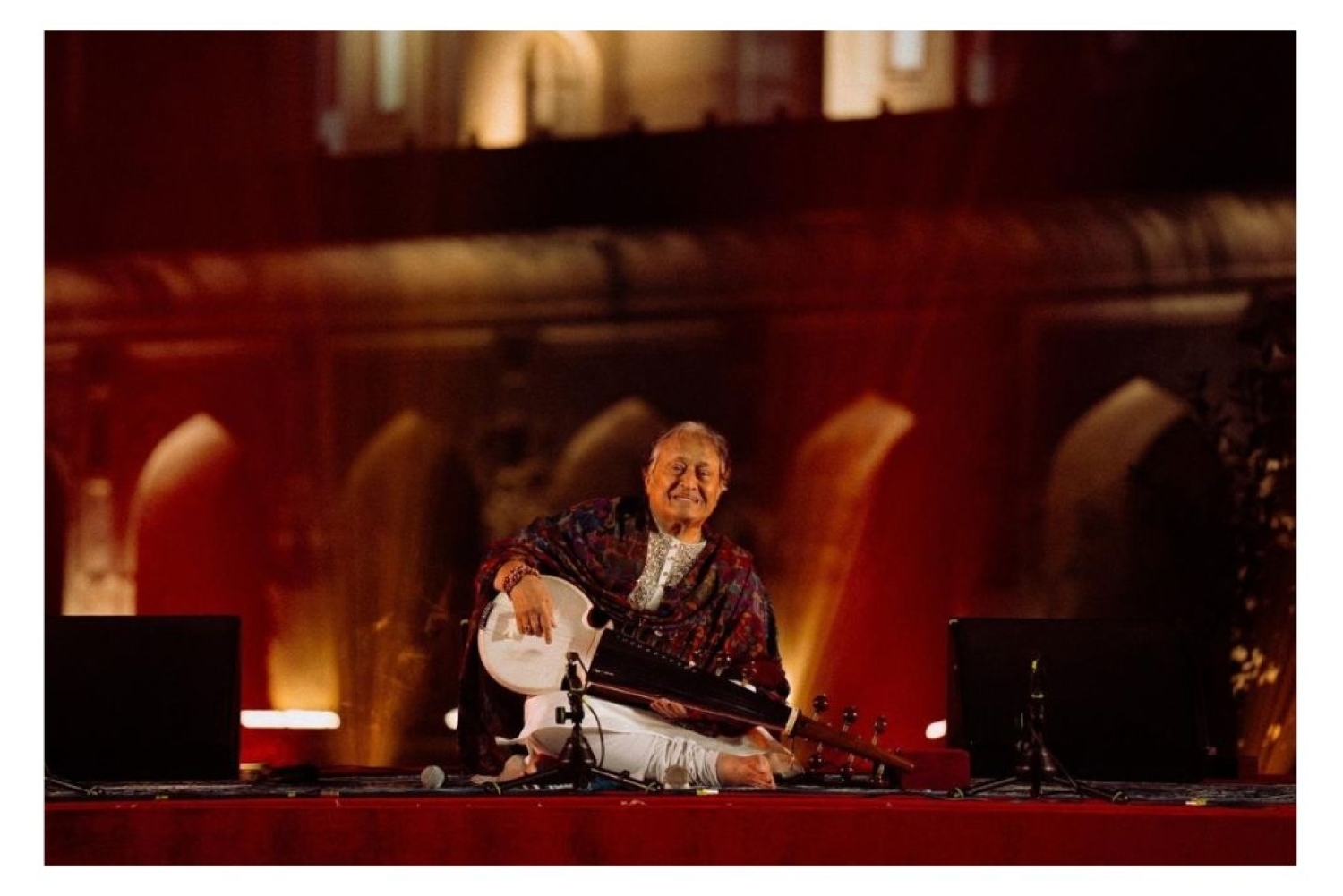
Some evenings feel as though they belong to another time. In Lucknow, at a mehfil curated by IBTIDA - Ek Mehfil, there were no screens and no distractions. We sat on takiyas with candles lit around us, and all they asked was that we listen. This is the world that Tanvi Singh Bhatia and Anubhav Jain have been building for several years. Both come from careers in brand storytelling, and they chose to step away from the concert and gig format to create something more personal. They create a space that evokes the old darbar, where the audience sits close to the artist and the evening is as much conversation as performance. Tanvi, who grew up in a home where her mother was a classically trained singer, speaks of IBTIDA - Ek Mehfil as a response to a gap she noticed in the cultural landscape. Artists, she felt, deserved to be celebrated with grandeur, away from the stiffness of the auditorium.
That care shows in every detail. Venues are chosen for their height and proportions so that chandeliers, decor and artists are on the same wavelength. You’ll even notice that Made in India brands form the backbone of each evening. Since its beginnings a few years ago, IBTIDA - Ek Mehfil has grown well beyond music. It now encompasses storytelling, conversations with veteran artists, heritage spaces and forgotten regional cuisines within the same frame. Tanvi has said that we are the last generation who can still receive this knowledge directly from the masters.
At the centre of that evening in Lucknow was Ustad Amjad Ali Khan. Off stage, he is among the gentlest souls one can meet. He spoke with such warmth and humility. The stories came in an unbroken stream, as they do from a man who has lived a long life wholly devoted to music. He gave himself to it so completely that he never thought of anything else, and you sense that this is the price of reaching where he has. The sacrifices are not small, and he does not pretend otherwise. He had played for IBTIDA - Ek Mehfil before, at Safdarjung Tomb, and spoke of what the founders are doing with real affection.
Yet even as he spoke, he was restless. Gently, almost like a child, he kept saying, ‘Let me perform now, let me please go on stage.’ Then he did, and the magic took hold of the room completely. You understood that for him, the stage was where all the stories led.
What follows is our conversation, in his own words.
Can you talk a little about your father and the gift of music he gave you?
When the time of Wajid Ali Shah ended, our ancestors reached Gwalior and became court musicians to the Maharaja Scindia. My father said this even before music: respect every religion. I wish every school in our country and every parent in our country would teach their children to respect every religion. The character of India is such that there are thousands of religions, but we all depend on each other. I play the sarod, but who makes my sarod? Hemendra Chandra Sen, who has just passed away, from Kolkata. This is the history of our country. It is like a bouquet of flowers, with different colours and different fragrances. When we play in the concert hall, people of every religion come, because music is God. The one who loves music does not see whether a Hindu is playing or a Muslim is playing.
M. F. Husain was such a great painter and artist. Our countrymen gave him a lot of respect and love. In our family there are Amaan and Ayaan, and now Ayaan's two twin boys, Abeer and Zohaan. My wife, Subbalakshmi Baruah, is from Assam. Ayaan's wife, Neema Sharma, is from Mauritius and Mumbai. We feel we belong to every religion in the world, and every religion of India.
It is very sad how a PhD becomes radical, how a PhD becomes communal. Unfortunately, education could not create compassion and kindness in a human being. My father was a very pious man. That era was such that we couldn’t question anything. We had no time to think, and we were not even given a chance to do any other work. They used to say: either read a book or learn music. You can only be good at one thing. They believed that because of education, you cannot become a good musician.
But today a PhD is also a good singer, a PhD is also a good musician and educated people are doing good work. But there is an old saying, ‘Jack of all trades, master of none’. This was their thinking. So they used to do penance. You must have heard the story that Mian Tansen, who was in Akbar's court, was blessed by God with such power that when he sang Raag Malhar, it rained, and when he sang Raag Deepak, the lamps were lit. All this happens through penance.
“When we play in the concert hall, people of every religion come, because music is God. ”
You said in your first interview that music has no religion and no borders. It is like flowers. Can you talk to us a little about the power of music?
Music has connected the world. Music does not belong to any religion, like flowers, air, water, fire, fragrance, colours. There are two types of music. One is pure sound. We call that sound Swar hi Ishwar. If you listen to sound, you feel connected somewhere. That is why in yoga there is an asana called Bhramari. We make a sound, or we say Om.
These are the seven notes: Sa, Re, Ga, Ma, Pa, Dha, Ni. Within them there are a total of twelve musical notes. All the music of the world, whether it is Western music or rock or folk, behind it there are twelve notes. Whether it is a Hindu or a Muslim, they have the same breath. The breath is alive because of the breath.
Similarly, when you write lyrics on these notes, whether it is Bhagwan kripa karo or whatever language you write in, you have to take the support of the notes. Because of the words, the song becomes famous. Take Hum Tum Ek Kamre Mein Band Ho, Chaabi Kho Jaye, the world enjoys it because of the words. Otherwise, the notes are just da, da, da, da, da, da.
The film world is entirely for sale. That is why they need a writer, a musician, thousands of people. But in our classical music, we try to please the gods and goddesses. Shyam is mentioned, Ganesh is mentioned, Shiva is mentioned. And in thumri and dadra, the old ones, all have romance in them. This kind of language is eternal. Because of the words, classical music has not reached the common man.
You have also said in interviews, and it is absolutely true, that the rootedness of classical music, which requires penance and practice, is so hard and so challenging.
The thing is that there was struggle and there will always be struggle. That is why today, in the world of Bombay, millions of boys and girls are standing in line so that someday they get some work in Bollywood.
You once said in an interview that, ‘Classical music is like entering a dark tunnel, hoping that you will see sunlight someday’.
That is true. In this, we were not allowed to ask our guru, "What will happen to us tomorrow? Will we make it?" We had to surrender to God. Whoever is in this field has surrendered his future to God. Otherwise, in every other way of life, every student first researches their future.
But we are poor people. We are happy with whatever we have. And happy with whatever we don’t have. We are in search of heaven, and through heaven we feel connected with the supreme power.
But how does the new generation in your family take to this?
My grandchildren were fascinated by Michael Jackson. Now they are obsessed with BTS, and they keep discovering new music. Then they became so fond of football that they introduced me to Ronaldo and Messi. One is a Messi fan and the other is a Ronaldo fan. But yes, thank God, they are still practising and playing music. They are still interested. Every student in school stays there from morning till 4 o'clock, so they have very little time to practice. But all the credit goes to my son, Ayaan who is still trying to instill a sense of discipline in them. They are also fans of Amaan [Ali Bangash] Taya. He is a friend, and he got them interested in wildlife. The children have a great passion and know exactly how many tigers there are in which region. I always tell them, ‘This is a dangerous animal; it eats humans’. They say, ‘No, no, it attacks humans only when it gets old’.
Tanvi and Anubhav are working to reconnect audiences with intimate musical traditions while introducing India’s cultural heritage to younger generations. What do you think of the work they are doing through IBTIDA - Ek Mehfil?
We played for them for the first time at Safdarjung Tomb, and we kept getting their reports. They are doing a very good job. They are connecting the world, and they are introducing our culture to the young generation. Now we have to play in Bombay on 6th December. I am very happy to work for them and help them achieve their goal in life.
Words Hansika Lohani
Date 7.10.2026