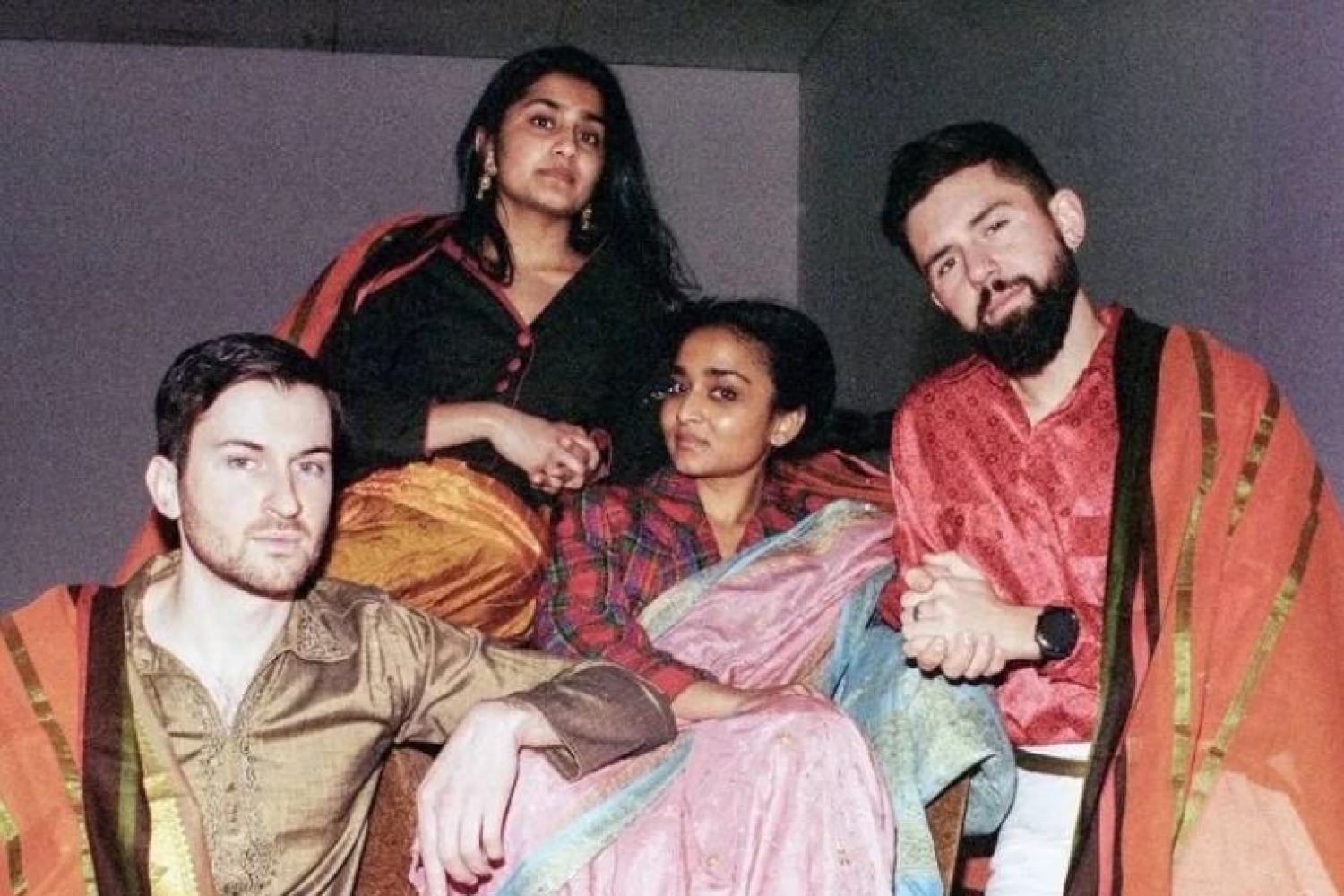
Mira and Dipha grew up as sisters and as musicians. Their earliest performances were not on grand stages but at local community spaces in Bergen, Norway, where they wanted to give minority cultures visibility. Back then, their artistic work was largely about representation, a way of presenting a somewhat stereotypical image of South Asian culture to a Norwegian audience. Over time, however, the need to move beyond surface-level symbols and into something more self-defined became impossible to ignore. Toward the end of high school, the idea of forming a band took shape and Mira invited her classmate Jakob Hamre, who was already playing with bassist Jakob Sønnesyn, to join. It began as a practical constellation; two sisters with a flute and a guitar, but grew into a deliberate artistic project: to explore their heritage in a more rebellious, confident and musically expansive way.
The Tamil sisters’ family history is marked by displacement and silence. Mira and Dipha’s parents fled the civil war in Sri Lanka and rebuilt their lives in Norway, yet the stories from before their arrival remain fragmented and painful. But their parents chose to share the narrative of what came after: the struggle to enter the Norwegian labour market, the effort to integrate and the pride in what they have achieved. As second-generation Tamils, Mira and Dipha navigate this gap between what is told and what is left unsaid and it is precisely in this space that their music is formed: a search for language, sound and stories that can validate the diaspora.
How has navigating a dual identity, of being Norwegian and Tamil, impacted your work and lives?
Preserving the Tamil language through our music has always been an important motivation. At the same time, we have wanted to contribute our own musical expression to the Norwegian music scene, which can sometimes feel rather homogeneous. With our latest album, our focus shifted slightly. After carrying the responsibility of ‘representing’ something for so long, we wanted to dig deeper into our own emotional world. It has become more important for us to tell our unique story as second-generation Tamils in the Sri Lankan diaspora.
You use a wide range of instruments in your music. How do you decide who plays what and which instruments are most important in shaping your sound?
The bamboo flute is the main source of all our music. We learned Carnatic music in our small hometown of Bergen, though this cannot be compared to the training one might receive in India, London or Canada. We have therefore had to teach ourselves by listening to recordings and watching concerts online. Our way of playing Carnatic music has become the result of our own exploration.
We also use an acoustic guitar and a small percussion setup, which creates a more intimate sound. We feel that this captures the essence of baila and Tamil folk music better than, for example, what keyboards and drum kits would. At the same time, our sound already includes electronic elements and as we continue to explore our soundscape, it is possible that more electronic elements will appear in the future.
How would you describe your individual journeys in finding your own artistic voices and how did those voices come together to form the sound of 9 Grader Nord?
Our individual musical journeys are rooted in quite different traditions and that diversity is what shapes the sound of 9 Grader Nord. Mira (bansuri flute, guitar, vocals), who composes all the band’s music, draws on strong influences from South Indian and Carnatic music, as well as Tamil folk traditions - baila and flamenco. The music’s influence from Western pop and rock is felt mainly in the structure of the songs and in the way the instruments and vocals interact and sound together. Dipha (vocals, bansuri flute, guitar) shares much of this musical background and contributes a highly dynamic vocal expression, ranging from soft and intimate to soulful and powerful. The music also carries clear traces of jazz through the use of odd time signatures, extended harmonies and flute improvisations, whether one defines jazz as improvisational music or improvisation as the essence of jazz.
Jakob Hamre (percussion) brings a background from rock and metal, giving the music a powerful and dynamic edge, while Jakob Sønnesyn (bass) is inspired by funk, soul, R&B and other genres, where the bass plays a central, melodic role. Even though the compositions originate with Mira, the others naturally leave their mark on the music through interpretation and the energy they bring to the band.
Vayppu tells the story of the first generation of Tamil refugees. What was the emotional process of making that piece like for you?
The generation that fled to Norway is now approaching retirement age. Many Tamils have built stable and good lives here; Norway has been a good country for immigrants. Yet our generation also sees another side: the sacrifices they made, how hard they worked and how many now struggle with health issues as a result of demanding lives. In some newer immigrant communities, we see how injustice reproduces itself. Systemic racism remains a reality, even in a country as fair as Norway.
With Vayppu we wanted to address the submissive attitude our parents’ generation sometimes has toward the host nation and Western societies in general. The song is about daring to break unjust patterns that keep people with power and privilege in dominant positions. Even if you have achieved a good life yourself, it is important to contribute to making the world more just. We feel proud when we perform this song, though we must admit it has not always been well received by our parents’ generation. We also know that some in Norway, especially after the recent political shift to the right, may perceive the song as ungrateful or hypocritical.
This is an article from the May 2026 Bookazine. For more such stories, grab a copy here.
Words Hansika Lohani
Date 21.11.2026