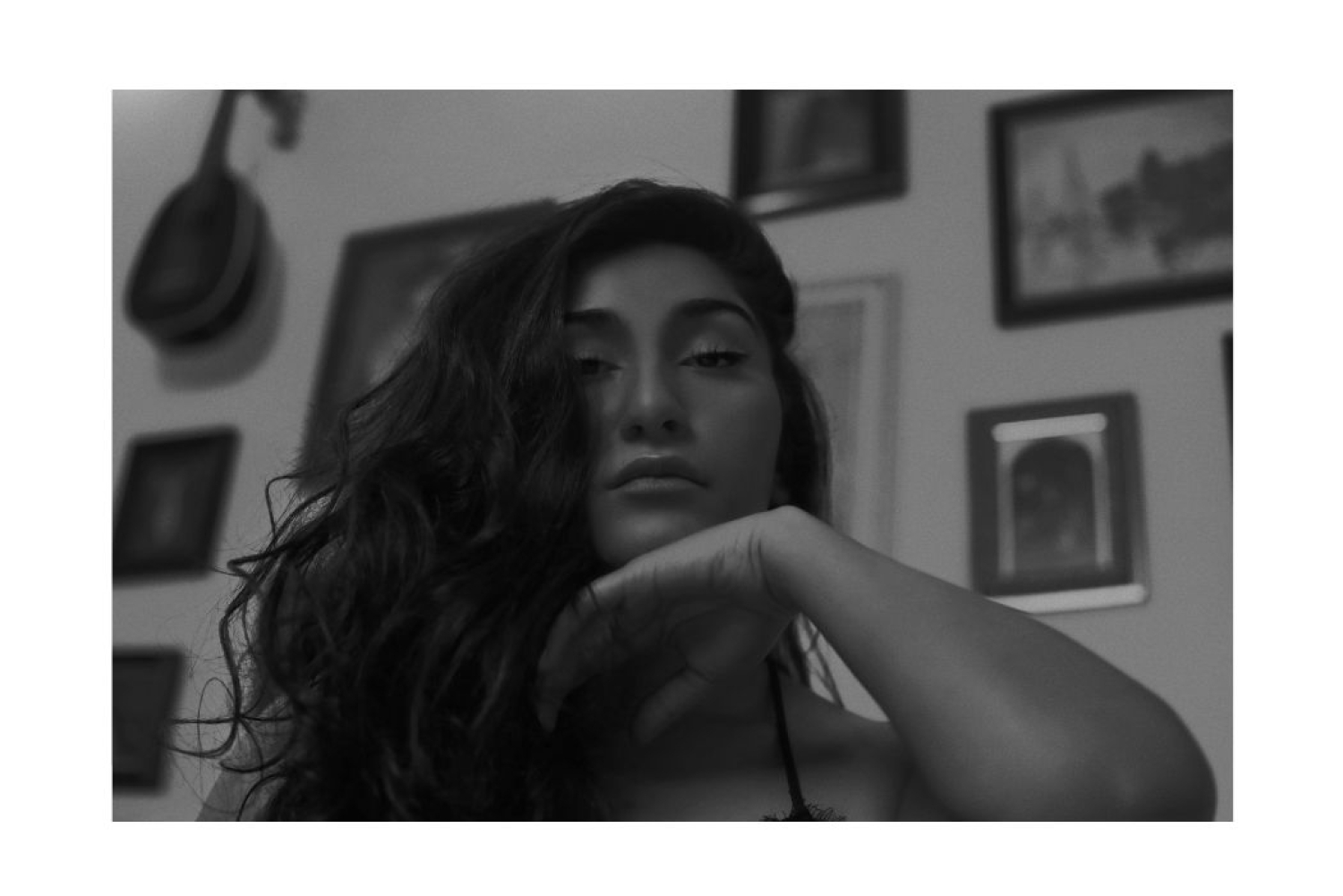
Granddaughter of the visionary Charanjit Singh, whose Ten Ragas to a Disco Beat has since become a near-mythic cult classic, and daughter of celebrated composer Raju Singh, Rachel grew up in a home where music wasn’t just background noise. It was a living, breathing presence.
Instruments were treated with the kind of reverence most people reserve for deities. Compositions floated casually through daily life. Watching her father and grandfather work, Rachel witnessed not just their technical abilities but also their joy in exploration and creation. It’s no surprise, then, that her own arrangements and melodies feel like a meeting point between Hindustani practice and the ever-shifting soundscape she grew up with.
That state of being found an important chapter at Berklee College of Music. Rachel first arrived there as a vocalist, stepping into a space where, back home, women weren’t always centred or celebrated as composers. A few semesters in, something shifted: she picked up a guitar, taught herself to play, and wrote her first song. In a place where vulnerability was encouraged, she found not only the courage to experiment, but the safety to discover what her own voice could really hold. We asked Rachel to return to the roots and ruptures that shape her art.
How do you nurture and evolve your voice as a singer-songwriter? Do you follow specific daily rituals or techniques, much like artists continually refine their craft?
As for proficiency, my morning riyaz and practising my instruments are a daily ritual. Seeking to grow, learn and improve my sound constantly. Remembering that if you're sounding good when you practice, you're not really pushing yourself and learning something new. While creating, on the other hand, I allow a lot more space to flow. Repetition, for example, looping my guitar parts and getting lost in it, allows me to go into a space where I’m creating honestly.
Owl's Eye remains a hauntingly beautiful track from 2021, with its evocative shehnai, layered guitars, and your self-created visuals evoking family legacy. What sparked the title, and do you recall the core inspirations, emotions, or process behind writing and producing it?
Somewhere in 2019, I found myself rummaging through dusty boxes and stumbled upon old albums and heirlooms. As I went through these moments preserved on film, I felt like I was a present, witnessing these events, as time morphed. That feeling was first captured in a guitar piece that I wrote, which slowly built into the arrangement it is today, each instrument as another layer, capturing the essence of the marriages and music that led to me. Once I had a lot of the song together, the lyrics came last. I happen to be taking a class at Berklee about Folklore, animals and their spiritual meaning. There, I learnt that owls represent wisdom, transformation, and trusting in the mystery of the spiritual realm. It is believed that they can see what is hidden behind the veil. So as I travelled through each frame at a time, I felt closer to all that came before me.
While crafting the Owl's Eye music video as a tribute, what new stories or facets did you uncover about your grandfather Charanjit Singh or your father that deepened your appreciation for your lineage?
Owl’s Eye is a song that reflects how music has the power to help us express and reflect all at once. It takes us through the journey of fears, doubts, joys and exploration that have now led up to my life today through generations. Sitting with my grandmother and arranging all the scattered images in a timeline, listening to all the stories of her and my grandfather’s journey. Seeing all the instruments I grew up around and the places they've travelled and the people they've played with. Hoping these instruments could also tell stories. Especially going through the pictures of my dad at different ages, learning to play the guitar on the same classical Yamaha as I first learnt to play on.
Do you primarily draw inspiration from within (personal legacies or emotions) or do you tend to look outward and engage more with the outside world?
I do primarily lean towards drawing inspiration from within. As a neurodivergent person, music has always been my safety net, and learning to write songs became the way that I processed experiences and regulated through life. My first single, Dear Mind was a depiction of my deeper inner conversations and experiences as a queer individual. Followed by Owl’s Eye, a search to learn more about all the marriages and music that led to me. Then came Go Grow, a reminder to constantly prune and evolve, and finally Kahaan, a song that explores questions of belonging, disassociation, and self-reckoning.
How would you describe discovering or defining your unique musical voice and sensibility, perhaps the ethereal nostalgia in tracks like Owl's Eye or the poetic Hindi introspection in your recent work?
I’m constantly discovering my sound, and I try not to define my musical voice in a certain way. I believe it's meant to evolve, and everything should keep changing and growing. However, in my process, I use art to make sense of the world and make it through difficult feelings and thoughts, and somewhere in that self-soothing and creating a safe space for myself, it seems to make space for the listener to do the same.
Can you walk us through how Kahaan, with its shimmering lyrics about wandering paths, hesitant fires, and elusive companions, came to be? What personal or creative sparks fueled its composition, production with your brother Joshua, and self-directed video?
Kahaan is a deeply personal project; it’s the song that started a ripple, a journey, into a new world and language to create in. The first of a progression of untangles I like to call the Myna Series. Where each song is released as a single, for every chapter of life and learning. The inception of this song began with a really special moment on my travels, where i stumbled upon a herd of deers, and later learnt of an ancient Indian parable about a musk deer that scents an intoxicating fragrance and searches frantically throughout the forest for its source, only to realize in its final moments that the scent was inside its own navel all along, symbolizing that what we're all searching for, is within.
That feeling that eased time when the deers stopped and looked right back at me and watching them wander with such softness, brought about the chorus. ‘Bataa, Chaadar odhe tu aaj, Kandhon pe rakh ke jahaan, Jaataa kahaan hai tu?’ The song explores the physical, spiritual, and mental spaces we search for to feel grounded, safe, and at rest, and ends with coming home to ourselves. ‘Sehmi aag, Rehtaa kahaan hai tu, Kar le paar, Khud hi duaa hai tu.’ Once the song found its place in its delicate production, I then went back to square one and wandered the Nilgiris with my camera. I came home with a drive full of pure joy, and then I took my time learning and editing. It felt like something I had to do myself to complete the circle, much like Owl’s Eye.
You handle visuals masterfully, crediting yourself for Owl’s Eye; and Kahaan's videos. Have you formally studied design or film, and how does this visual artistry integrate with your songwriting process?
My artistic curiosity extends to multiple facets of expression. I haven’t studied film or design as such; music is the craft that I chose to study and learn the depths of. I think of it as telling a story, capturing the world the way I am experiencing it. My most important tool will always be my voice and sound. Visually, the work continues to feel documented in nature, through my own lens, unscripted. I intentionally left a broken sense of storyline in my editing process to reflect what dissociation has felt like for me. I like playing with form, observing, and letting the process stay fluid. Clay has also become an important part of my work. Creating and sculpting something from nothing, and in the process, being shaped as much as you shape it. Like in Kahaan, the cover art of the song is a shade of glaze specific to the song, that will be followed by a sculptural series inspired by the song.. In many ways, the music and the visual art are in constant conversation, inspiring each other simultaneously.
Tell us all about the new music you’re creating, what was it like and what inspired it?
I took some time to navigate through my mental health intentionally, and feel grounded in what I’m trying to say with my art. Somewhere in that process of making it through those obstacles rather than around it, I created with a different sense of purpose, with every step I took forward. This year is filled with many singles, some in English, others in Hindi adding to the Myna Series, and some really special works in collaboration with Javed Akhtar and other incredible artists, all building up to an album that I'm incredibly excited to put out into the world.
Words Hansika Lohani
Date 16.2.2026