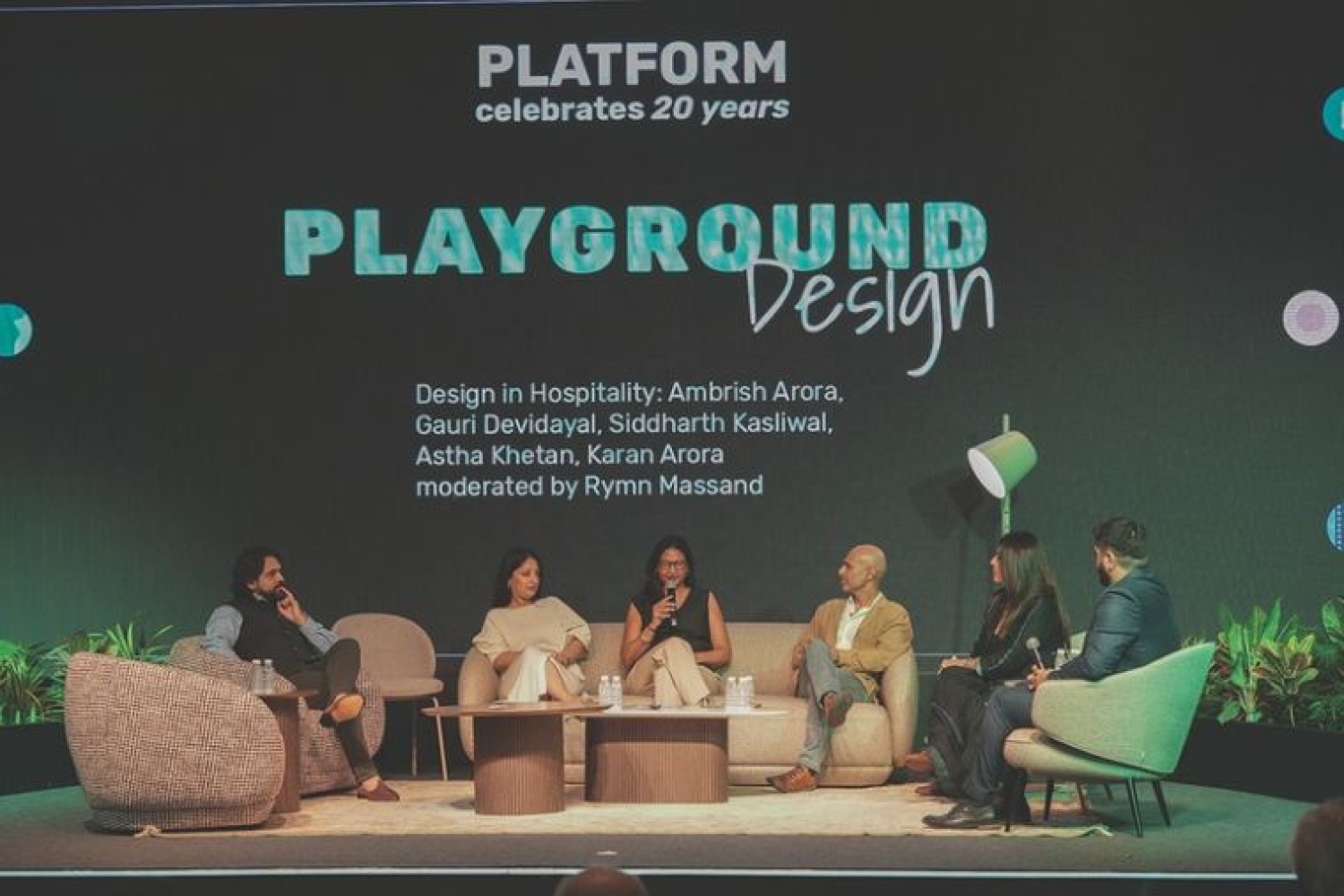
Siddharth Kasliwal, co-founder of The Johri in Jaipur, Aastha Khetan from The House of Things in Udaipur; Gauri Devidayal of The Table in Bombay, Ambrish Arora, the amazing architect of Studio Lotus and Karan Arora from The Macallan joined me for a cosy conversation on stage to celebrate Platform’s 20 years at Platform Playground. The importance of design in hospitality, travel and F&B has been integral to attract a sophisticated and thoughtful audience.
Rymn Massand: All of us here are founders and we started our businesses and brands not necessarily because we identified a gap in the market, but because we felt compelled to create something that first satisfied us and over time, attracted a wider audience. For me, one of the first impulses was to bring to life things I didn’t see elsewhere. Things inspired by my travels, my influences, my personal obsessions. What drove you people to start and when did you realise that design, curation and a particular aesthetic were essential to the world you wanted to build?
Gauri Devidayal: I’m actually the one person who tried talking my husband out of getting into this business and not starting the restaurant. But here we are fifteen years later. With neither of us being from hospitality, the inspiration was, as you said, travel and wanting something new for ourselves. And just creating something that we wanted to go to every week; that was pretty much the inspiration behind the restaurant And I was very happily doing my day job as an accountant while this idea was being conceived in our living room.
And my one contribution to the restaurant design and also why the restaurant is named The Table, was the feature of a community table in the restaurant. This idea came from the Monmouth Coffee House, which was just below my office in London, which had this fantastic community table with a big pot of sugar in the middle and every time you went in there, it had this great vibe with people sitting next to strangers over coffee and conversations. And that was the one thing that inspired the community table in the restaurant. It threw a lot of people off when we opened but it’s my favourite seat in the house.
RM: Sid, your attention to design detail carries through to your ceramics and plateware. You’ve spoken about being inspired by your travels in Morocco and Turkey, but how do you bring that back to India without it feeling like a copy or, on the other hand, overtly Indian? Can you talk about that?
Siddharth Kasliwal: Johri began with Abhishek [Honawar], Naina [Shah], my two other partners and me, driven by a shared love for travel. Morocco and Mexico are two cultures that are very similar to India. When we first went to Marrakech in 2012, it surprised me and strongly reminded me of the old city of Jaipur. These two cultures evolved in parallel, at a time when there was no Instagram or constant photography, yet they still felt so similar in nature. What struck me there was how the French had converted the riads, the old homes, into beautiful hotels. La Maison de l’Orient was one of the properties that completely blew us away. I told Abhishek that Jaipur had the same potential and the same gap: you either have grand palatial properties like Rambagh Palace or those run by big luxury chains like the Oberoi or you have the standard commercial hotels like the Marriotts but there is nothing in between. There was nothing for a young traveller who wants to experience Jaipur from the heart of the old city and be surrounded by thoughtful design. Most of the so-called heritage properties had sadly become places with clumsy modern wall paintings, trying to pass as heritage when they were not. That was the gap we saw and we were often discouraged. People told us no one would go into the old city because it was too filthy and full of trash and were certain no one would go there. I felt that was exactly the point, because Jaipur is one city where culture and heritage naturally meet, where the community intersects and where you can feel the city’s energy in the bazaars.
The city was built as a centre for artisans and craftsmen and I always say that in Jaipur you never need to look far to be inspired. That became the idea behind The Johri: guests could walk through the bazaars, stay in a luxury boutique property and be completely immersed in Indian culture without feeling like they were in some artificial, theme-park version of a city. The building that houses The Johri, Lal Haveli, was built in 1872 and was the second-tallest building after the City Palace, so it was already a landmark. Converting it into a five-suite property with a restaurant that has become a popular spot for people in Jaipur felt incredibly rewarding because we had envisioned it and it worked. Our attention to detail is slightly above and beyond what most places attempt, whether it is the plateware, the wall murals or the little details on the coasters. This deliberate, multi-layered thinking is one of the biggest draws. Many people visit just to experience the design and see what this level of finesse feels like. I credit Naina for all the crockery and many of those details. Three forces came together: my eye for detail from the jewellery world, which is our family profession; Naina’s background in embroidery and Abhishek’s experience in hospitality. We brought three different industries together and wove them into The Johri.
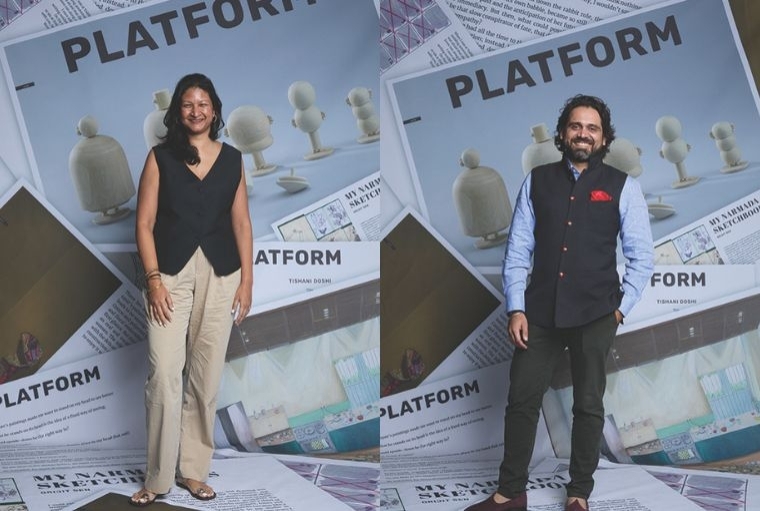
Gauri Devidayal & Siddharth Kasliwal
RM: Ambrish, you’ve done many smaller projects, like The RAAS Jodhpur, which you built from scratch to reflect the fort and its setting and you’ve also worked on larger brands like the Oberois and the Tajs. I won’t ask you for a favourite project. But, I am curious: how do design and expectations differ for you between smaller, often family-run properties with a strong individual vision and the larger, more standardised hotels that follow a uniform brand approach, even if they aren’t exactly cookie-cutter?
Ambrish Arora: I am going to change the question a bit and instead of answering what is expected, speak about how we approach different brands. One of the biggest challenges is understanding the nature of the brand we are working with and what it truly stands for. I see our role as designers as being facilitators who heighten or build on the offering of the people we are designing for. In hospitality, the basic touchpoints all come back to guest experience. Especially in leisure, people go to a hotel to live out an aspiration or a fantasy, which then connects to a sense of place. The first step is to discover that sense of place and to understand what embodies its essence. For example, Siddharth spoke about the history of Jaipur and the walled city. In the case of RAAS, we approached it through the artisanal and material heritage of the place, then interpreted that in a contemporary idiom because we believed it was important to give new life to skills and materials rather than replicate what already existed. There were three existing buildings that we restored, and the new buildings have a contemporary form but use traditional materials and skills. This also resonated with Nikhilendra [Singh], the owner of RAAS Hotels and aligned with the frugality with which he wanted the place to exist in terms of material, spirit and form.
By contrast, when we work with a brand like Oberoi, I had the good fortune of working with Mr V. P. Oberoi and came to understand the obsession with service, where everything is centred on the guest: where they sit, where the switch is placed, and every seemingly mundane detail. The degree of attention to every movement in the room was incredible and that is what he and the Oberoi brand stood for, so our task was to mould ourselves to that ethos. These are two ends of a spectrum and our work is about bridging all of it: engineering, space, form-making and storytelling. The storytelling comes from where you are and what that place means. We try to dig deeper into where we are building and ask what story the guest would like to take away with them when they visit that city, town, state or culture.
RM: Astha, he’s also talking about the spaces they inhabit. So not everything is straightforward; it depends on whose story you’re telling and choosing to put them first. How has that shown up in your work with The House of Things? You’re now moving into different areas, more than just curating, supplying, and designing. Where do you find the design convergence that feels most true to you and to your client?
Astha Khetan: So as Ambrish rightly said, it always starts with the vision of the client and the history of the place. But for me, the idea is also, ‘sensorial mixology’. For example, a Beekman in New York or a Lake Palace in Udaipur, you want it to be intimate, romantic… So the artwork, the fabric, the art, the light, everything sort of comes together harmoniously in that place. Similarly, now, sustainability is a big deal and there are hotels coming out which talk about getting closer to nature. One project that we very closely work with is called the One Hotels, which is expanding now across the world. And they really bring nature into the skin of the hotel. Everything from saving water to using reclaimed wood, everything in the hotel talks about that. So it’s really building on the narrative of what the brand stands for and what you really want your guests to take home. It is a mix of narrative, materials, your pillow, your smell; everything adds up. It’s a good blend. And that blend is exactly what makes the experience. Because at the end of the day, emotions are at the heart of all design. So, what’s the emotion that you’re carrying back?
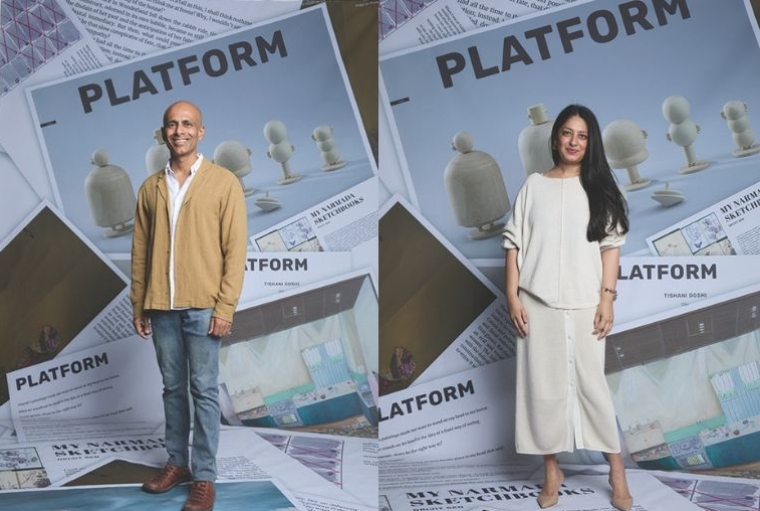
Ambrish Arora & Aastha Khetan
RM: Ambrish, you said something interesting about frugality and luxury. Traditionally in India, luxury has meant plentitude; marble, gold edging and lots of extras. Now it’s more about how we want to feel in a space. Functionality comes first. Then the space must evoke an emotion, without overwhelming you with things; it should quietly do its job. So Gauri, as we talk about storytelling and narrative and about the feelings shaped by our travels: are you trying to evoke a particular emotion you’ve experienced elsewhere and now translate through design… beyond the obvious senses of smell, light and touch?
GD: I think in our restaurant, when we were briefing the designer, we were not entirely sure how to articulate what we eventually achieved. What we did know was that, for those few hours you spend in the restaurant, we want you to escape. You should feel transported somewhere else and that experience is not just about the food. The design of the space plays a very important role in that. Over the last fifteen years of having The Table, one of the biggest lessons I have learned is that creating a restaurant space that feels timeless rather than trendy is very difficult. You want it to avoid feeling flashy and impressive only when you first open and instead remain relevant over time, even over a decade. I think that is one of the hardest things for a space to achieve. Eating out and going to restaurants is not just about the act of eating. What makes us return again and again is the memory that is created, something you want to recreate.
There is something that strikes a chord, you start to crave it and you go back for that feeling. A space has to keep creating that feeling for you over a long period of time. At the same time, we have worked with different architects over the years for different restaurants and we often have to hold them back because this is not meant to be a design statement. The design is intended to be almost subliminal. Every detail has been carefully considered but it is not necessarily the reason someone comes to the space. So having some restraint in design, while still creating a space that evokes a feeling, is much harder than it sounds. I do not know if that has been your experience but you are right: less is more in every way.
RM: Not always but in a restaurant, minimalism is a statement in itself. The restraint is intentional. It is not for a lack of ideas; it comes from a very thought-through decision about what we want to present to the world. All the functionality is taken care of but it is not always decorative. Design still fulfils that role. Karan, I wanted to ask you about The Macallan’s recent re-packaging of their bottle with 1990’s designer David Carson, who created Ray Gun magazine and upended the magazine world at the time. He was a surfer and a skateboarder and still is in his 60s. He was a rebel, with no formal design training and he created a magazine we would all save up to buy because it was just amazing. The Macallan commissioned him, which I first thought was an odd choice but it actually works, to create their new packaging and overall look and feel. For a legacy brand like The Macallan, what was it like to work with this rebellious designer? Why him?
Karan Arora: He is an icon in the graphic design industry, who has truly transformed the field. At The Macallan, we believe in ‘masters working with masters’, collaborating with leading figures in their respective industries. The Macallan is now entering an important new chapter as we begin our third century of production, so it felt like the right time to create a new visual identity. David’s work is layered and complex, almost like a whisky from my portfolio, with successive layers of text and typography.
This mirrors what we do at The Macallan, where our whiskies are known for their layered complexity and emotional impact. Although we are a legacy brand, The Macallan consistently balances heritage with innovation. Our packaging reflects this, as we regularly launch new products and collaborations with curators like David. He was a natural fit for our design philosophy.
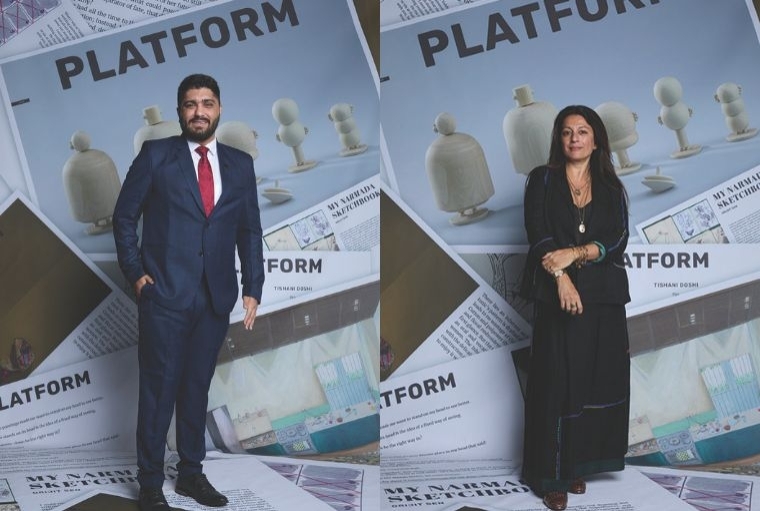
Karan Arora & Rymn Massand
RM: To me, the key is serving the story and the client, rather than trying to impose something. If a choice fits a brand that’s complex, layered and curatorial, I find that choice quite interesting. Ambrish and Astha, since you both commission work, do you usually pick what feels like a logical fit or do you sometimes deliberately choose something outside your norm to see what happens?
AA: When we did RAAS, which was the first hotel we worked on and which led to an ongoing relationship with this client who is now a dear friend, I remember being really nervous because it was our first architectural commission. I asked Nikhilendra to send me a written brief about what he wanted from the hotel because at the start, it was meant to be a heritage project and we knew we could not achieve that with the budget he had and he knew it too. He said, ‘You know what? I don’t care. As soon as the guests walk in, I want them to have sex’, and I still have that email saved somewhere in the studio and when the hotel was built, he said it worked. It was a great way for RAAS to capture the energy with which he was thinking; there was a certain masculine energy to the place, which I believe still exists. It was an unusual collaboration, but it has lasted and there has been a consistency of spirit. A key part of that has been our approach, which originated in the studio and resonated with him, of engaging with craft. As anyone who has worked with craft knows, you do not commission a finished product from a craftsperson; they have a process and if you really want the best from the craft, you have to let the craftsperson determine the end result and see your own role as facilitating a new journey with them. We have been very fortunate to do this not only in hospitality but also in government buildings and public spaces, where we have had the opportunity to work with craftspeople.
Sadly, craft is often seen mainly as something nostalgic or worthy of saving, rather than as a powerful set of skills that can enable extraordinary outcomes. In these collaborations, which I truly see as collaborations, we have often begun with one intention and ended with something entirely different because of what the craftspeople brought to the table and the freedom with which they chose to express themselves. Our role has simply been to push them beyond their comfort zones and help them change the stories they hold in their heads, while letting their skills and their ease with their chosen materials determine the final result. That consistent element of surprise across various commissions continues to inform much of our work and it has been deeply rewarding.
AK: I’d like to add to that. Building on what Ambrish said, I’ve had the good fortune to see both of his RAAS projects, which are amazing and make beautiful use of craft. For me personally, the projects we work on range from boutique and luxury. With high-end luxury, owners usually have a more defined vision, they understand craft and they are happy to incorporate it. In contrast, in more business-oriented, cookie-cutter hotels, you really need to build a narrative because otherwise, a hotel in Delhi, Mumbai or Ahmedabad would all look the same. The question is how to make the public spaces speak a distinct language in each hotel. That is where craft and art come in and allow you to tell a story.
It is wonderful when you can work with local craftspeople and be specific to that place but the possibilities of print, digital tools and even generative AI also work wonders now, especially for more budget-sensitive projects. You still have to make the client feel good and emotionally connected to a business hotel they are walking into and I think it is now a successful blend of craft and technology that works well for projects. That is where we are heading. Craft is still supreme but we also cannot ignore the digital transformation that is underway.
RM: Gauri, what do you think about unexpected pairings?
GD: I think our entire journey at The Table has been about unexpected pairings. We’re the kind of people who will fly back with crockery in our luggage because we saw some¬thing and felt it was going to bring a dish to life. It’s amazing how a piece of crockery can change how you perceive a dish. For example, there is something about those details I referred to earlier that is completely subliminal. You do not have to notice everything but it still shapes your expe¬rience of being there. That is the part we have the most fun with or at least I have the most fun with because I am not a chef and I cannot cook. That is how the restaurant brings me joy.
This is an article from the October EZ. For more such stories, read the EZ here.
Words Rymn Massand
Date 24.10.2026