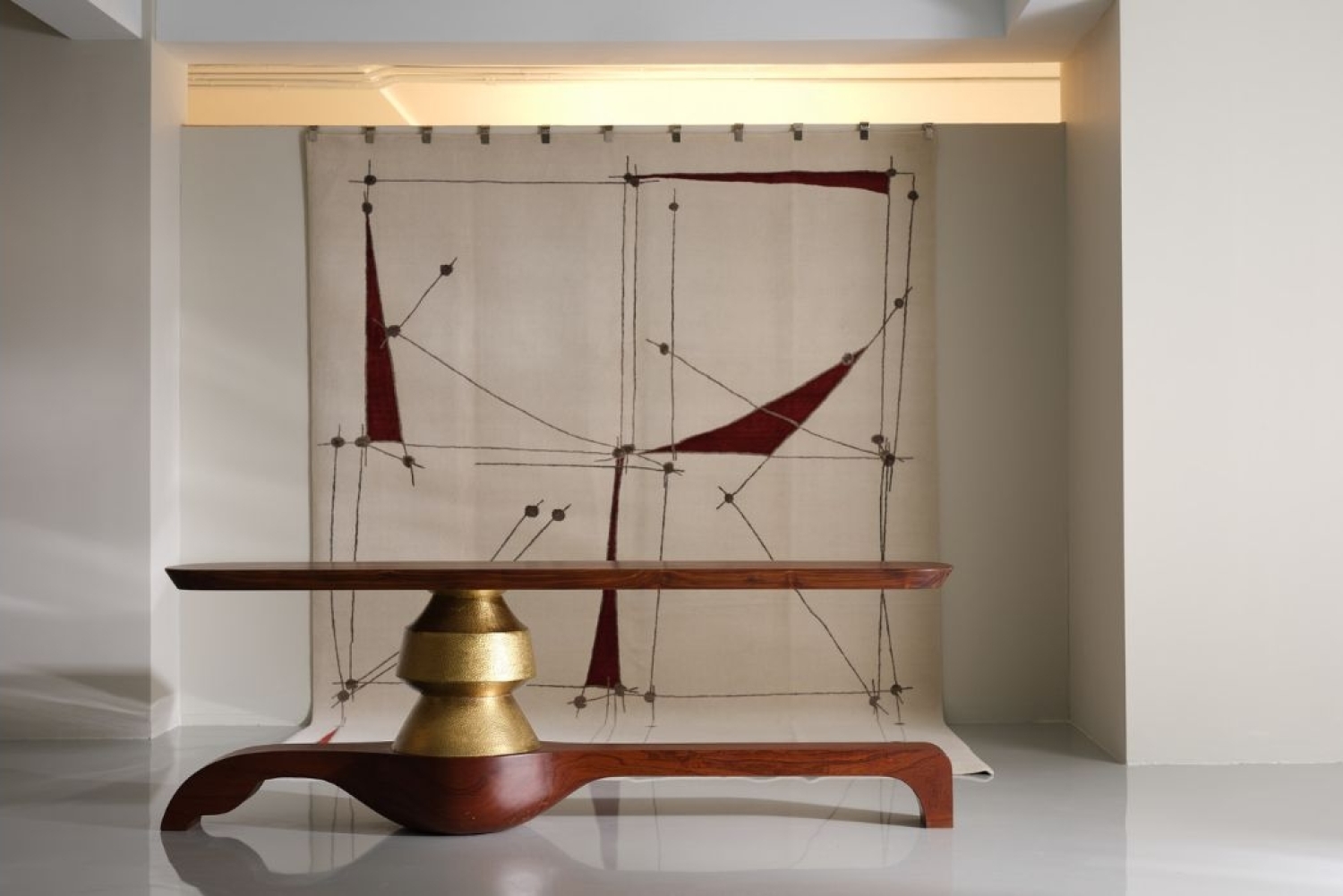
Rebecca Ruben for Rhizome Ghee Console Table 90 in L X 18 in W X 30 in H Reclaimed teak wood, Brass. Wood with monocoat finish, Mathaar texture on Brass.
Rebecca Ruben for Rhizome Ghee Console Table 90 in L X 18 in W X 30 in H Reclaimed teak wood, Brass. Wood with monocoat finish, Mathaar texture on Brass.
House of Santal, NYC’s first South Asian design gallery, emerges from a desire to give craft a global stage. What began as a shift from venture capital into interiors soon became a deeper inquiry into the region’s design language, shaped by the incredible depth of craft and design emerging across South Asia. The gallery centres work where tradition does not fit into the box of an ‘ornament, but a foundation for contemporary design,’ bringing artisans and designers into a shared, forward-looking conversation that feels both familiar and new. We’re in dialogue with Raksha Sanikam, the founder.
Can you start off by telling us a little about the idea for House of Santal? How did it come about?
In 2018, I pivoted from venture capital into a new role through which two interior decoration projects came my way. Through that process, I began visiting and exploring design shows across India, which opened my eyes to the incredible depth of craft and design emerging from the region. It was a turning point. I realized that this work deserved a global stage.
Craft has always been present around us, often limited to surfaces or categorized as “ethnic.” But over the last two decades, a new generation of designers has begun working with craft at its core, pushing its boundaries and reimagining what it can become. That shift stayed with me.
With that as a foundation, I went on to pursue my Master’s in Interior Architecture at Pratt, using that time to further explore and shape this idea. I experimented with representation along the way, but it was only about a year ago that I fully committed and took the plunge.
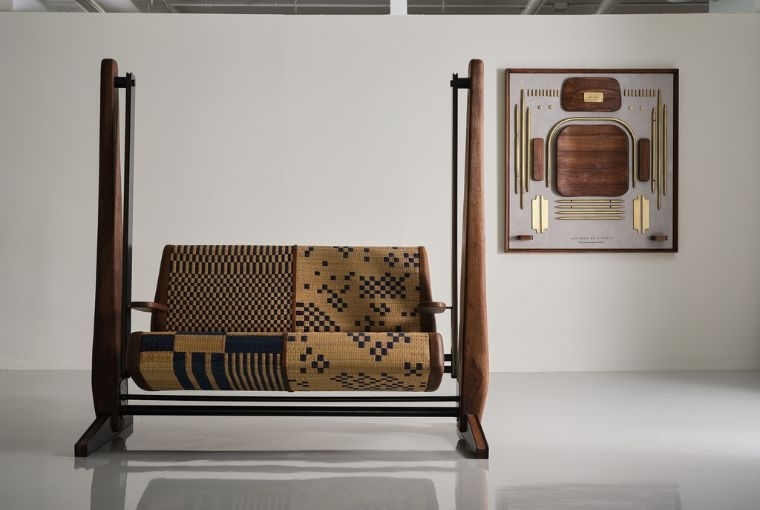
Veeram Shah and Majja Design Studio for Design Ni Dukaan 5 ft 11 in L × 2 ft 7.5 in W × 5 ft 11 in H Solid Teakwood, Mild steel, Pattamadai mats. Burnt wood finish, matt PU on Mild steel
Tell us about your focus on bringing legacy artisan traditions to the forefront of the international design stage.
India, and the broader South Asian region, is uniquely privileged to hold an extraordinary depth of artisanal knowledge, with generations of makers and a vast range of techniques embedded across the country. However, over the last couple of decades, the perceived value and demand for this craft within the region has been steadily declining. What is often seen as commonplace locally can, through the lens of geographical distance, become rare and deeply valued elsewhere.
This idea of cultural and geographic arbitrage has always stayed with me. I realized that for these practices to regain the recognition they deserve, they need to be positioned on a global platform, alongside the best in contemporary design. My focus is on bringing these legacy traditions into that international context, not as heritage artifacts, but as part of a forward-looking design conversation. By doing so, the intention is to elevate not just the objects, but the entire ecosystem behind them, increasing visibility, value, and long-term sustainability for the artisans and designers shaping this work today.
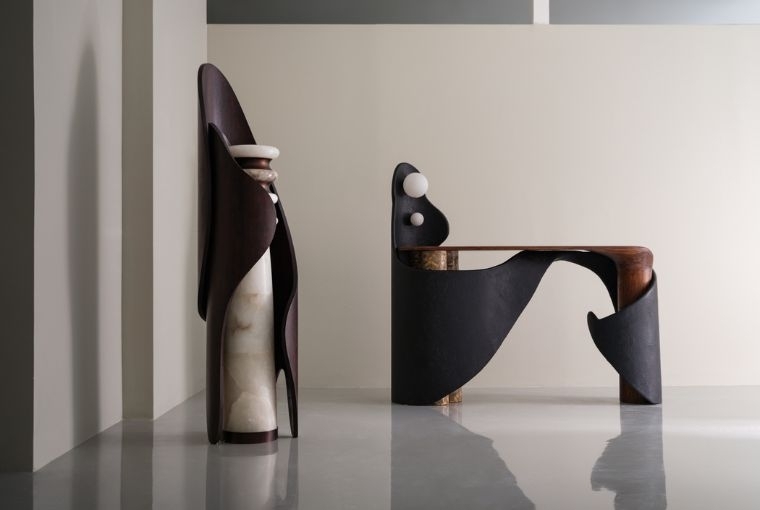
Akshay & Avani Khurana for Beyond Dreams Vaayu 6 in L x 18 in W x 54 in H Teak Wood, Wood Chips in Resin, Bent Composite Wood in concrete finish. Golden Loom & Charcoal Drift finish.
What was your curatorial process and vision? What draws you to a piece, and what makes it feel like it belongs within the House of Santal?
The underlying thread that anchors the curation is a deep engagement with legacy craft, not as ornament, but as a foundation for contemporary design. The process begins with understanding the integrity of the craft, how it is made, where it comes from, and how it has been translated into a new context. From there, I look at the depth of design thinking and its relevance to the way we live today.
What draws me to a piece is often an intangible tension, where tradition and experimentation coexist, something that feels both familiar and new. For a work to belong within House of Santal, it must stand as a beautiful object while contributing to a larger narrative around material, memory, and making.
To you, what does a meaningful collaboration between designer and artisan look like?
A meaningful collaboration is one where craft is integral to the design, not applied as a surface afterthought. It comes from a designer’s intent to work with the logic, limitations, and possibilities of the craft itself, allowing it to shape the outcome. At the same time, it requires a deep respect for the artisan, not just as a maker, but as a co-author in the process. The most compelling collaborations are those where the artisan’s skill doesn’t just execute a vision, but actively informs and elevates it, with both voices clearly present in the final piece.
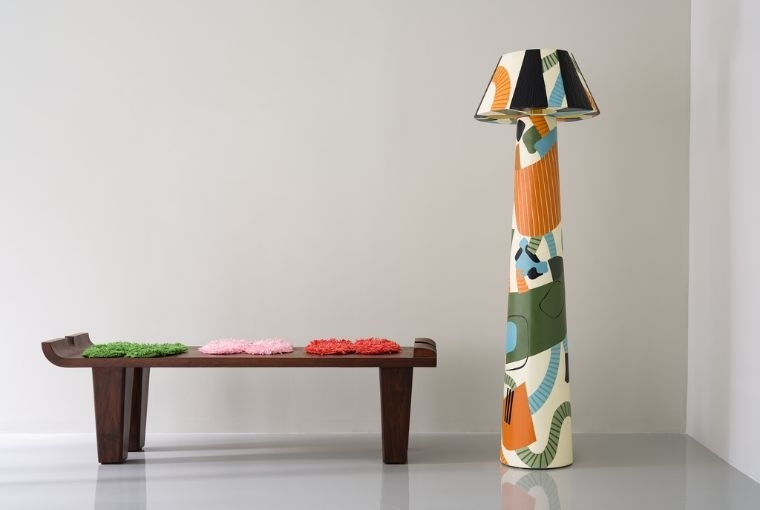
Nynika Jhaveri in collaboration with Anikesa Dhing for Studio Nyn Fuzzy Bottoms 66 L x 21 D x 21 in H Solid Teak Wood, Hand-Crocheted Acrylic Wool
What kinds of conversations are you hoping House of Santal can open up over time?
I hope House of Santal can open up conversations around representation, value, and authorship across the entire production chain. At its core, it’s about creating space for artisans to move beyond execution and engage more freely with design thinking, while also ensuring they are recognized and valued for their contribution.
There’s also a larger dialogue around placing Indian design within the global collectible context, where increased visibility and appreciation can gradually shift perceptions and pricing. This is not something that changes overnight. It requires a collective effort across designers, artisans, platforms, and audiences. We see House of Santal as a small but committed contributor to that long-term shift.
According to you, what is the future of design?
In a world shaped by AI and rapid production, the value of the hand only becomes more significant. Legacy crafts, learned through experience and passed down through generations, are becoming increasingly rare. At the same time, the world is becoming more culturally aware. Cross-pollination and collaboration are emerging as a new language of design.
We see House of Santal as a bridge between South Asia and the global design landscape, working alongside other platforms to bring these practices into a broader, more contemporary conversation.
Words Neeraja Srinivasan
Date 17.4.2026
Photos Joe Kramm
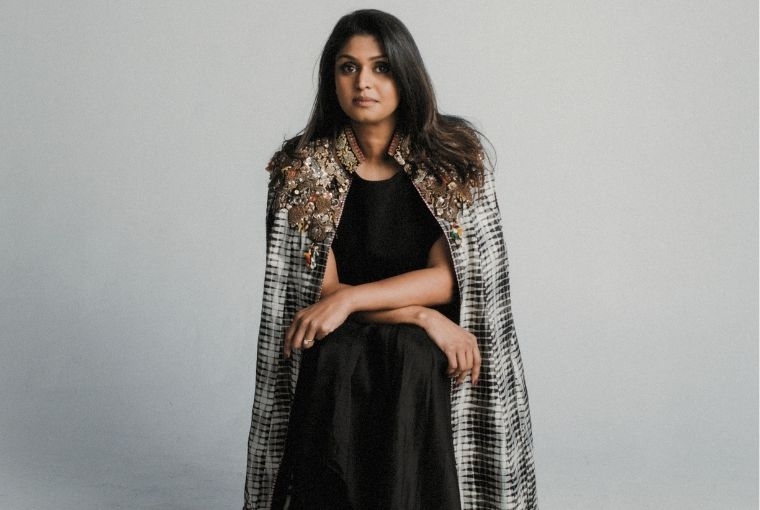
Raksha Sanikam, Photo by Sam Morrison