The founders of The Vernacular Modern were drawn to artisans working by hand, curious about what sustains their commitment to practices that are increasingly difficult to continue. For Deeptashree Saha and Abhirup Dutta, what started as a series of conversations gradually deepened into a more engaged inquiry. They began travelling to remote villages, often off the map, meeting craftspeople with no immediate intention of incorporating these encounters into their work. It was, at first, a process of self-study. Over time, these interactions evolved. Artisans began sharing samples and objects, wanting to explore. That exchange set things in motion.
Their work today spans furniture, lighting, and objects that reinterpret traditional crafts for contemporary spaces. This includes innovative creations like woven grass fans, leather lighting pieces, and stone inlay surfaces treated with cyanotype. Emerging as an offshoot of Woodlabs, their carpentry workshop, The Vernacular Modern was shaped by a desire to work with grassroots knowledge and skill sets, and to explore how they might find relevance within daily urban life.
Reinterpreting the Vernacular
We approach this in three steps: documenting the crafts, understanding the technique, and studying the visual grammar. That visual language often exists because a king or patron once wanted it a certain way. For us, it became important to explore how it could be reinterpreted today. Take Madur, a traditional grass mat used as a bed topper before electricity. That need no longer exists, and the craft has been reduced to a wedding trousseau item. Many people no longer know why they include it. We wanted to understand how it could be refitted into current use, and now use it in our pakha [fan] for the blades, creating long mats of fifteen to twenty feet. This required reworking the loop so artisans could handle larger surfaces. For us, it always comes back to understanding the material and technique, and how they can serve present-day needs.
On Collectibles
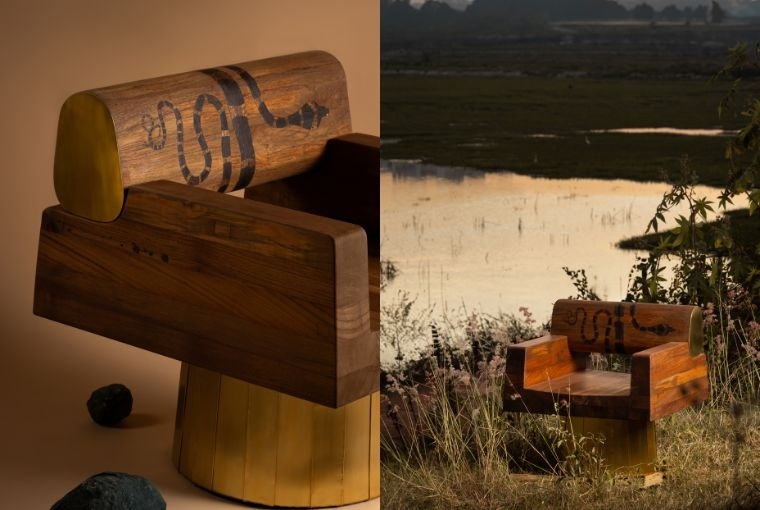
A collectible, to us, is something that is not entirely mainstream, or something that may eventually fade away. Since we work with many crafts, we often collaborate with artisans from the last practicing generation of that craft. There is a subconscious effort to create pieces that say: this exists, why not engage with it? Through that dialogue, we hope to build awareness and open up the possibility of revival.
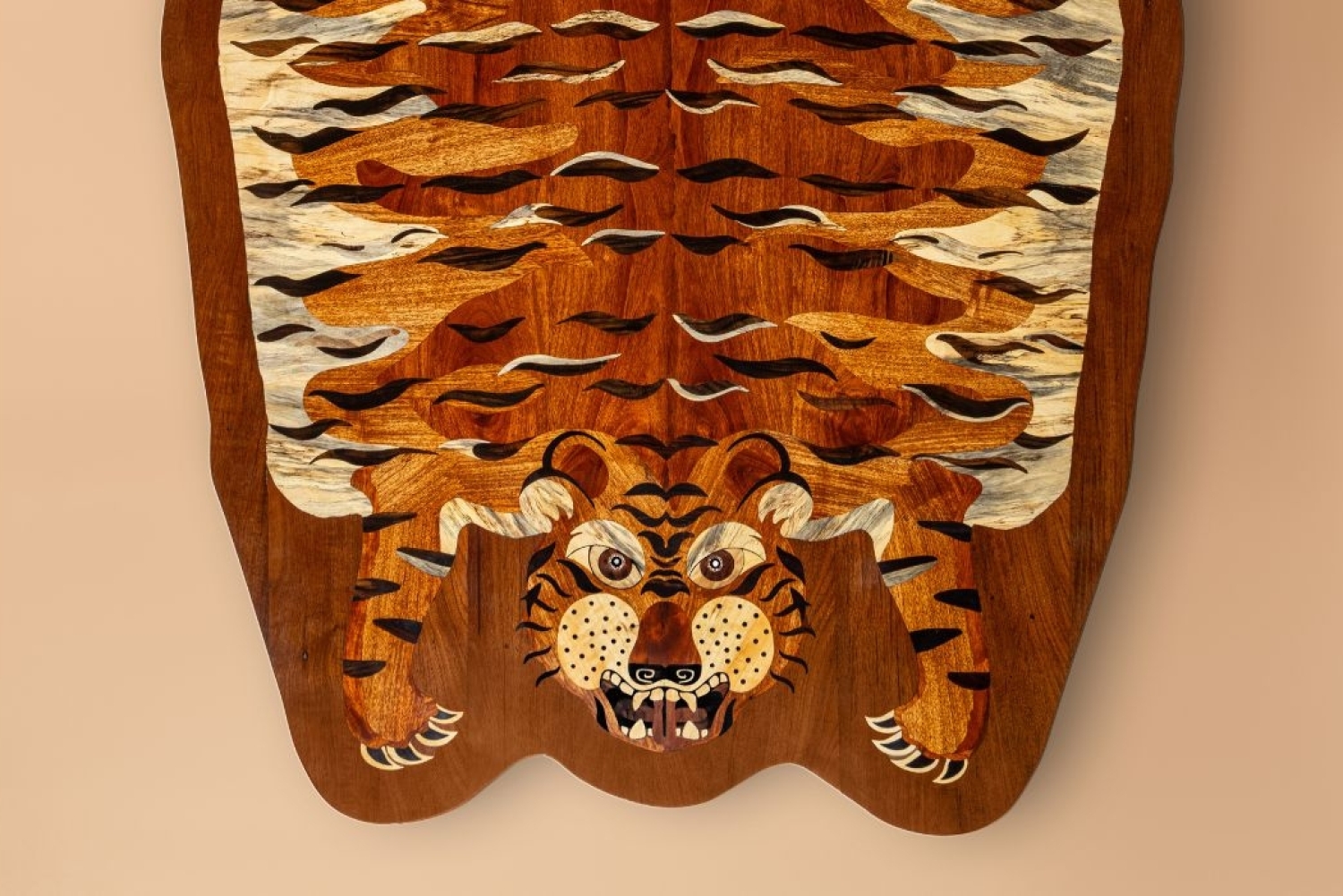
Marquetry is a strong example of this. It was largely practiced as fine art, where artists created landscapes or portraits using wood. While highly skilled, such specific work does not always reach a wider audience. The challenge was to find a balance where the craft becomes the statement. In doing so, we hoped to create something compelling enough for the next generation to continue. We found success with marquetry, but during our four-year journey, we lost Mr. Mohanji, with whom we began working, and who had practiced since the age of twelve. His sons, however, were able to carry it forward. That continuation of lineage felt significant.
Design and Everyday Living
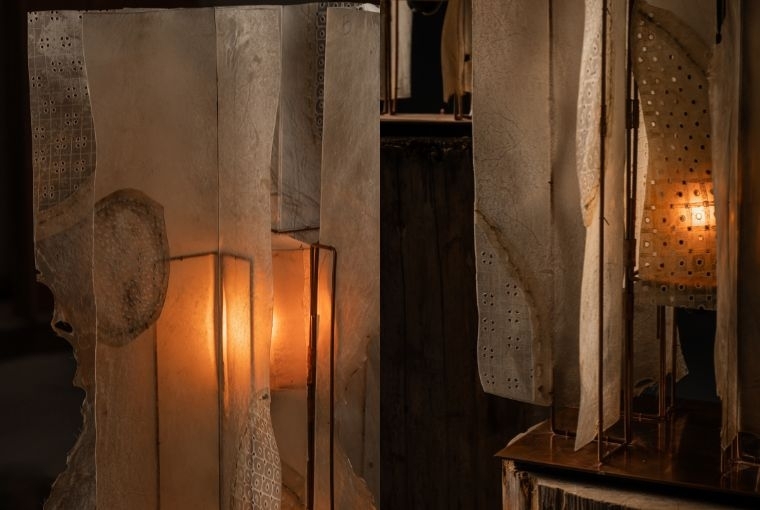
Our design process begins with learning the craft. Once we understand each step involved, it becomes interesting to explore the less obvious aspects that still tell a story. When working with the leather sector, we found their traditional practice had gone through major shifts. Leather puppetry, once used for storytelling, had faded. Artisans then moved to painting deities in temples, but even that declined as modern construction replaced fine handwork. We returned to the origin of the material itself: how leather is processed. Chamra Deepa, our creation, focuses on how leather filters light, how thin it can be sliced, how it is cleaned, and how damage is repaired. That process became the design.
Neela Ratri
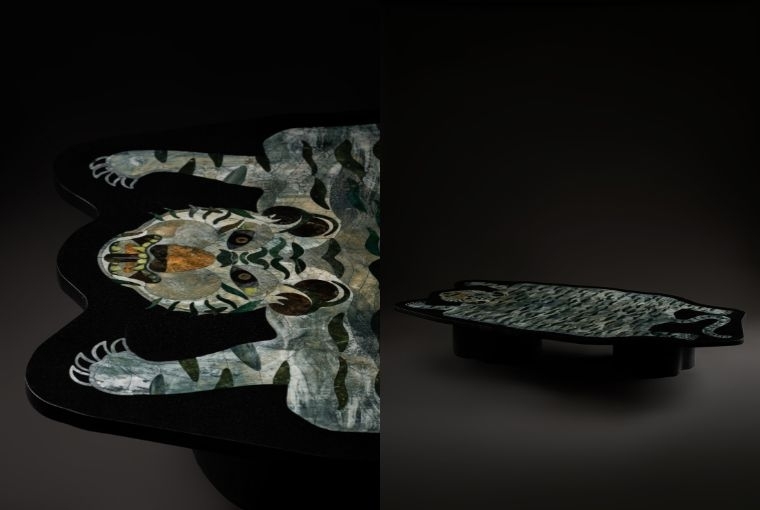
One of our most exciting recent launches is the cyanotype stone collection. Cyanotype is a process in which a chemical combination turns blue when exposed to UV light. Historically used for photo printing, it is now mostly seen as a hobby on paper or textiles. What drew us in was the shade of blue it produces, as blue in nature is rare. While experimenting on wood, we began applying the chemical to leftover materials, including stone pebbles around the workshop. These stones also turned blue and retained the colour. This led us to question why we overlook local materials while idealising imported ones. The stones around us are just as resilient and beautiful.
As we worked with them, the colour variation ranged from blue to green. The collection, called Neela Ratri, features stone inlay using humble Indian stones, all cyanotyped. The pieces resemble nightscapes, creating an effect that feels both striking and unfamiliar. It brings together a modern technique and a traditional practice, allowing them to find a new voice together.
This article is from the May EZ. For more such stories, grab your free copy of the EZ here.
Words Neeraja Srinivasan
Photography Hansoga Photography
Date 25.5.2026