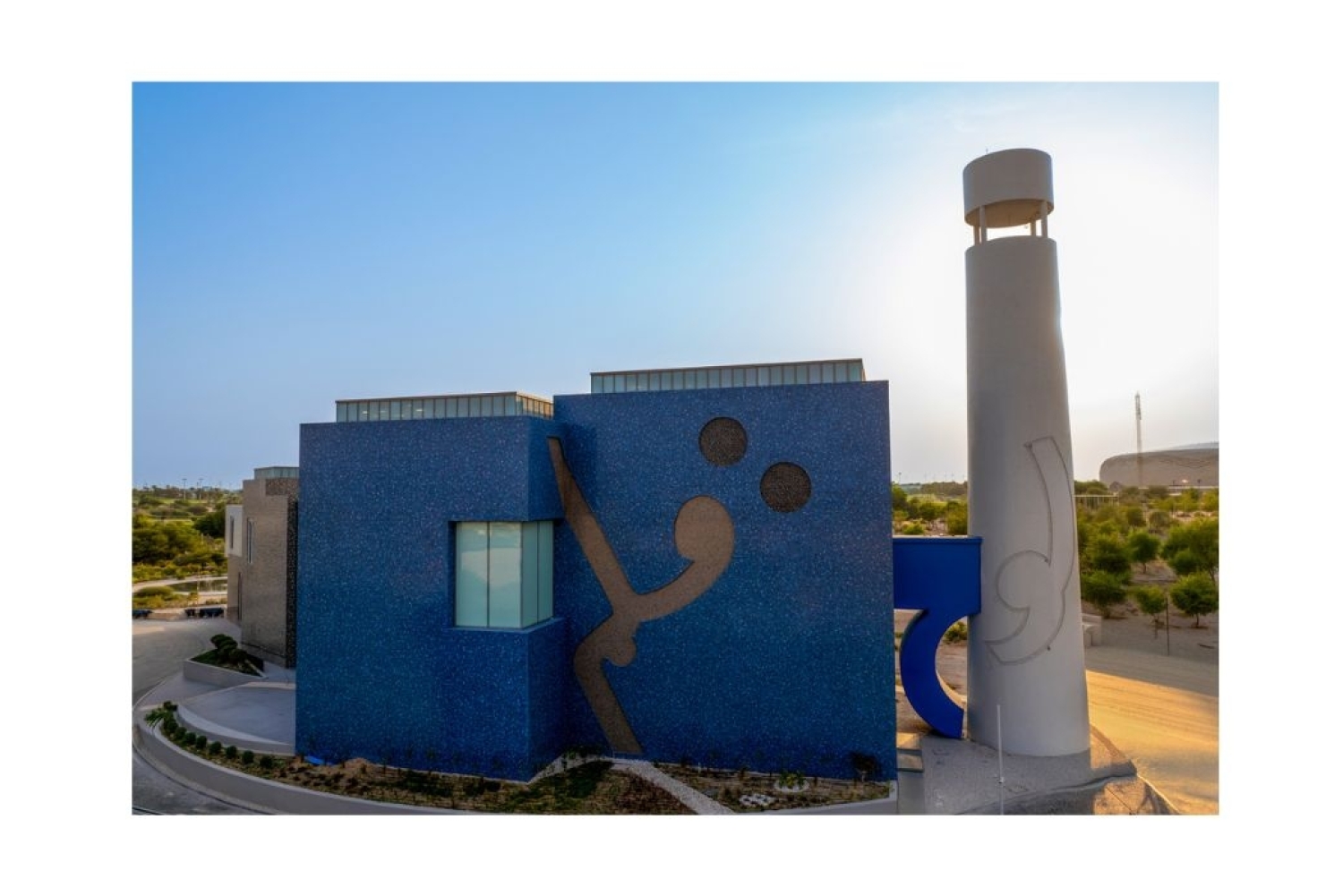
Martand Khosla’s architectural interpretation of the Lawh Wa Qalam: M. F. Husain Museum in Doha, Qatar, is both a homage and an evolution of the artist’s original vision, transforming a symbolic sketch into an adaptive, contemporary landmark. Drawing upon Husain’s unique thought behind art for art’ sake, Martand has woven together multicultural references and modernist sensibilities to reflect both the artist’s legacy and Doha’s cultural context. His approach placed the museum at the heart of Education City, creating a dynamic space that encourages public engagement, layered dialogues and inventive programming. While the Qatar Foundation shaped the storytelling and multimedia aspects within the museum, Martand’s role was to create the architectural framework that supports and reveals these narratives. The result is a museum that serves as a platform for ideas, uniting architecture, education and art in an inspiring space.
How did working with M. F. Husain’s original sketch, for his own museum, inform your architectural design process? Can you share specific ways you adapted his vision to meet the museum’s modern purpose and environment?
Husain’s sketch was an idea for a museum. Unlike architecture, it wasn’t anchored to either a site or a scale. Yet it carried within it a formal, philosophical and social intent; a vision for what a museum should represent within society. Like much of his art, the drawing could be read on multiple levels: literal, symbolic and metaphorical. During the early stages of design, we held several conversations with the Qatar Foundation to develop an architectural language that could encompass these many readings of the sketch. Beyond its formal and cultural references, its gestures toward multiculturalism and regionalism, we also spoke extensively about the role of a museum in contemporary society and particularly in Doha.
The building sits at the heart of Qatar Foundation’s Education City, a hub of higher learning and discourse, so these contextual aspects became key to both its design and its program. As a drawing, Husain’s concept was site-agnostic and scale-agnostic; he offered indications of form and cultural clues rather than a fixed plan. The architectural challenges were therefore about scale and context, to translate his artistic intent into a built environment. It was clear to me that the project had to acknowledge the formal intent of the sketch but evolve beyond it to address the complex realities of site, program and experience. In our studio, the starting point was the blue mosaic tiles of the façade. From there, we developed the main ‘Blue House’ and extended the same material language into the ‘Grey House’. We referenced the architectural vocabulary of the adjacent Seeroo fi al ardh, Husain’s last major artistic commission, which is now part of the museum, to create the cylindrical junction between the two; a volume that houses the main staircase, which also doubles as seating for visitors. This outward-looking element visually connects the museum to Seeroo fi al ardh.
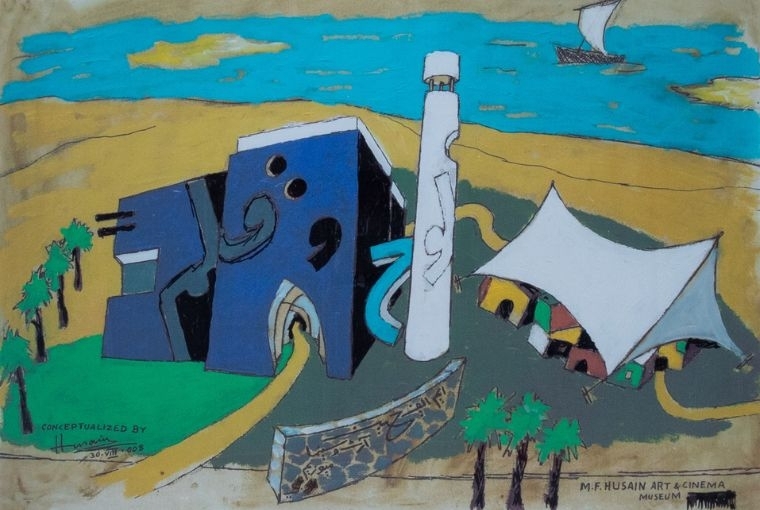
Artist: Maqbool Fiza Husain, Year: 2008, Title: Sketch by Maqbool Fida Husain
As an architect and an artist, where does your process begin – and how do you know when a work is complete?
My creative processes unfold across multiple scales, often simultaneously. In my art practice, I tend to work in series because larger ideas require several iterations before reaching a point of resolution or satisfaction. I’m not necessarily searching for completion in each work; I’m seeking balance between responding to what came before and questioning what’s next. It’s a bit like climbing a ladder, though more often like Snakes and Ladders. Reaching the top is sometimes simply the cue to move on and in that act lies a sense of completion for a series. Architecture, of course, is different. It’s guided by its context, utility and constraints. Finance, engineering and function inevitably shape its form. In my practice, I prefer to visualise the final building completely before construction begins. Architecture allows less room for tentativeness or improvisation; it’s slower, more deliberate and often less forgiving than sculpture or painting. Ultimately, for both architecture and art, completion is revealed only by time. If, years later, I can return to a work and still feel that it lacks nothing in form or intent, then I know it is complete. Those moments, however, are rare.
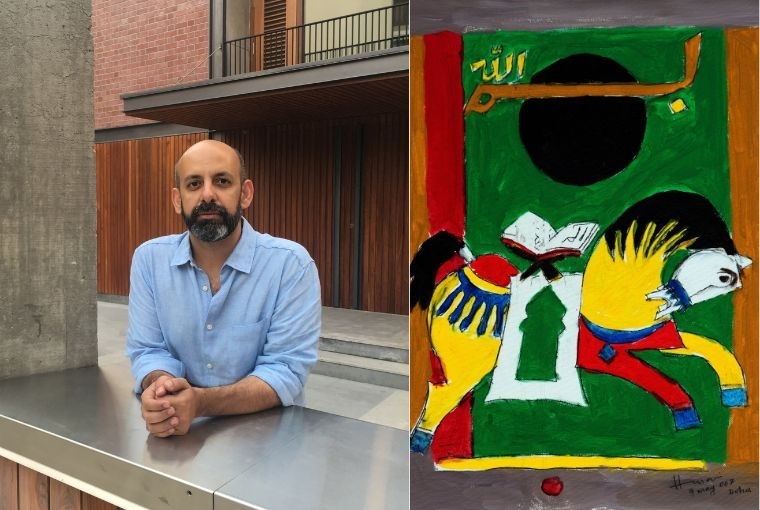
L: Martand Khosla, Photo by Dolly Singh, R: Artist: Maqbool Fida Husain, Year: 2007, Title: Zuljanah Horse, Courtesy of Qatar Foundation
This article is an exclusive excerpt from our November 2025 Bookazine. For more such stories, grab your copy here.
Words Hansika Lohani
Date 6-12-2025