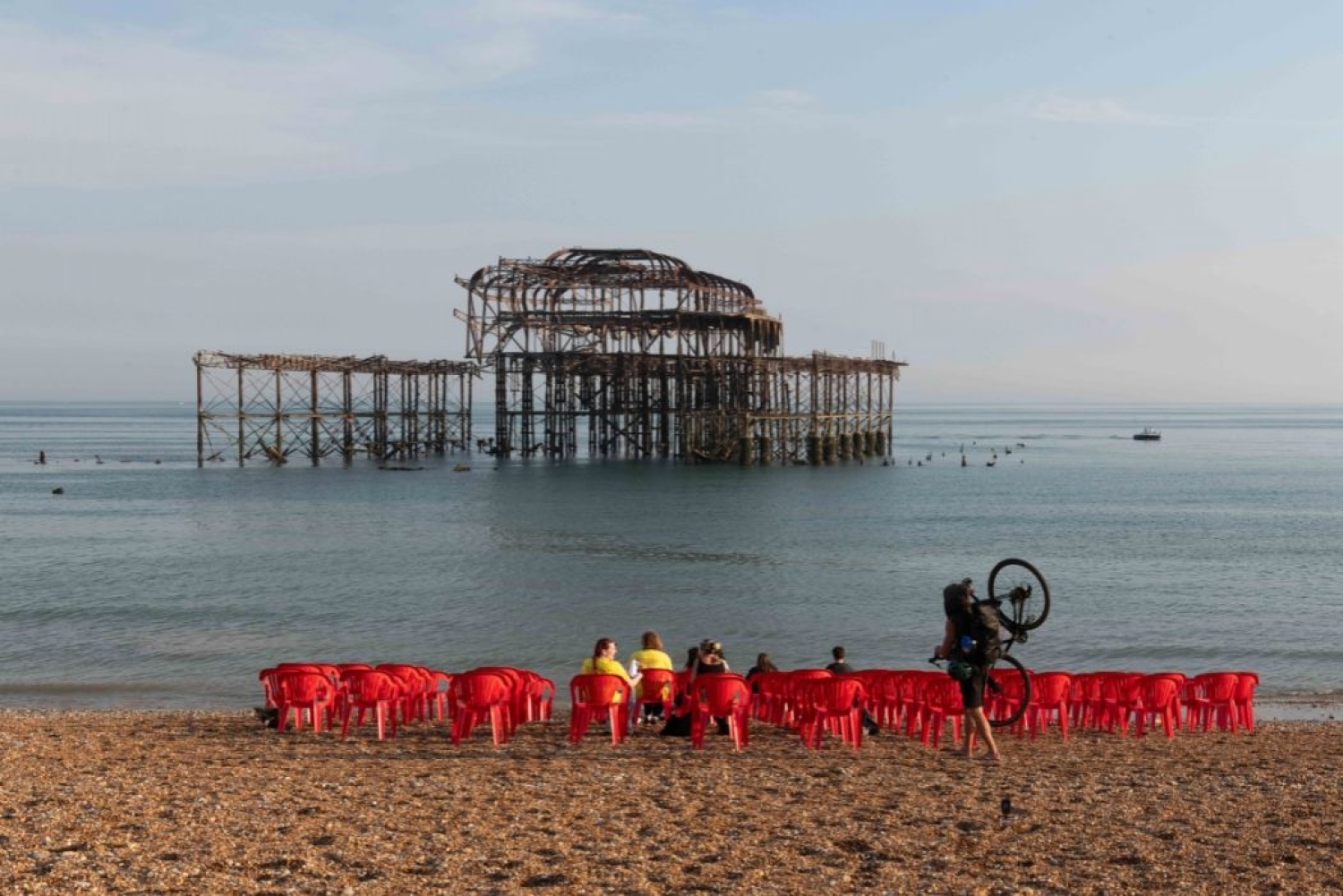
Brighton Festival / Public Art with Howareyoufeeling.studio
Brighton Festival / Public Art with Howareyoufeeling.studio
Suryan Saurabh doesn’t like fitting into labels. Growing up across many cities, he was shaped by different cities, spaces and people and the diverse culture of India. After realising he wasn’t meant for Software Engineering, he found his way to design, where there is no limit to exploration. Since then, his practice has moved fluidly between architecture, photography, book design, exhibition design, product design and printmaking. Suryan describes this approach as an ‘elastic practice,’ one that allows storytelling to travel across mediums rather than remain confined to one. For him, curiosity is the constant thread, guiding work that begins with a feeling and grows into entire worlds of its own.
I first encountered his work at a site-responsive installation by Devanshi Jain, a fashion designer based in Delhi. Both of them had come together to present an interactive evening at Devanshi’s studio, in such a way that participants could observe the process of garments coming to life. It featured installations indoors and outdoors, with the work itself drawing from avian architecture, mimicking the movements of birds, with strips of tomato derived bio-leather then hand-woven. Suryan’s ideation brought the garments into interesting, cool, quirky settings through the installation, making them one with the nature that surrounded the studio. We speak to him about his early fascination with design, not fitting into a single bracket and finding meaningful collaborations.
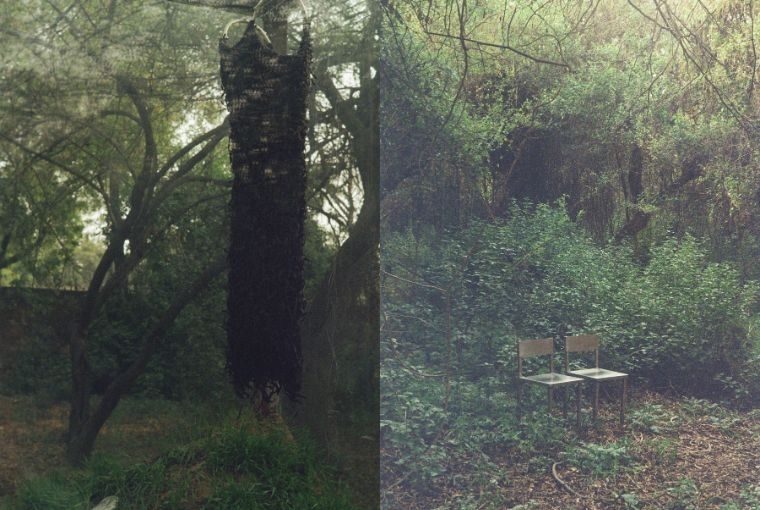
Site Responsive Installation with Devanshi Jain
How did your relationship with art and design develop? Can you take me back to the roots?
I essentially grew up across many cities. My dad was in the Air Force, so we kept moving around with him, which allowed me to observe many different cities, spaces and people; the diverse culture of India. I changed around nine schools which also led me to be a little sociable, to meet people, make new friends and stuff like that. It also came with its own kind of transition. You get excited when you get there but you also know you have to leave soon. I grew up in a mixed group of brothers and sisters. Most of them were engineers and all seeking jobs, and I also thought I'll do that. I took up Software Engineering, but realised within a year that I wasn’t meant for that. During a college bus trip, I met somebody from the architecture department in the same campus and it really piqued my curiosity. They would come in with different models and DIY stuff, large sheets of paper, sometimes in pen and ink, sometimes in colour. I thought to myself, what is this?
I used to be very nifty as a kid. I used to make toys, build small-scale furniture and help my mom dress up the house a little. I gave my exam for architecture, told my family I'm not doing well in Engineering, and then found Design. I was quite fortunate that I landed up there because there is no limit to exploration when you come to design. Then came four years of Design education. Lots of furniture building, lots of model making and lots of trips to old towns to do case studies and drawings. One studio that particularly piqued my interest was Studio Mumbai, run by Bijoy Jain. I applied and got through.
In a way, design accepted me and carved a way for me. I worked with him for many projects and exhibitions for around a year. Then, I graduated and wanted to work in a different format. The studio was in Alibaug, south of Bombay, in the middle of nowhere. Being a kid who had essentially grown up in Delhi, the monsoons were scary and it was quite challenging. So, I wanted to be in the city. I found another studio, Sameep Padora and Associates. They worked on many fast-paced projects, restaurants, exhibitions, book design and VR. I was there day in and day out for around a year and a half.I started to realise that I also needed to identify something for myself that I wanted to do. I quit and came to Delhi. I was travelling a lot, taking assignments that took me across India.
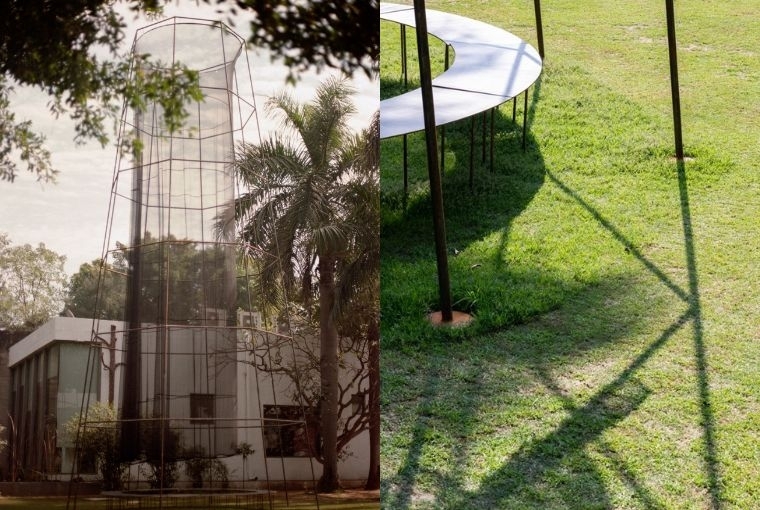
n+1, India Art Fair Pavillion
How did architecture find you?
I tried working in architecture, but architecture's problem is you need a client, you need a patron to build your designs. I did not find that for many years. I started helping friends photograph projects for their master's applications. That documentation became a small portfolio. Their principal architects saw those images and I started getting meetings. It was completely accidental. I kept threading into the next opportunity and it became a big photography enquiry. I started experimenting with different mediums allied to design. I did book design, exhibition design, product design and printmaking.
Lately I've been meeting some very kind people and working on projects where it starts from the visual, but springs into an entire world of its own. I feel there is a big alignment from travelling throughout my childhood, to finding design, wanting to practise design, initially not finding clients but slowly making my own routine. When it comes to profession, gender or city, we assign a lot of brackets. For example, one may say I am a male architectural photographer from Delhi. I have a problem with the rigidity of these terms.
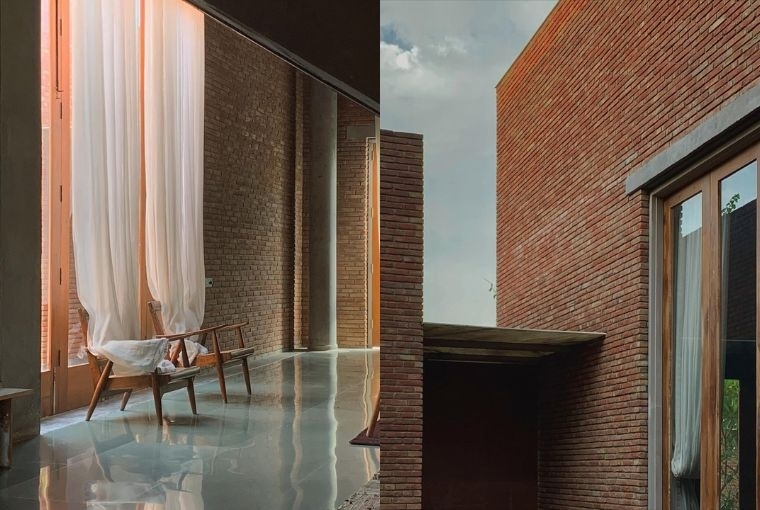
House 10 | Architecture
You've spoken about not fitting into a single bracket. Why is that important to you?
I feel like it comes back to childhood exposure, because you do things to fit in and then when you do fit in, you realise it's actually pretty boring. A couple of years back, I attended a lecture at RCA in the Product Design department. They had a very interesting observation about fluidity in creative professions and that's where I found the term ‘elastic practice.’
I feel one’s curiosity or storytelling has to be elastic enough that it can accommodate many mediums. If I want to say something to an audience, that medium can be anything. We are not bound to too many mediums. Most people who have done extremely well in life get trained in one medium and then move into different mediums to explore, because just a singular medium is limiting.
Expression fluidity is something I think we are inching towards. In the West, fluidity in your professional capacity is much more appreciated. In India, technical expertise is appreciated a lot, which is also a great thing. But where I belong, I wish to try different mediums and pull a story through. That's the kind of practice I want to identify with, one where I am allowed to participate in many mediums.
Can you talk about projects where people physically interact with your work and experience it in person? Take us through your creative process.
I do try and do more of these projects. They're a little extensive in terms of production. It takes a couple of months to put them together. One of my dearest collaborators is Howareyoufeeling.studio. We have been in constant dialogue for years. It starts from a feeling. What feeling would you like to communicate while somebody experiences something? There's a lot of writing, keywording and mood boarding that happens. There is a certain sense of emotional directionality that one wants to work around.
Then comes the question of what we want to say. We feel many things, but how do you articulate that? After that comes the physical articulation. It can be a space. Does it look nice? Do we show it in the morning or evening? How many people should experience it? Then comes documentation. Documentation of the experience becomes the thing where I'm allowed to participate as a photographer. There is a role that comes in at every stage. After that comes reflection. Did we do well? What happened? Is there a different way we can do something about it?
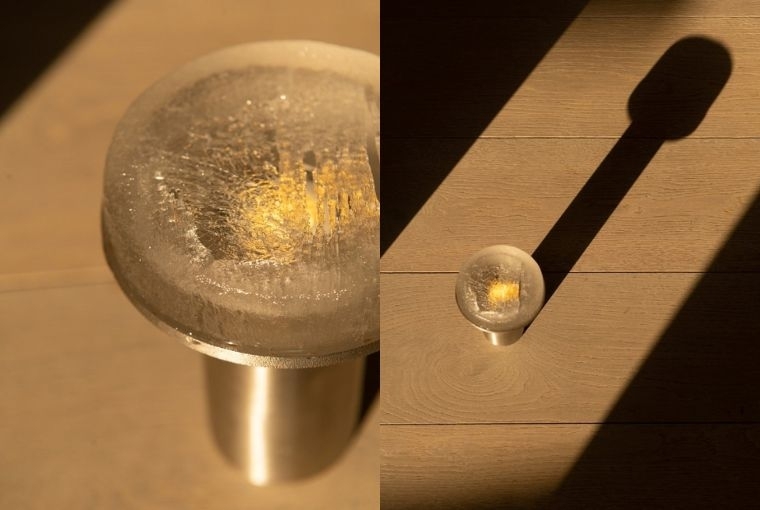
Ice Lamp
What is four three five and what role does it play in your practice?
four three five is actually my old house address, where I started getting excited about design when I was first introduced to it. I used to have 3D printers and a lot of materials in my room. At some point it became so much that I had to move my bed out and sleep on the floor while exploring and making models. It's quite dear to me. I always feel like I want to go back to that exploration space. Hence, I started four three five.
One example is an ice lamp I worked on. I was curious about what would happen if we made perishable products, something that is not so permanent, because we run behind too much permanence. But nothing is permanent. That lamp was made partly from ice and it dies out in two hours, much like a candle. There is excitement, anticipation and also sorrow. These are expressions I try to explore in many projects. I also released two books recently. They apply the same mechanism to buildings. We see architecture as a permanent expression, but through political, corruption-based or land-use issues, architecture does go away. For the past ten years I've been exploring architecture that ends up on magazine covers and gets celebrated. But I'm interested in what happens to that house or building forty years later, when that love fades away.
What needs to change for young artists and designers trying to find opportunities today?
It's important to step out of the house. Go meet people who are doing similar work, or people doing completely different work who can bring a different perspective to your project. Do a pilot project with them. That's how I started. I trusted other people, they trusted me, and together we found sponsors, clients and patrons to produce something that had not been produced before.
Once you have that proof of concept, the second thing you need to focus on is repetition.You have to do it for a year, ten years and probably the rest of your life. The power is in the repetition. Find the right collaborators and do it in repetition. If you do it enough, you will get noticed. Then eventually you realise you don't need that kind of audience altogether because you're happy doing it. You have to collaborate, you have to support each other. Don't gatekeep any information. There has been enough gatekeeping in India specifically. Just be out there, support each other. It's a lovely way of living life.
Words Neeraja Srinivasan
Date 12.6.2026
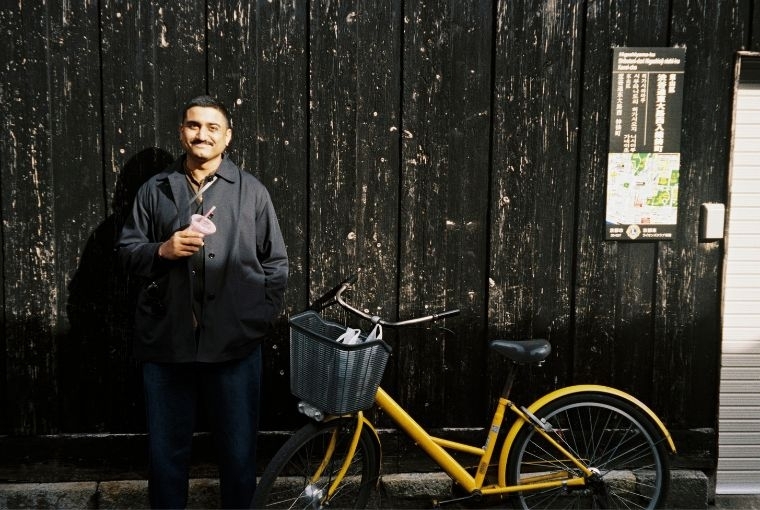
Suryan Saurabh