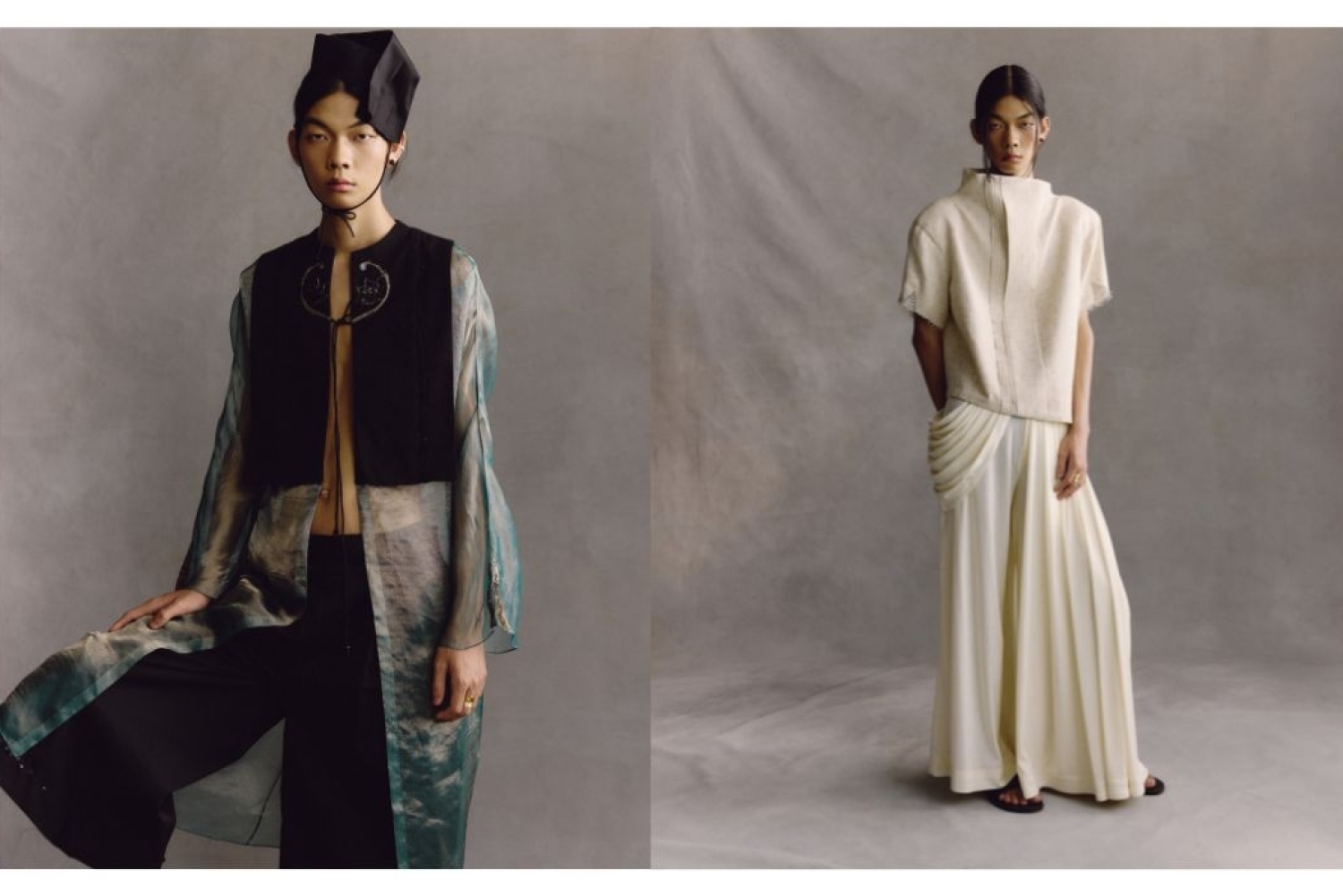
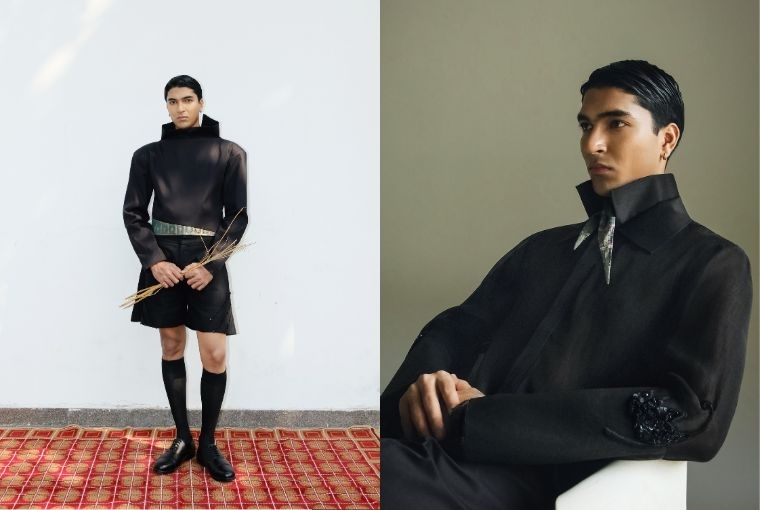
Indian festivals tend to capture culture and imagination through textiles and fashion like no other. For Shivanshu Sonker, born in Varanasi and brought up in Kolkata, the influence of sarees, embroidery, fabrics, and materials during the festive season was a constant throughout his childhood. It is through the magic of festivity, alongside an early inkling towards art, that he was inched towards fashion. A graduate of NIFT, Shivanshu launched Ashiva Shu soon after, a label with a multifaceted purpose: to highlight the craft of Varanasi, empower local karigars and create unique silhouettes. The resulting garments fall squarely into a realm of unconventional, structural clothing, with a side of elevated grace. The proportions are elongated and asymmetrical, achieving the perfect footing between drama and elegance. There are multiple layers to each look, allowing for an edge of unexpectedness; dramatic collars that certainly catch the eye, along with subtle references to Indian textile traditions dotted throughout.
Finding Space for Varanasi's Textile Traditions
My roots are from Varanasi and that's why I say that the brand is born in Varanasi. All our inspiration, craft and fabric come from Varanasi. At the moment, our statement fabric is Banarasi brocade because I find that a really interesting fabric to work with. It's so culturally rich as well. We also work with chanderi. In terms of craft, we incorporate the traditional embroidery techniques of Uttar Pradesh. For example, we have recently worked with mukaish, a Persian-inspired embroidery technique. It is a very delicate and meticulous embroidery technique and it is quite expensive as well, but we really want to bring that craft forward into today's generation. Our end goal is to uplift the state and give employment opportunities to the weavers and karigars back home.
Introducing ‘Queerswear’
The distinction of queerswear comes into play because queer men tend to be more expressive and extravagant. For example, when you want to dress up, traditional menswear does not really satisfy what you want to wear. But when you go to the women's section, you don't feel welcome because that's not your space. Even if you wear pieces from there, they might not look as flattering because our bodies are anatomically different.
I felt that there is a need for a specific line that targets queer men because there is no such clothing that is dedicated to them. I want to make it look sophisticated and still make them true to their identity as well. Not too loud, because the whole brand philosophy is that less is more. We don't want to go over the top; we want to be quietly present. Queerswear came out of that ideology, and we want to grow and make it more of an inclusive space.
Choices of Colour
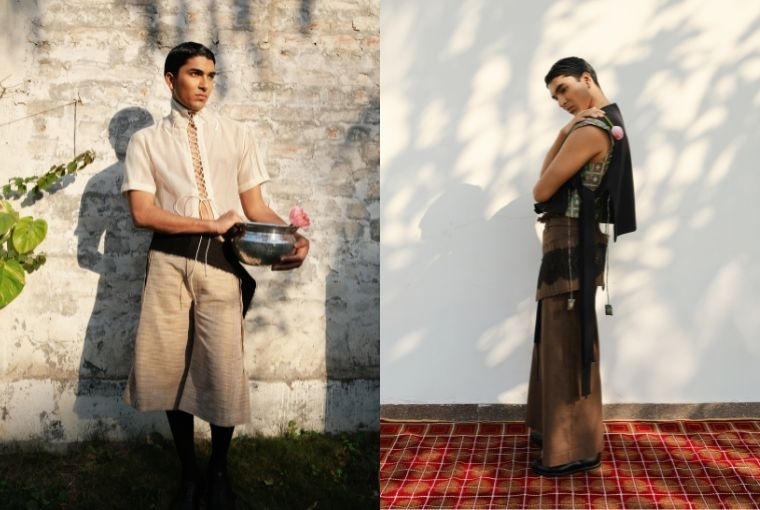
Varanasi is a land of ghats, flowers and nature, and I really wanted to take that ideology into the whole collection. That's why you will find a lot of shades of beige. We also use silk tissue, which we have in antique gold and teal. We really want to shift the focus away from the flamboyant and keep it subtle. The whole ideology is also to take away traditional restrictive menswear that is already there in the Indian market and bring out a new perspective on Indian clothing to the global platform. Even if you look at our silhouettes, you wouldn't find typical menswear silhouettes such as bandhgalas or sherwanis.
Navigating Tradition and Staying Contemporary
I think being in between the two is actually the most interesting part because when you are not so focused just on the traditional, you also have the opportunity to grow beyond that and look at what more you can do. In terms of keeping it contemporary, it's more about what you envision and what you see the people of today and tomorrow wearing.
For example, if there is a Nehru jacket and a kurta, I would think about different possibilities. What if I combine the two into one garment? What if I strip one part of the Nehru jacket and add it to the kurta? If you look at our Neel Laher silk tissue kurta, the inspiration for that came from combining both the Nehru jacket and the kurta into one. We also have our signature motif, a half-bloom lotus. I really wanted to take away the traditional lotus motif and give it a new form altogether. Initially, the half-bloom lotus began with intricate threadwork, sequins and kardana. Then, it evolved into zardozi and zari work as well. When we try to look beyond tradition or merge it with what is happening today and make it relevant, that's where beauty comes from.
This is an article from the July EZ. For more such stories, read the EZ here.
Words Neeraja Srinivasan
Date 28.7.2026